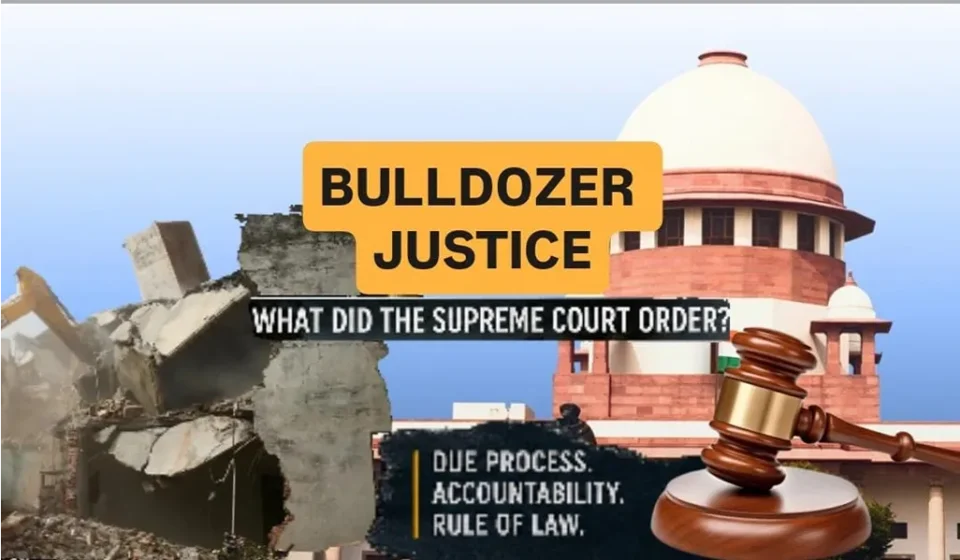

Can a house be demolished because its owner is accused of a crime? That question lies at the heart of India’s “bulldozer justice” debate. Over the past few years, demolition drives against properties linked to people accused of crimes have triggered intense political and legal controversy. Supporters have described such action as a strong response to illegal construction and encroachment, while critics have questioned whether administrative power was being used as a form of punishment.
The Supreme Court’s intervention brought the issue directly into the constitutional debate overdue process, executive power and the rule of law. In its November 13, 2024, judgment in In Re: Directions in the Matter of Demolition of Structures, the Supreme Court laid down safeguards that authorities must follow before demolishing properties. The message was significant: a person cannot be punished merely because they have been accused of a crime, and executive authorities cannot replace the judicial process.
What Is “Bulldozer Justice”?
“Bulldozer justice” is a political and media phrase rather than a formal legal concept. It became widely associated with demolition drives in which authorities used bulldozers to remove houses, shops or other structures belonging to people accused of crimes or involved in controversial cases. Governments have often maintained that such demolitions are undertaken because the structures violate municipal, building or land laws.
The controversy arises when demolition appears to be connected to the criminal allegation against the property owner. This creates an important legal distinction. A government can act against an illegal structure if the law permits it. But a government cannot treat demolition as an alternative punishment for a person merely because that person has been accused of an offence. That distinction became central to the Supreme Court’s judgment.
- Pahalgam Attack 2025: The Attack That Challenged Kashmir’s Security Narrative
- Uttarakhand Cloudburst: How Extreme Weather Threatens India-China Border Infrastructure
- Indian National Congress: Rise, Decline and Future Battle
- Mecca Agreement: A New Security Order Taking Shape?
- Kanwar Yatra 2026: History, Routes, Rules and Significance
Why Did the Supreme Court Intervene?
The Supreme Court of India issued landmark pan-India guidelines on November 13, 2024, to regulate arbitrary demolitions and curb what has increasingly been described as “bulldozer justice.” The ruling was delivered by a division bench comprising Justice B.R. Gavai and Justice K.V. Viswanathan. Exercising its special powers under Article 142 of the Constitution, the apex court laid down binding procedural safeguards for authorities across states and Union territories, emphasizing that demolition cannot be used as a form of punishment and that executive action must remain within the framework of law.

The Court’s intervention was rooted in concerns over the potential misuse of executive power. In a constitutional democracy, criminal guilt is determined through judicial process: police investigate, prosecutors present the case, and courts determine guilt or innocence. Administrative authorities, meanwhile, may enforce building regulations, remove encroachments and act against unauthorized construction, but such powers must be exercised through established legal procedures.
The central concern was that demolishing a person’s home merely because they were accused of a crime could effectively turn administrative action into punishment without trial. The Supreme Court therefore stressed procedural safeguards designed to prevent arbitrary action and protect due process. The judgment and related judicial material are available through the official Supreme Court of India website.
Supreme Court Guidelines on Bulldozer Justice
The court prescribed a framework intended to ensure that demolition does not become arbitrary.
Some of the key safeguards include:
- Prior notice: Authorities must inform the affected person before demolition.
- Reasonable time: Adequate time must be given to respond or seek legal remedies.
- Clear violation: The notice should clearly state the alleged unauthorized construction.
- Right to respond: The affected person must get an opportunity to present objections.
- Personal hearing: Authorities should consider the response before taking action.
- Reasoned order: The demolition decision must explain its legal basis.
- Documentation: The entire process should be properly recorded.
- Videography: Demolition proceedings should be documented.
- Official accountability: Officials may face consequences for unlawful demolition.
The objective is not to prevent governments from enforcing building laws. Instead, the court sought to ensure that enforcement follows a transparent and legally reviewable process.
The Most Important Principle: Accused Does Not Mean Convicted
Perhaps the simplest way to understand the judgment is through one principle: Accused is not the same as convicted.
A person accused of a crime remains entitled to the protections of the legal system until guilt is established through the appropriate process. This does not mean that an accused person or their property is immune from every government action. If a building independently violates construction or land-use regulations, authorities may take action under the relevant law.
But the criminal accusation itself cannot become the justification for demolition. This distinction protects the presumption of innocence and prevents executive authorities from creating a parallel system of punishment. The Supreme Court’s approach therefore goes beyond the bulldozer itself. It is fundamentally about who has the power to punish and under what procedure.
Can Illegal Properties Still Be Demolished?
The Supreme Court did not say that illegal structures cannot be demolished. Governments and local authorities continue to have the power, under applicable laws, to act against unauthorized constructions, encroachments and other violations. However, the judgment challenges the use of demolition as a shortcut to punishment. If a property is found to have been constructed illegally, the authority must follow the prescribed statutory procedure, which ordinarily includes issuing notice and providing the owner an opportunity to challenge the proposed action.
At the same time, the Court recognized that certain situations involving unauthorized constructions on public roads, streets, footpaths and similar public spaces may be governed differently. Therefore, the judgment should not be interpreted as granting permanent protection to illegal constructions; rather, its core message is that enforcement must remain lawful, procedural and non-punitive.
Legal Demolition vs “Bulldozer Justice”
The difference can be understood through a simple comparison:
| Lawful Demolition | “Bulldozer Justice” |
| Based on an identifiable legal violation | Appears linked to punishment for an allegation |
| Follows prescribed procedure | Procedure may be bypassed |
| Notice is provided | Notice may be missing or inadequate |
| Owner gets an opportunity to respond | Meaningful hearing is denied |
| Decision is supported by reasons | Action may appear arbitrary |
| Legal remedies remain available | Immediate action can undermine remedies |
| Enforcement is based on the property | Punishment appears connected to the person |
This distinction is critical because not every demolition is “bulldozer justice.” The presence of a bulldozer does not automatically make government action unlawful. The legal question is whether the authority has followed the law and whether the demolition is based on a legitimate violation rather than being used as punishment.
In the context of bulldozer justice, that means an administrative authority cannot transform a criminal allegation into an immediate punishment.
Why the Supreme Court Guidelines Matter
The Supreme Court Guidelines on Bulldozer Justice are ultimately about something much larger than bulldozers. They address a fundamental question in any democracy: What limits should apply when the state exercises its power against an individual? A government can enforce building laws. It can remove illegal structures. It can protect public land and regulate construction. But when a person is accused of a crime, the question of guilt belongs to the criminal justice system. That is where the distinction between law enforcement and punishment becomes critical. The Supreme Court has therefore placed due process at the centre of the bulldozer justice debate.
The lasting significance of the judgment will depend on implementation. If authorities consistently follow the required procedures, demolition can remain a legitimate tool of law enforcement. If those safeguards are ignored, however, the same power can raise serious questions about executive overreach.
The central message is simple: A bulldozer can enforce a lawful demolition order. It cannot replace the court that decides guilt.
What is bulldozer justice?
“Bulldozer justice” is a popular term used to describe demolition actions that are perceived as punitive, particularly when properties belonging to people accused of crimes are targeted.
What are the Supreme Court guidelines on bulldozer justice?
The Supreme Court established procedural safeguards for demolition, including prior notice, an opportunity to respond, a reasoned decision and appropriate time for legal remedies, along with documentation and accountability requirements.
Can an accused person’s house be demolished?
A criminal accusation by itself cannot justify punitive demolition. Any demolition must have an independent legal basis relating to the property and must follow applicable procedures.
Did the Supreme Court ban demolition drives?
No. The judgment does not prohibit lawful demolition of unauthorized structures. It seeks to prevent arbitrary or punitive demolition.
Can illegal construction still be demolished?
Yes. Authorities can take action against illegal construction under applicable laws, subject to the relevant legal procedures and safeguards.
Why is the Supreme Court’s bulldozer justice judgment important?
It reinforces due process, executive accountability and the rule of law while drawing a distinction between administrative enforcement and criminal punishment.