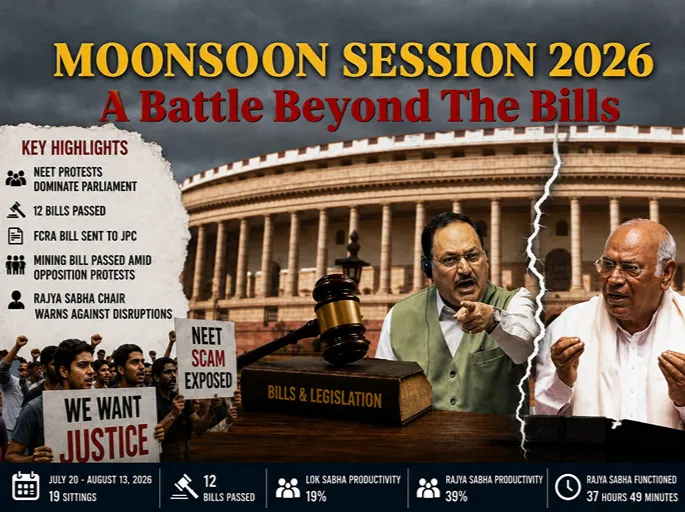

The Monsoon Session 2026 ended on August 13 with Parliament divided over both legislative priorities and political accountability. The Lok Sabha and Rajya Sabha were adjourned sine die after weeks of protests, repeated disruptions and sharp clashes between the government and Opposition over issues including the NEET controversy and police action against students.
The government highlighted the passage of 12 Bills as evidence of legislative progress. Yet parliamentary productivity remained low, particularly in the Lok Sabha. Parliamentary Affairs Minister Kiren Rijiju said the Lok Sabha recorded 19% productivity, while the Rajya Sabha reached 39%.
However, the session cannot be judged by legislation alone. Its larger significance lies in the growing tension between passing Bills quickly and allowing meaningful parliamentary scrutiny. The session has therefore raised a bigger question: can Parliament maintain legislative efficiency while protecting debate, accountability and the Opposition’s right to be heard?
Monsoon Session 2026: How It Unfolded
The Monsoon Session 2026 was held from July 20 to August 13, with 19 scheduled sittings. The agenda included major Bills on taxation, higher education, the Supreme Court and foreign contributions. However, political tensions quickly took centre stage as the Opposition raised the alleged NEET paper leak and police action against student protesters.
The dispute repeatedly disrupted parliamentary proceedings, affecting Question Hour and limiting opportunities for MPs to raise questions and public concerns. As protests continued, legislative debate was increasingly overshadowed by political confrontation, making disruptions one of the defining features of the session.
NEET Protests Drive the Row
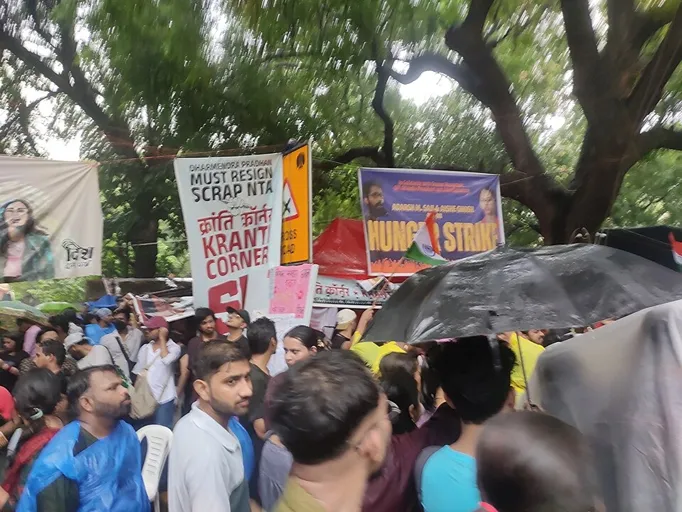
The NEET controversy quickly moved beyond education, becoming a wider political confrontation over government accountability and the police response to student protests. Opposition parties demanded answers over the alleged police action and sought accountability from Education Minister Dharmendra Pradhan.
The standoff intensified on August 12, when Home Minister Amit Shah offered to hold a detailed debate, while Parliamentary Affairs Minister Kiren Rijiju said the government was ready to extend the discussion time. However, Rahul Gandhi rejected the offer, arguing that students wanted answers about the alleged police action rather than a government lecture. The dispute highlighted a deeper divide over how Parliament should address the concerns raised by protesting students.
Bills, Debate and FCRA
The government highlighted the passage of 12 Bills during the session, but Parliamentary Affairs Minister Kiren Rijiju acknowledged that debate and discussion were far less successful. He noted that only the legislation addressing unfair means and paper leaks in examinations received full discussion in both Houses. This created the session’s central contradiction: the government could point to legislative output, while the Opposition argued that limited debate weakened parliamentary scrutiny and accountability.
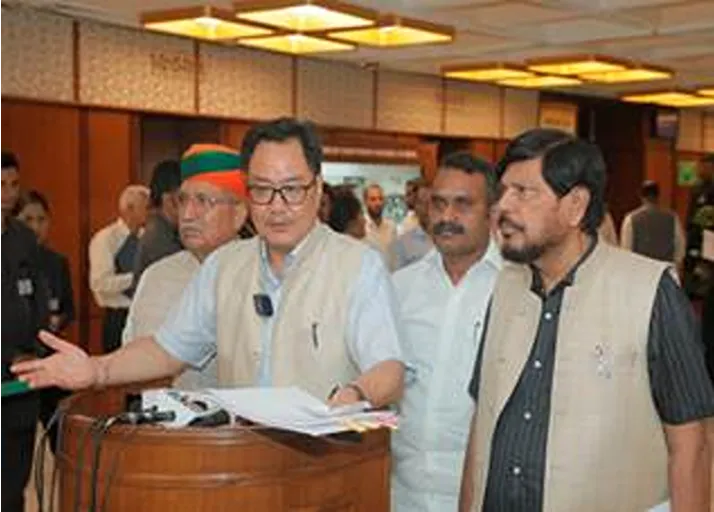
The Foreign Contribution (Regulation) Amendment Bill, 2026 offered a different outcome. The legislation, which addresses foreign-funded assets linked to organisations whose FCRA registration expires, is surrendered or cancelled, faced concerns from political and civil society groups. On August 12, the government agreed to refer the Bill to a Joint Parliamentary Committee (JPC), allowing more time for examination. The move showed that parliamentary pressure could still influence the government’s legislative approach.
Mining Bill and Political Confrontation
The final day of the Monsoon Session 2026 reflected the political tensions that had dominated Parliament for weeks. The Lok Sabha passed the Mines and Minerals (Development and Regulation) Amendment Bill, 2026 through a voice vote amid Opposition protests, without a detailed debate.
The Bill was later taken up for discussion in the Rajya Sabha, where Opposition MPs raised concerns over federalism, centralisation and state revenues. RJD MP Manoj Kumar Jha argued that the proposed changes could increase the Centre’s control over mining policy. The debate also highlighted the wider importance of legislative scrutiny, as mining reforms can affect state finances, natural resources, investment and local communities.
Rajya Sabha Raises Alarm
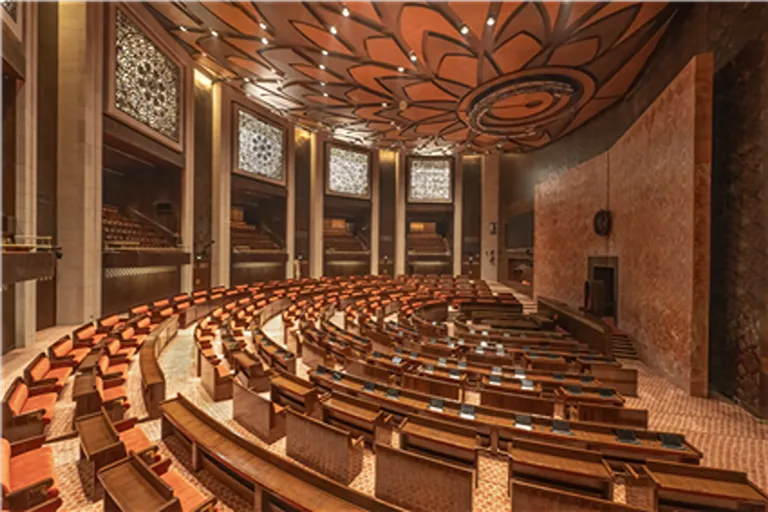
Rajya Sabha Chairman C.P. Radhakrishnan ended the session with a strong warning over persistent disruptions and disorder in the Upper House. He said the Rajya Sabha functioned for 37 hours and 49 minutes during the session.
Radhakrishnan stressed that repeated disruptions can weaken public confidence in Parliament. His remarks also highlighted a broader institutional challenge: democratic disagreement is essential, but it must not prevent Parliament from debating legislation, questioning the government and representing public concerns effectively.
Government and Opposition Clash
The government and Opposition ended the Monsoon Session 2026 with sharply different assessments. Parliamentary Affairs Minister Kiren Rijiju described the session as successful in legislative terms, while arguing that repeated Opposition protests limited debate and disrupted scheduled business.
The Opposition rejected that assessment. Rajya Sabha Leader of Opposition Mallikarjun Kharge accused the government of weakening parliamentary democracy, while Congress MP Karti Chidambaram said Opposition parties needed greater space to raise public concerns. The dispute highlights a larger institutional challenge: while disruption can be used to draw attention to political issues, prolonged protests can limit parliamentary scrutiny. At the same time, passing legislation quickly does not necessarily ensure meaningful debate.
| Indicator | Figure |
|---|---|
| Session period | July 20–August 13, 2026 |
| Scheduled sittings | 19 |
| Bills passed | 12 |
| Lok Sabha productivity | 19% |
| Rajya Sabha productivity | 39% |
| Rajya Sabha functioning | 37 hours 49 minutes |
| Major flashpoint | NEET protests |
| Major legislative development | FCRA Bill sent to JPC |
| Final-day major Bill | Mines and Minerals Amendment Bill |
What Comes Next?
The end of the Monsoon Session 2026 will not end the political battles surrounding it. The NEET controversy is likely to remain a major issue, while the FCRA Amendment Bill will undergo further scrutiny through the Joint Parliamentary Committee. Mining reforms could also remain contentious because of their implications for states, businesses and resource-rich communities.
The next parliamentary session will therefore be an important test for both sides. The government will seek to advance its legislative agenda, while the Opposition will push for greater space to raise public concerns. Ultimately, restoring meaningful debate will require both sides to find a balance between political protest and effective parliamentary functioning.
Conclusion
The Monsoon Session 2026 was about far more than the number of Bills passed. It exposed a deeper struggle over parliamentary debate, political accountability and the balance between government authority and Opposition scrutiny.
The government can highlight legislative output, while the Opposition can point to disruptions and limited debate. Yet the larger measure of Parliament’s effectiveness lies in the quality of discussion, the scrutiny of legislation and the ability of MPs to raise public concerns.
The real battle, therefore, extends beyond the Bills. Restoring confidence in Parliament will require both the government and Opposition to move beyond repeated confrontation and create greater space for meaningful, structured debate.
What is the Monsoon Session 2026?
The Monsoon Session 2026 was the scheduled parliamentary session held from July 20 to August 13, 2026, across 19 sittings.
How many Bills were passed during the Monsoon Session 2026?
Parliamentary Affairs Minister Kiren Rijiju said 12 Bills were passed during the session.
Why was the Monsoon Session 2026 disrupted?
The main confrontation centred on the alleged NEET paper leak and police action against protesting students. Other political disputes also contributed to repeated disruptions.
What happened to the FCRA Amendment Bill?
The FCRA Amendment Bill was referred to a Joint Parliamentary Committee for further examination. The move gives lawmakers additional time to examine its contentious provisions.
Why is parliamentary productivity important?
Productivity indicates how much scheduled parliamentary time is used for legislative and deliberative work. Low productivity can reduce opportunities for questions, debate and executive scrutiny.