
For millions of women, the Ladli Behna Yojana is more than a monthly bank transfer. It has become a visible part of household finances across Madhya Pradesh. Now, however, the scheme is entering a more demanding phase. Questions are emerging around its beneficiaries, implementation, fiscal impact and long-term direction.
The timing is significant because the 39th instalment is now in focus. At the same time, the state government is reviewing the scheme’s wider impact.
What Is Ladli Behna Yojana and Why Was It Launched?
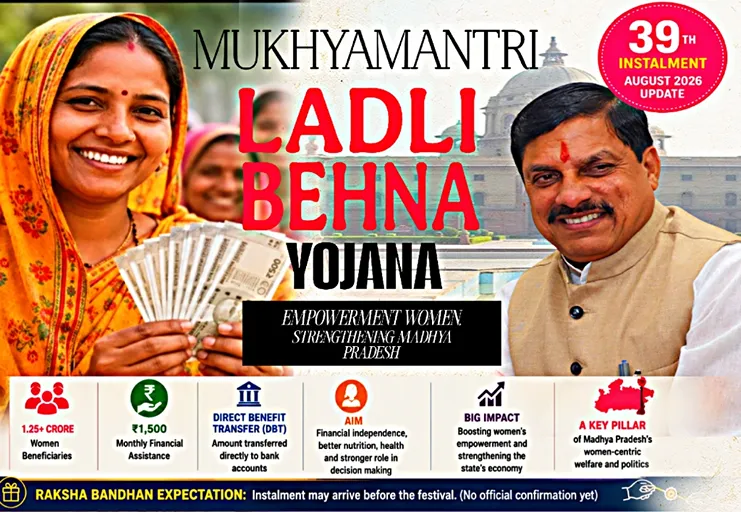
The Ladli Behna Yojana was launched by the Madhya Pradesh government in 2023. Its central purpose was to strengthen women’s economic independence. The scheme also targets household nutrition, health and women’s role in family decisions.
The official portal says eligible women receive ₹1,500 every month. The payment is made directly into the beneficiary’s own Aadhaar-linked bank account. The scheme therefore follows a direct-benefit model. Money reaches beneficiaries without requiring a separate spending condition.
Initially, the monthly assistance was fixed at ₹1,000. It was later increased to ₹1,250 and then ₹1,500. The scheme’s official database currently shows more than 1.25 crore eligible applicants. That scale makes it one of Madhya Pradesh’s most significant welfare programmes.
Who Benefits From Ladli Behna Yojana?
The scheme is aimed primarily at eligible married women in Madhya Pradesh. Widowed, divorced and abandoned women can also qualify under the scheme. However, unmarried women are not covered under the current rules. Age requirements and other eligibility conditions also apply. The applicant must satisfy the government’s income, employment and asset-related criteria. Several categories are excluded from receiving the benefit.
These include families with annual income above ₹2.5 lakh. Families with income-tax payers are also excluded. Certain government employees, pensioners and elected representatives are covered by exclusion rules.Similarly, ownership of more than five acres of agricultural land can affect eligibility. Registered four-wheelers can also create an exclusion. These conditions show that the scheme is not a universal payment. Instead, it is a targeted welfare programme.
Key Numbers at a Glance
| Category | Current position |
|---|---|
| Monthly assistance | ₹1,500 |
| Annual assistance | ₹18,000 |
| Launch | 2023 |
| Eligible applicants shown online | 1.25 crore+ |
| Family income ceiling | ₹2.5 lakh |
| Payment method | Direct Benefit Transfer |
| Required bank account | Beneficiary’s own account |
| e-KYC | Required |
| Implementing department | Women and Child Development Department |
The official portal also requires Aadhaar linking and active DBT facilities. Samagra-Aadhaar e-KYC is required before applications can be accepted.
What Does Implementation Look Like on the Ground?
The biggest challenge is not announcing the payment. It is maintaining an accurate beneficiary database. Applications are processed through designated camps, Gram Panchayats and ward offices. Verification is therefore built into the delivery system. However, eligibility can change over time. Beneficiaries can cross age limits or develop circumstances that affect eligibility.
Recent reporting has highlighted this issue ahead of the 39th instalment. One report said around seven lakh women had been removed from the scheme. The reported removals were linked mainly to age and technical eligibility issues. The figures should be treated as reported developments rather than a final official assessment.
This creates an important policy question. How can verification remain strict without excluding genuine beneficiaries? The answer will depend heavily on transparent appeals and accessible grievance systems. It will also depend on accurate e-KYC and banking records.
Why Ladli Behna Yojana Is in the News Now
The Ladli Behna Yojana is back in focus as the 39th instalment approaches in August 2026. Chief Minister Mohan Yadav has said that ₹1,500 will soon be transferred to eligible beneficiaries, with reports putting their number at around 1.25 crore. The timing is also significant because Raksha Bandhan falls in August. In 2025, the Madhya Pradesh government announced an additional ₹250 payment as a Raksha Bandhan gift for beneficiaries. That move has created expectations around this year’s instalment, although its exact 2026 transfer date should not be treated as confirmed without an official announcement.
Beyond the payment itself, the festival connection gives the scheme a wider social and political dimension. Welfare assistance can gain greater visibility when it coincides with an important cultural occasion. However, the timing alone does not establish an electoral motive. The scheme is also being assessed after three years. A government-backed impact audit is examining its broader outcomes, including whether regular financial support has strengthened women’s economic position.
Therefore, the current debate is no longer only about when the next ₹1,500 will arrive. It is increasingly about who remains eligible, how effectively the scheme is implemented, and what its next phase should look like.
What Ladli Behna Yojana Means for Politics and What Comes Next
The Ladli Behna Yojana reflects a wider shift in India’s state-level welfare politics. Direct cash transfers have become increasingly important, while similar women-focused programmes have emerged across several states. For Madhya Pradesh, however, the scheme also presents a major economic commitment. A large beneficiary base means that monthly payments require sustained budgetary support. Therefore, the government must balance welfare expansion with long-term fiscal sustainability.
At the same time, the scheme creates a direct relationship between the state and its beneficiaries. This can strengthen the visibility of government welfare programmes. However, it also makes implementation more important. Accurate beneficiary verification is essential for controlling leakages and protecting public trust. Yet, excessive exclusions could create dissatisfaction among genuine beneficiaries. The balance between verification and inclusion will therefore remain important.
The ongoing impact audit could influence the scheme’s next phase. It may determine whether the current structure should be retained or modified. Policymakers could also face pressure over whether ₹1,500 remains sufficient as household expenses increase. The government could maintain the existing amount, increase the payment or connect the scheme with wider empowerment programmes. The bigger opportunity lies beyond monthly financial assistance. If cash support is combined with employment, skills and financial inclusion, the scheme could move toward a more sustainable model of women’s economic empowerment.
What happens next will therefore depend on more than the next instalment. The government’s decisions on funding, eligibility, verification and long-term reforms will determine whether Ladli Behna remains primarily a welfare payment or evolves into a broader economic empowerment programme.
Conclusion
The Ladli Behna Yojana has grown from a state welfare initiative into a major policy experiment. Its success cannot be measured only by the amount transferred each month. It must also be judged by access, inclusion, transparency and women’s economic independence. The upcoming instalment will attract attention.
Yet the larger story lies beyond the payment itself. If the government’s impact review produces meaningful reforms, the scheme could enter a more mature phase. If verification remains the dominant issue, questions about exclusion and implementation will continue. Either way, Ladli Behna Yojana is likely to remain central to Madhya Pradesh’s welfare and political debate.
FAQ
What is Ladli Behna Yojana?
It is a Madhya Pradesh government welfare scheme providing monthly financial assistance to eligible women.
How much money is provided under the scheme?
Eligible beneficiaries currently receive ₹1,500 per month through direct bank transfer.
Who can benefit from Ladli Behna Yojana?
Eligible married women can benefit. Widowed, divorced and abandoned women are also covered under the scheme’s rules.
Is Aadhaar e-KYC required?
Yes. The official portal states that Samagra-Aadhaar e-KYC is required before an application can be accepted.
Why is Ladli Behna Yojana in the news in August 2026?
The 39th instalment is approaching, while the government is also assessing the scheme’s impact. Beneficiary verification has also generated attention.