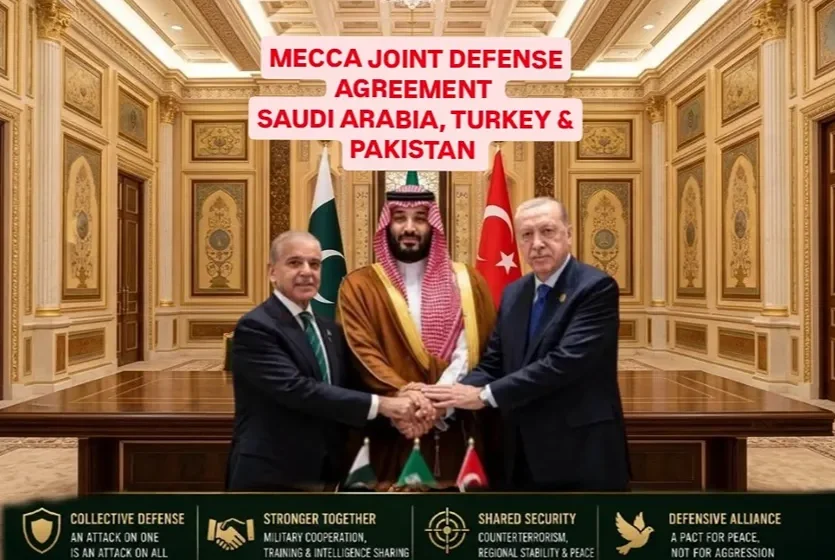

A new chapter in regional security has emerged as the Mecca Agreement brings Saudi Arabia, Turkey, and Pakistan closer through a joint defence framework. The Mecca Agreement has emerged as one of the most significant defence developments involving Saudi Arabia, Turkey, and Pakistan. The pact brings together three influential countries at a time when regional security calculations are rapidly changing. Signed in Mecca, Saudi Arabia, the agreement establishes a collective defence framework where an armed attack against one member would be considered an attack against all three. The move raises a major geopolitical question: Is the Mecca Agreement becoming the foundation of a new regional security bloc?
Why Was the Mecca Agreement Signed?
The Mecca Agreement, officially known as the Mecca Joint Defence Agreement, is a trilateral mutual defence pact between Saudi Arabia, Turkey, and Pakistan. The agreement was signed on 7 August 2026 in Mecca, Saudi Arabia by Saudi Crown Prince Mohammed bin Salman, Turkish President Recep Tayyip Erdoğan, and Pakistani Prime Minister Shehbaz Sharif.
The pact builds upon earlier defence cooperation between Saudi Arabia and Pakistan. In September 2025, both countries signed a Strategic Mutual Defence Agreement, which created a foundation for deeper military coordination. The new arrangement expands that framework by bringing Turkey into the security partnership. The agreement comes amid rising tensions across the Middle East. Regional conflicts, security threats, and uncertainty surrounding traditional alliances have encouraged countries to explore stronger independent defence arrangements.
Saudi Arabia has traditionally relied heavily on partnerships with major global powers for security. However, recent geopolitical shifts have encouraged Riyadh to build multiple strategic partnerships. Turkey, meanwhile, has expanded its military influence through defence exports, overseas deployments and regional diplomacy. Pakistan brings decades of military experience, strategic geography and one of the region’s largest armed forces. Together, these factors make the partnership geopolitically significant.
- Kanwar Yatra 2026: History, Routes, Rules and Significance
- Owais Yaqoob MMA Journey: India’s Next Big Fighter?
- Chandipura Virus Outbreak Analysis: A Growing Health Concern Among Children
- Why India Rejected UK Migrant Returns Over Nirav Modi
- Sonam Wangchuk Reality: Facts Behind the Fame, Influence and Controversies
Key Pillars of the Mecca Agreement
The Mecca Agreement focuses on collective security and deeper defence cooperation among the three countries.
1. Collective Defence Commitment
The central feature of the pact is its mutual defence principle. Any armed attack against one signatory would be treated as an attack against all three members. This approach is designed to strengthen deterrence by signalling that threats against one country could trigger a wider regional response.
2. Enhanced Defence Cooperation
The agreement aims to expand cooperation in multiple areas, including:
- Military coordination
- Defence planning
- Strategic consultations
- Security cooperation
The joint statement highlighted the goal of strengthening collective security and promoting stability in the region.
3. Strategic Partnership Between Three Powers
Each country brings different strengths to the partnership:
| Country | Strategic Strength |
|---|---|
| Saudi Arabia | Financial resources, Gulf influence, strategic location |
| Turkey | Defence industry, military technology, regional influence |
| Pakistan | Large military force, defence experience, strategic capabilities |
Together, the three countries create a partnership combining economic power, military experience, and defence technology.
Strategic Goals
The rise of the Mecca Agreement reflects a broader shift in regional security thinking.
Saudi Arabia’s Security Calculations
Saudi Arabia has traditionally relied heavily on international security partnerships. However, recent regional tensions have encouraged Riyadh to diversify its defence relationships. The pact allows Saudi Arabia to strengthen cooperation with countries that have established military capabilities. It also supports Saudi Arabia’s broader effort to increase strategic independence while maintaining relationships with global powers.
Turkey’s Expanding Defence Role
Turkey has become an increasingly important defence actor through its growing military industry. Its drone technology, naval capabilities, and defence exports have expanded Ankara’s influence beyond its immediate neighbourhood. Through the Mecca Agreement, Turkey gains a stronger role in Gulf security discussions and regional diplomacy.
Pakistan’s Strategic Position
Pakistan has maintained close defence relations with Saudi Arabia for decades. The country contributes military experience, training capabilities, and strategic importance due to its location between South Asia, Central Asia, and the Middle East. The agreement could further strengthen Pakistan’s role in regional security affairs.
The Promise and Challenges of the Mecca Agreement
The Mecca Agreement is not being presented as an alliance directed against a specific country. A Turkish official described the agreement as defensive in nature and said it was not aimed at any particular actor. However, analysts suggest the pact reflects concerns about regional instability and the need for stronger coordination. The agreement was signed against the backdrop of wider Middle East tensions, including conflict involving Iran and attacks affecting Gulf security concerns.
Despite its importance, several questions remain unanswered about the future structure and effectiveness of the Mecca Agreement. While the pact outlines collective defence principles, it does not publicly specify exact troop commitments, deployment plans or detailed military response mechanisms.
Although the agreement shares some similarities with collective defence arrangements, analysts caution against directly comparing it with NATO. Experts describe it as a framework for regional security cooperation rather than a fully integrated military alliance with a unified command structure. There are also discussions about whether additional countries could eventually join the framework. However, no confirmed expansion has taken place, leaving the future scope and influence of the agreement uncertain.
Possible Global Consequences
Impact on the United States
The agreement could influence Washington’s role in Middle East security. However, analysts note that the pact does not necessarily replace existing partnerships with the United States. Instead, it may represent an attempt by regional countries to create additional security options and increase strategic flexibility.
Impact on Iran and Regional Balance
Iran is likely to closely monitor the development of the agreement. However, the pact’s stated focus remains collective security rather than direct confrontation. The long-term impact will depend on how the partnership develops and whether it expands into a broader regional security framework.
Rise of Regional Security Groups
The Mecca Agreement reflects a wider global trend in which countries are increasingly creating flexible regional partnerships instead of depending only on traditional alliances. This shift highlights the growing importance of regional powers in shaping future security arrangements.
Mecca Agreement: Security Bloc or Political Signal?
The long-term importance of the Mecca Agreement will depend on its implementation. Many international agreements gain attention when announced but face challenges during execution. The success of this partnership will depend on clear military cooperation mechanisms, financial commitments, political coordination and effective crisis response planning. For now, the agreement represents an important strategic signal. It shows that regional powers are exploring new security models in a changing global order.
Conclusion
The Mecca Agreement represents a major attempt by Saudi Arabia, Turkey, and Pakistan to strengthen regional defence cooperation. While the pact does not yet represent a full military alliance, it creates a new security framework with significant geopolitical implications. Its future influence will depend on implementation, military coordination, and whether other countries become involved. For now, the agreement signals a changing Middle East where regional powers are seeking greater control over their own security future.
What is the Mecca Agreement?
The Mecca Agreement is a trilateral defence pact between Saudi Arabia, Turkey, and Pakistan that establishes a collective security framework.
When was the Mecca Agreement signed?
The agreement was signed on 7 August 2026 in Mecca, Saudi Arabia.
Does the Mecca Agreement create a NATO-style alliance?
No official NATO-style structure has been confirmed. Analysts describe it as a regional security cooperation framework.
Why is the pact important?
The agreement connects three major regional players and could influence future security arrangements in the Middle East.
Could other countries join the agreement?
Possible expansion has been discussed, but no additional members have officially joined.