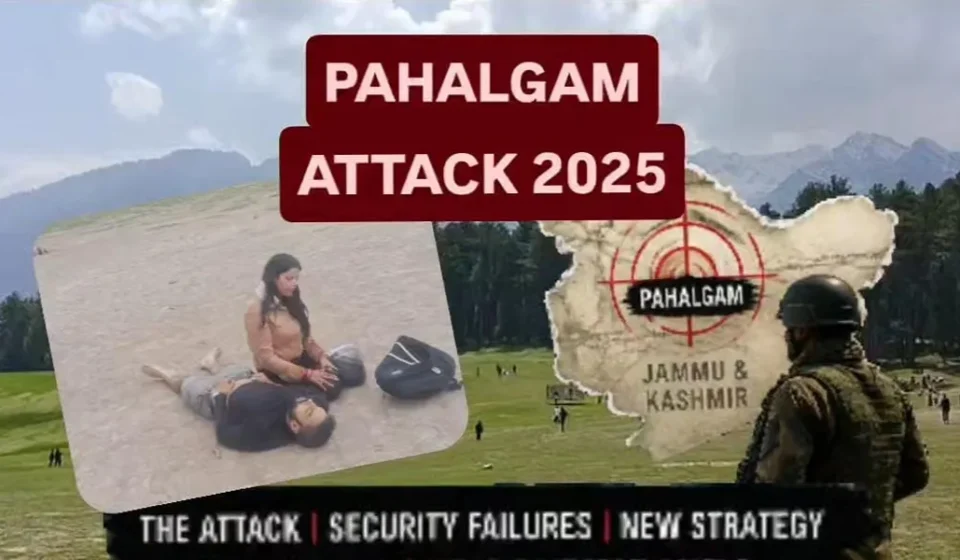

For years, Kashmir was being presented as a region moving towards stability, with rising tourism, improved connectivity and declining militant activity. The Pahalgam Attack 2025 suddenly challenged that narrative, reminding India that despite security improvements, the threat of terrorism in Jammu and Kashmir remains active.
The attack on tourists near Pahalgam’s Baisaran Valley became one of the most significant security incidents in Kashmir in recent years. Beyond the immediate tragedy, it raised larger questions about intelligence preparedness, protection of civilian areas and the future of Kashmir’s security strategy.
The incident was not only an attack on individuals but also an attempt to strike at one of the strongest symbols of normalcy in the region tourism.
What Happened in the Pahalgam Attack 2025?
The Pahalgam Attack 2025 took place on April 22, 2025, near Baisaran Valley in the Pahalgam area of Anantnag district, Jammu and Kashmir. The attackers targeted tourists visiting one of Kashmir’s most popular destinations. The incident shocked the country because Pahalgam had been considered a relatively secure tourist zone and was attracting record numbers of visitors.

According to initial investigations, the attack involved militants carrying out a targeted assault against civilians. The incident triggered a large security response involving multiple agencies, including Jammu and Kashmir Police and central security forces. The attack immediately shifted national attention towards the security challenges still present in the Valley.
Why Was Pahalgam Targeted?
Tourism Became a Symbolic Target
One of the biggest questions after the attack was why militants chose a tourist location.
In recent years, Kashmir tourism had witnessed significant growth. The region was increasingly being promoted as a peaceful destination, with visitors returning after years of instability.
Targeting tourists served multiple purposes:
- Creating fear among visitors
- Damaging Kashmir’s tourism image
- Challenging government claims of improved normalcy
- Gaining national and international attention
A successful attack on a tourist destination carries a psychological impact much larger than the immediate casualties.
Attempt to Challenge the Image of Normalcy
After the abrogation of Article 370 in 2019, the government highlighted improvements in security conditions, infrastructure development and economic opportunities in Jammu and Kashmir. However, militant groups continued attempts to demonstrate that they could still carry out attacks. The Pahalgam incident highlighted a changing pattern where militants increasingly focus on soft targets rather than traditional security installations.
Was There a Security Failure?
One of the most debated questions after the attack was whether there were intelligence or security gaps. Tourist destinations create unique security challenges. Unlike military installations, public places cannot have extremely restrictive security measures without affecting tourism and civilian movement.
Questions raised after the attack included whether sufficient security arrangements were present in tourist zones, whether intelligence about possible threats was effectively acted upon, whether security planning matched the increasing number of visitors, and whether vulnerable tourist routes were adequately monitored. The incident highlighted the difficult balance between maintaining an open tourism environment and ensuring public safety.
Kashmir After Article 370: Security Improvements and New Challenges
The security environment in Kashmir has changed significantly over the past few years. Government agencies have reported improvements in counter-terror operations, including increased intelligence coordination, crackdowns on militant networks, improved surveillance systems and stronger border security.
However, security experts have also pointed towards new challenges. Militant strategies have evolved from large-scale attacks to smaller, targeted operations designed to create maximum psychological impact. The focus has increasingly shifted towards civilians, migrant workers, political workers, security personnel and tourist locations. The Pahalgam attack demonstrated that reducing violence does not mean eliminating the threat completely.
Major Terror Attacks in Kashmir: A Changing Pattern
| Year | Attack/Event | Location | Impact |
|---|---|---|---|
| 2019 | Pulwama terror attack | Pulwama | Major escalation in India-Pakistan tensions |
| 2020–2024 | Targeted civilian and security attacks | Various districts of Kashmir | Rise of selective attacks |
| 2025 | Pahalgam Attack | Anantnag district | Attack on tourists and Kashmir tourism image |
The pattern shows a shift from attacks focused mainly on security forces towards attacks designed to create fear among civilians.
Government Response After Pahalgam Attack
Following the Pahalgam Attack 2025, the Indian government launched a multi-layered security and diplomatic response aimed at targeting those responsible and preventing similar attacks in the future.
The attack triggered intensified counter-terror operations in Jammu and Kashmir, with security agencies focusing on identifying the attackers, dismantling support networks and strengthening protection around vulnerable civilian areas, especially tourist destinations.
Operation Sindoor: India’s Counter-Terror Response
The most significant development after the attack was Operation Sindoor, a military response launched by India on 7 May 2025 against terror infrastructure linked to the perpetrators of the Pahalgam attack. The operation marked a continuation of India’s evolving counter-terror approach, where the focus has shifted from only responding to attacks internally to taking targeted action against terror networks and their capabilities.

Diplomatic and Military Fallout
Operation Sindoor increased tensions between India and Pakistan, with both countries engaging in diplomatic exchanges and heightened security measures. India maintained that its actions were directed against terror infrastructure and not against civilians, while Pakistan responded with its own statements and security measures. The international community called for restraint while closely monitoring developments between the two nuclear-armed neighbours.
Strengthening Kashmir’s Security Framework
Beyond immediate military action, the Pahalgam attack and the response that followed pushed authorities to reconsider security arrangements in Kashmir. The focus expanded towards protecting tourist locations and other soft targets, improving intelligence coordination, expanding surveillance capabilities and strengthening rapid response mechanisms.
Together, the Pahalgam attack and Operation Sindoor represented a major shift in India’s security conversation — from preventing individual incidents to building a broader counter-terror framework designed for evolving threats. a familiar political divide in India — between demands for stronger counter-terror measures and questions regarding intelligence failures.
India-Pakistan Angle and Regional Impact
Kashmir-related attacks have historically influenced India-Pakistan relations, and the Pahalgam attack was no exception. India has repeatedly accused Pakistan-based militant networks of supporting terrorism in Jammu and Kashmir, while Pakistan has rejected such allegations. The attack added further tension between the two countries and affected diplomatic relations.
The broader regional implications included increased security focus along borders, diplomatic pressure on Pakistan regarding terrorism and renewed discussions on cross-border militancy. For India, the attack reinforced the argument that terrorism remains a major challenge requiring international cooperation.
How Pahalgam Changed Kashmir’s Security Model
The biggest long-term impact of the attack may be on how security planning is conducted in Kashmir.
Protecting Soft Targets
Earlier security strategies focused heavily on preventing attacks against government facilities and security forces. After Pahalgam, tourist destinations and public spaces gained greater attention. Possible measures include better surveillance systems, increased security presence at tourist locations, improved intelligence gathering and faster emergency response systems.
Technology-Based Security Approach
Modern counter-terror strategies increasingly depend on technology. Security agencies are focusing on artificial intelligence-based monitoring, digital intelligence networks, improved communication systems and data-based threat assessment. The challenge remains maintaining security without restricting normal civilian activity.
A New Security Challenge for Kashmir
The Pahalgam Attack 2025 marked a turning point in Kashmir’s security conversation. While the region has witnessed improvements in infrastructure, tourism and connectivity, the attack showed that militant threats continue to evolve. The challenge for India is not only preventing attacks but also protecting the confidence of residents, tourists and businesses that depend on peace.
The future of Kashmir’s stability will depend on a combination of security measures, intelligence capabilities, economic development and public confidence. Pahalgam was not only an attack on tourists, but it was a challenge to the idea of a peaceful and transforming Kashmir.
What was the Pahalgam Attack 2025?
The Pahalgam Attack 2025 was a terrorist attack that took place on April 22, 2025, near Baisaran Valley in Pahalgam, Jammu and Kashmir. Militants targeted tourists, making it one of the most significant attacks on civilians in the region in recent years.
Why was Pahalgam targeted by militants?
Pahalgam was targeted because it represents Kashmir’s growing tourism sector and improving image as a peaceful destination. An attack on tourists aimed to create fear, damage confidence in Kashmir tourism, and challenge claims of increasing stability in the region.
How did the Pahalgam Attack impact Kashmir tourism?
The attack raised concerns among tourists and local businesses dependent on tourism. Hotels, transport operators, guides and other tourism-related sectors faced uncertainty as security concerns affected visitor confidence. The incident highlighted the importance of balancing tourism growth with stronger security measures.
Did the Pahalgam Attack change Kashmir’s security strategy?
Yes, the attack increased focus on protecting soft targets such as tourist locations and public spaces. Security agencies have emphasized stronger intelligence networks, surveillance technology, faster response mechanisms and improved coordination between different security forces.
What is the larger geopolitical significance of the Pahalgam Attack 2025?
The attack affected India’s internal security debate and also influenced India-Pakistan relations. It renewed discussions around cross-border terrorism, counter-terrorism cooperation and the challenges of maintaining peace and stability in Jammu and Kashmir.