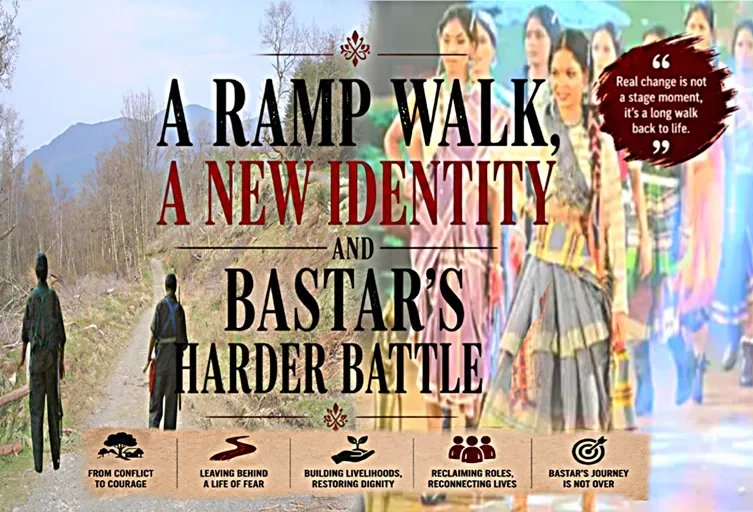

A fashion ramp in Raipur became an unlikely stage for a much larger story about conflict and recovery. Nine former women Maoists from Bastar recently walked the ramp in traditional Chhattisgarh handloom clothing. Their appearance was more than a fashion event. It offered a visible example of what can happen after people leave an armed movement. However, it also exposed the harder question surrounding Naxalism rehabilitation.
Leaving an insurgent organisation can end one chapter. It does not automatically rebuild a person’s livelihood, identity, relationships or social position. The event therefore deserves attention beyond its striking visuals. It reflects the difficult transition from conflict to ordinary civic life.
From Bastar’s Conflict Zone to a Raipur Stage
Nine former women Maoists from Bastar appeared at a National Handloom Day event in Raipur. Their participation brought together two very different worlds: Bastar’s history of insurgency and Chhattisgarh’s traditional textile culture. The women walked the runway wearing Kosa silk and other Chhattisgarh handloom garments. The ramp walk was also captured in a video shared by the Government of India’s official @mygovindia Instagram account, giving the event wider public visibility. They were also given training before the event, helping them prepare for the public appearance.
For the participants, the experience was reportedly unfamiliar. They had spent parts of their earlier lives within Maoist networks. Now, they were appearing before an audience in a completely different setting. The event also had a practical dimension. Handloom was not simply used as a visual theme. It connected the women with a traditional industry that could potentially support future livelihood opportunities. Chhattisgarh Chief Minister Vishnu Deo Sai also interacted with the participants and encouraged them in their new lives.
That distinction is important. Appearance can create confidence and visibility. However, Naxalism rehabilitation ultimately depends on what happens after the event. The women still need opportunities to develop skills, earn stable incomes and participate normally within their communities. Education and vocational training can also help make their transition more sustainable.
Therefore, the Raipur ramp walk should be viewed as one visible step within a much longer rehabilitation process. Its importance lies less in the fashion show itself and more in the possibility of creating new economic and social pathways for people leaving an armed movement.
For background on India’s broader approach, readers can consult the Ministry of Home Affairs surrender and rehabilitation guidelines.

Chhattisgarh’s Rehabilitation Push
The state has increasingly linked security operations with rehabilitation and development. In March 2025, the Chhattisgarh government approved its Naxalite Surrender/Victim Relief and Rehabilitation Policy. The policy provides support related to financial assistance, education, employment and security. That approach reflects a broader understanding of internal conflict. A surrendered cadre must have reasons to remain outside the insurgency. Therefore, employment and social stability become important security issues.
The central government has also reported financial assistance and vocational support for surrendered cadres. In 2025, it reported more than 2,300 surrenders nationwide. In January 2026, 26 Naxalites surrendered in Sukma. Seven of them were women, according to Akashvani News. The group was placed under the state’s rehabilitation framework. These developments suggest that surrender is increasingly being treated as the beginning of a process. That process must eventually move beyond financial packages.
The Real Test of Naxalism Rehabilitation
The hardest part of Naxalism rehabilitation begins after a person leaves an armed movement. Surrender may remove someone from an insurgency. However, it does not automatically provide a stable future. Former cadres must find employment, rebuild relationships and regain their place in society. Their families may also need access to education, healthcare and secure housing. Therefore, rehabilitation cannot depend only on financial assistance. Skills training and long-term livelihood opportunities are equally important.
This is where Bastar’s handloom tradition could offer a practical pathway. The Raipur ramp walk showed how local culture can become part of the reintegration process. However, social acceptance remains harder to achieve. Former cadres may continue to face stigma because of their past. As a result, community participation must accompany government support. The issue also has wider implications for India’s internal security strategy. For years, counter-insurgency operations dominated the response to Maoist violence. Increasingly, however, security measures have been combined with development and rehabilitation..
For Bastar, this makes rehabilitation part of a larger security equation. Security can create the space for peace, but livelihoods and social acceptance can help sustain it. The Raipur ramp walk therefore represents more than a symbolic appearance. It offers a glimpse of what reintegration could look like when former cadres are given opportunities to reconnect with culture, work and society. Still, one event cannot demonstrate that rehabilitation has fully succeeded. The real measure will come years later, when former cadres can build independent lives without their past determining their future.
Naxalism Rehabilitation: What Comes Next?
The next phase will be judged less by dramatic surrender ceremonies. It will be judged by what happens afterwards. Successful Naxalism rehabilitation should eventually become almost invisible. Former cadres should be able to work, study, raise families and participate in society without their past defining every interaction. That will require continued government support. It will also require community participation and credible livelihood opportunities.
For Bastar, this could become one of the most important tests of the post-insurgency period. Security forces can reduce the space available to armed groups. Rehabilitation can help prevent former cadres from returning. Development can then address some of the conditions that allowed conflict to persist. The three elements must therefore work together.
The Real Test Comes After the Applause
The Raipur ramp walk offered a striking image of transformation. Former women Maoists appeared in traditional Chhattisgarh clothing before an audience that once might have viewed their past very differently. Still, the applause is only one moment. The deeper measure of Naxalism rehabilitation will be whether these women can build secure and independent lives.
Their journey shows why surrender should not be viewed as the finish line. It should be understood as the beginning of reintegration. For Bastar, the harder battle may now be creating a future where leaving violence behind also means finding dignity, opportunity and belonging. That is where rehabilitation becomes more than a security policy. It becomes a test of whether peace can become a sustainable way of life.
FAQ
What happened at the Raipur ramp walk?
Nine former women Maoists from Bastar participated in a National Handloom Day event in Raipur. They walked the ramp wearing traditional Chhattisgarh handloom clothing.
Why is the event significant?
The event symbolised a transition from armed insurgency toward mainstream social participation. It also highlighted rehabilitation through culture and potential livelihoods.
What does Naxalism rehabilitation involve?
It can include financial assistance, vocational training, employment support, housing, education and measures supporting social reintegration.
Has Chhattisgarh introduced a new rehabilitation policy?
Yes. The state approved the Chhattisgarh Naxalite Surrender/Victim Relief and Rehabilitation Policy-2025. It replaced the earlier 2023 policy.
Is the ramp walk proof that rehabilitation has succeeded?
No. It represents one positive moment, but successful rehabilitation requires sustained employment, social acceptance and long-term stability.