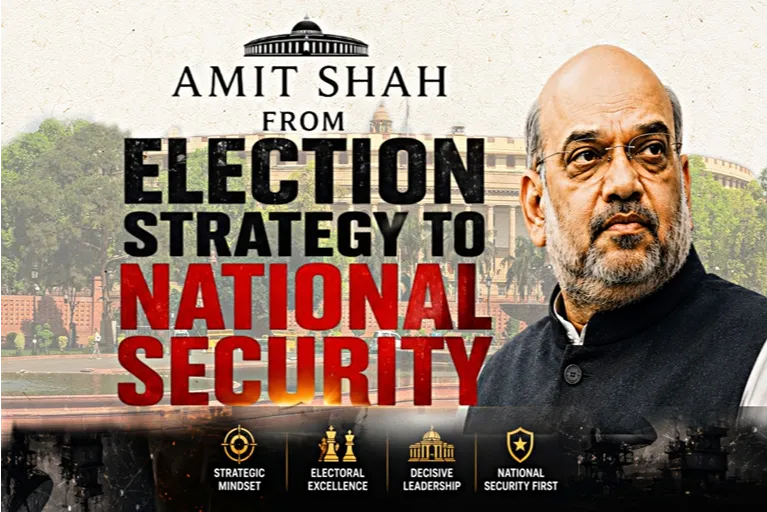

Few political careers in India have combined organisation, electoral strategy and government power like that of Amit Shah. His journey from grassroots politics in Gujarat to the Union Home Ministry has been closely linked with the rise of the BJP under Narendra Modi.
The Amit Shah’s political career has therefore become important beyond his personal story. It offers a window into how political organisation can be converted into electoral power. It also shows how a party strategist can eventually become one of India’s most influential ministers. Shah remains the Union Home Minister and Minister of Cooperation in 2026. His political responsibilities continue to cover internal security, federal relations, counterterrorism and several major policy areas.
From Mansa to Politics: The Making of Amit Shah
Amit Shah was born on October 22, 1964, in Mumbai to Anilchandra Shah and Kusumben Shah. His family had strong Gujarati roots, and his early years were spent partly in Mansa, Gujarat. He later moved to Ahmedabad, where he pursued higher education in biochemistry at Gujarat University.
Shah’s political journey began through grassroots organisational work rather than conventional electoral politics. He became associated with the Rashtriya Swayamsevak Sangh (RSS) and later joined the Akhil Bharatiya Vidyarthi Parishad (ABVP), the organisation’s student wing. According to the Ministry of Home Affairs, he served as an Ahmedabad city unit secretary of ABVP before taking on organisational responsibilities within the Gujarat BJP.
His family life has remained relatively private. Shah is married to Sonal Shah, and they have a son, Jay Shah. Beyond politics, he has been described as an avid cricket follower and reader, with interests including chess, history and literature. These early experiences became important to the Amit Shah’s political career. His years in the RSS, ABVP and Gujarat BJP helped him develop the organisational skills and political networks that later became central to his rise within the BJP.
From Gujarat Politics to the Modi– Amit Shah Partnership
Shah’s electoral rise began in Gujarat, where he gradually moved from organisational work into elected politics. He entered the Gujarat Legislative Assembly in 1997 and represented the Sarkhej constituency for several terms. In 2012, he shifted to the newly created Naranpura constituency. Overall, Shah served as a five-term Gujarat MLA between 1997 and 2017. His responsibilities also expanded within the Gujarat government. During Narendra Modi’s tenure as chief minister, Shah served as Minister of State for Home. He also handled portfolios including transport, prohibition, law and parliamentary affairs.
These years were significant because Shah gained experience in both party organisation and government administration. His political relationship with Modi also deepened during this period, creating the foundation for a partnership that would later influence national politics. The relationship became particularly important ahead of the 2014 Lok Sabha election. In 2013, Shah was appointed BJP national general secretary and given responsibility for Uttar Pradesh.
The state was politically crucial because it sends the largest number of members to the Lok Sabha. Under Shah’s organisational leadership, the BJP won 71 seats in Uttar Pradesh in the 2014 election, while its ally Apna Dal won two. The result significantly strengthened Shah’s reputation as an electoral strategist. More importantly, it marked his transition from a Gujarat-based political organiser to a national BJP leader. This breakthrough would soon open the next chapter of the Amit Shah’s career: his rise to the BJP presidency and his role in expanding the party across India.
Amit Shah Political Career: From BJP Strategist to Home Minister
As BJP president, Shah became known for strengthening the party’s organisational network through membership drives, booth-level coordination and election planning. His tenure coincided with the BJP’s expansion across several states, although the party’s success also reflected the leadership of Narendra Modi, state-level organisations and its wider political network. The next major stage of the Amit Shah political career came after the 2019 Lok Sabha election.
Shah won the Gandhinagar seat by 5,57,014 votes, having previously entered Parliament through the Rajya Sabha in 2017. He joined the Union Cabinet and took charge as Home Minister on June 1, 2019. The appointment shifted his role from managing party strategy to handling major areas of national governance. As Home Minister, Shah became responsible for internal security, counterterrorism, border management and other sensitive policy matters. This transition placed him at the centre of several major decisions that would define his political record.

Amit Shah: Key Decisions
Article 370 and Jammu and Kashmir
In August 2019, Shah, as Home Minister, introduced the government’s proposals on Jammu and Kashmir’s special status and reorganisation. Article 370’s provisions were made inoperative, while the former state was divided into the Union Territories of Jammu and Kashmir and Ladakh.
The move received strong BJP support but triggered political and legal debate over constitutional procedure, federalism and civil liberties. In December 2023, the Supreme Court upheld the constitutional validity of the decision.
Citizenship Amendment Act
The Citizenship Amendment Act (CAA) was passed in December 2019. It provided a pathway to Indian citizenship for specified persecuted non-Muslim communities from Pakistan, Bangladesh and Afghanistan. The government described the law as a humanitarian measure. Critics argued that its religious criteria raised constitutional concerns. The legislation also triggered widespread protests and became one of the most contentious issues of Shah’s first term.
Criminal-Law Reforms
Shah played a leading role in replacing India’s three major colonial-era criminal laws. The new criminal laws replaced the Indian Penal Code, Code of Criminal Procedure and Indian Evidence Act framework.
They came into force in July 2024. The government presented the reforms as a modernisation of criminal justice, while critics raised concerns about implementation and expanded police powers
Power, Security and Amit Shah’s Political Legacy
As Union Home Minister, Shah oversees key areas including counterterrorism, border management, Left-Wing Extremism, central armed police forces and coordination with state governments. His tenure has also been shaped by major policy decisions involving Jammu and Kashmir, citizenship and criminal-law reforms. These decisions have strengthened his reputation among supporters while attracting criticism over centralisation, civil liberties and political polarisation.
The Amit Shah’s political career therefore presents two contrasting perspectives. Supporters view him as a decisive administrator and highly effective political organiser. Critics question the wider impact of his governing approach. His lasting legacy will ultimately depend on how India’s political and institutional landscape assesses these decisions.
Controversies Surrounding Amit Shah
The Amit Shah’s political career has also been shaped by several major controversies. The most significant early controversy involved the Sohrabuddin Sheikh encounter case. Shah was accused by the CBI of involvement in a conspiracy surrounding the alleged fake encounter killings of Sohrabuddin Sheikh, his wife Kausar Bi and Tulsiram Prajapati. He denied the allegations and sought discharge.
In December 2014, a special CBI court discharged Shah from the case. The court held that the evidence was insufficient to proceed against him. The case remained politically controversial. Critics questioned the discharge, while Shah’s legal position was that he had been falsely implicated. The Supreme Court later rejected an attempt to reopen the case against him.
Another major controversy has involved the CAA and protests against it. The government’s handling of protests and questions surrounding civil liberties have remained subjects of political criticism. More recently, Canadian officials alleged in 2024 that Shah was connected to plots targeting Sikh separatists in Canada. India strongly rejected the allegations and described the claims as baseless. The allegations were not established through a criminal conviction against Shah.
These episodes illustrate why Shah’s political career cannot be understood only through electoral victories. His influence has also been accompanied by intense political opposition and scrutiny.
What Lies Ahead for Amit Shah’s Political Career?
The future of the Amit Shah’s political career will depend on several factors. His influence within the BJP will remain closely linked to the party’s electoral performance, while his record as Home Minister will increasingly be judged by policy outcomes rather than political messaging. At the same time, the implementation of major reforms will shape how his tenure is viewed historically. The long-term relationship between Shah and Narendra Modi may also remain significant in India’s political succession debate. For now, Shah remains a central figure in India’s governing establishment. His rise demonstrates how organisational politics can become a pathway to executive power, while his career shows how electoral strategy, party structure and government authority can reinforce one another.
Amit Shah: From Strategy to Statecraft
The story of the Amit Shah is ultimately a story about political organisation. He began with grassroots work and gradually moved through Gujarat politics, election management and party leadership. The 2014 Uttar Pradesh campaign changed his national standing. The BJP presidency then gave him control over a rapidly expanding political organisation. The 2019 transition to the Home Ministry gave him a different kind of power.
Since then, his name has become attached to some of the most consequential policy decisions of the Modi government. His supporters see that record as evidence of decisive leadership. His critics see it as evidence of increasingly concentrated political power. Either way, Amit Shah has become too significant to India’s political story to be viewed only as Narendra Modi’s strategist. His political career has developed into a separate force of its own.
FAQ
Who is Amit Shah?
Amit Shah is India’s Union Home Minister and Minister of Cooperation. He is also a senior BJP leader and represents Gandhinagar in the Lok Sabha.
When did Amit Shah become BJP president?
Amit Shah became BJP national president in July 2014. He later received a second term in 2016.
When did Amit Shah become Home Minister?
Amit Shah became Union Home Minister after the 2019 Lok Sabha election. He formally assumed charge on June 1, 2019.
What is Amit Shah known for?
Amit Shah is particularly known for political organisation, election strategy and his long association with Narendra Modi. His tenure as Home Minister has also been marked by major policy decisions.
What happened in the Sohrabuddin case involving Amit Shah?
Shah was accused in the case involving the alleged fake encounter killings of Sohrabuddin Sheikh and others. A special CBI court discharged him in December 2014 after finding insufficient grounds to proceed against him.