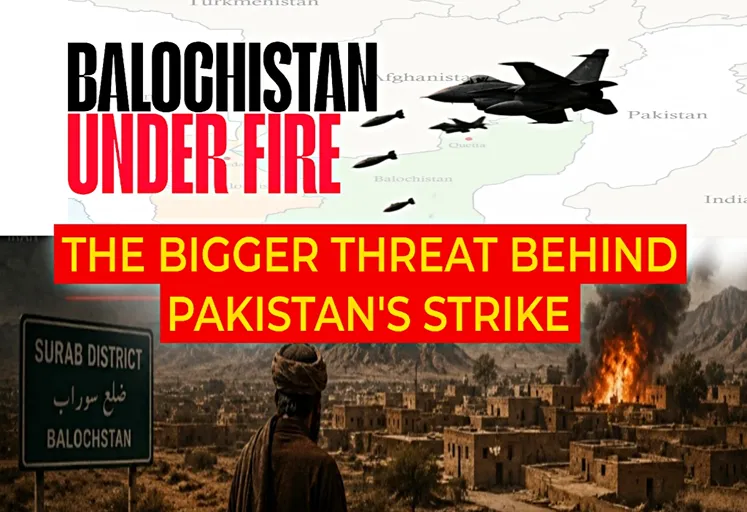

Pakistan’s Balochistan conflict has entered another tense phase after reports of an airstrike in Surab on August 12. The reported operation has triggered a sharp dispute over casualties and the identity of those targeted. Initial reports alleged that Pakistani military aircraft struck the Surab area. Civilian deaths were reported, including women and children. However, the figures remain contested and have not been independently verified.
That uncertainty matters because the incident comes amid a long-running insurgency. Therefore, the Pakistan Balochistan airstrike must be viewed beyond a single military operation. The bigger question is whether heavier military pressure can contain the conflict. Alternatively, could it deepen the cycle of violence that Islamabad has struggled to break?
Pakistan Balochistan Airstrike: What Happened?
Reports from August 12 placed the alleged Pakistan Balochistan airstrike in Surab district, particularly around the Gondhan or Gudar area. According to initial accounts, Pakistani military aircraft were involved in the operation. Reports also claimed significant civilian casualties. However, the reported numbers have varied widely, making the final toll difficult to establish. One report cited claims of more than 30 deaths, while another account reported 28 civilians killed, including women and children.
These figures should therefore be treated as preliminary claims rather than confirmed casualties. Access to the affected area has also been limited, making independent verification difficult. The central issue is now the identity of those targeted. If the operation was directed against an armed group, Pakistan could present it as a counter-insurgency action. However, confirmed civilian casualties would raise serious questions about targeting and proportionality.
The distinction matters because Balochistan has endured a long-running insurgency. Military operations have frequently been conducted alongside wider security campaigns against militant groups. At the same time, civilian communities remain caught between militant violence and state security operations. Therefore, the Pakistan Balochistan airstrike has become significant not only because of the reported attack, but also because of the unanswered questions surrounding its targets and casualties.
Reported August 12 Strike
| Location | Reported action | Reported casualties | Status |
|---|---|---|---|
| Surab, Balochistan | Alleged airstrike | 28+ reported | Disputed |
| Gondhan/Gudar area | Reported military bombing | Women and children reportedly among dead | Unverified |
| Wider Balochistan | Security operations | Figures vary | Developing |
Casualty figures are based on preliminary reports and remain subject to independent verification.
Pakistan’s Version and the Central Question
The central question is not simply whether Pakistan used military force. The more important question is what kind of operation was conducted. Pakistan has repeatedly described security actions in Balochistan through the lens of counter-insurgency and counter-terrorism. The province has faced attacks by Baloch militant organisations targeting security personnel, infrastructure and other targets. Therefore, Islamabad has a clear security argument for confronting armed groups.
However, military force carries serious risks when operations take place near civilian communities. This creates a difficult strategic balance. Pakistan must address militant violence while also limiting civilian harm. If that balance is lost, military operations can create new grievances. Those grievances can then become part of the insurgency’s political narrative.
Why the Surab Strike Could Deepen Balochistan’s Conflict
“We are free” is the message being echoed by Baloch nationalist groups this August. Yet Balochistan independence remains a contested political claim, not an internationally recognised fact. Against this backdrop, the reported Pakistan Balochistan airstrike comes amid years of militant attacks, political unrest and separatist demands, while insurgent violence and allegations of heavy-handed security practices have further deepened tensions.
Surab is particularly important in this context. The district sits within a strategically significant part of Balochistan. It connects areas that have experienced militant activity, political mobilisation and sustained security operations. The region has also featured in wider Baloch political mobilisation. For example, a 2024 Dawn report documented a Baloch Yakjehti Committee rally passing through Surab and other towns. The mobilisation highlighted grievances involving political rights, resources and development.
Therefore, the latest strike carries both security and political significance. A major military response could suppress immediate militant activity. However, it may not address the deeper grievances behind the conflict.
More importantly, each major militant attack can trigger another military response. That response can then fuel further resistance, creating a cycle that becomes increasingly difficult to contain. This retaliation cycle makes the Surab incident more significant than a single military operation. If tensions continue to rise, the Pakistan Balochistan airstrike could become another step in a broader escalation across the province.
Why Pakistan Is Relying on Harder Military Pressure
There is a straightforward reason Islamabad continues to depend heavily on security operations. Militant attacks create immediate pressure on the state. They threaten security personnel, transportation networks and critical infrastructure. A military response can therefore produce visible short-term results. However, the strategic problem is more complicated.
Balochistan’s conflict has persisted through multiple periods of military operations. That suggests that force alone has not produced a durable political settlement. Moreover, reports of civilian casualties can create additional resentment.
Consequently, Pakistan faces a difficult choice. It can intensify military pressure, or it can combine security measures with stronger political engagement.
The first option may offer faster tactical results. The second could require considerably more political effort.
Why the Retaliation Cycle Could Become a Regional Threat
This is where the latest Pakistan Balochistan airstrike becomes more significant. If militants respond to the strike, Pakistan could launch further military operations. That could lead to additional casualties, displacement and renewed militant attacks. Over time, such a cycle could make the conflict increasingly difficult to contain. More importantly, prolonged violence could turn Balochistan into a permanent security crisis. It could increase pressure on local communities and undermine confidence in provincial governance. The consequences would also extend beyond Pakistan’s internal security.
Balochistan borders both Iran and Afghanistan. It also contains Gwadar port and forms an important part of the China-Pakistan Economic Corridor. Therefore, continued instability could affect regional connectivity and economic projects. China’s interests could face higher security costs, while prolonged violence could complicate investment and infrastructure development.
The conflict could also create wider security concerns along Pakistan’s borders. Any sustained escalation would therefore carry implications for neighbouring countries and regional stability. For Islamabad, the challenge is no longer limited to defeating individual militant groups. The larger objective is to prevent Balochistan from becoming an increasingly entrenched conflict zone.
What to Watch Next
Several developments will determine the significance of the August 12 incident.
- Independent casualty verification will be crucial.
- Evidence about the intended target could clarify whether militants were the target.
- An official statement from Pakistan’s military or government could clarify its version of events.
- Militant retaliation could indicate whether the strike has intensified the conflict.
- International and domestic reactions could show whether civilian protection becomes a larger political issue.
The most important indicator will be what happens after the strike.
The Bigger Threat Is Escalation
The Pakistan Balochistan airstrike has raised questions that extend well beyond August 12. The immediate dispute concerns the target and casualty figures. Yet the deeper issue is whether military force can resolve a conflict rooted in security, political and economic grievances.
If civilian casualties are independently confirmed, pressure on Islamabad could increase.If militant retaliation follows, the conflict could enter another dangerous cycle. Therefore, the bigger threat may not be the strike itself. It may be the escalation that follows it.
For Pakistan, the challenge will be to contain armed groups without deepening the grievances that keep Balochistan unstable.
FAQ
What happened in Balochistan on August 12, 2026?
Reports alleged that Pakistani military aircraft conducted an airstrike in Surab district. Casualty figures remain disputed and independently unverified.
How many people were reportedly killed?
Initial reports varied. Some accounts reported more than 30 deaths, while another report cited 28 civilians. These figures remain preliminary.
Was the operation officially described as an airstrike?
Reports described military aircraft being used. However, the exact nature and stated objective of the operation require further official clarification.
Why is Balochistan facing conflict?
Balochistan has experienced a long-running insurgency involving militant groups, alongside political grievances concerning governance, resources and development.
What could happen next?
Further military operations or militant retaliation could intensify the conflict. Independent casualty verification and official statements will be important indicators.