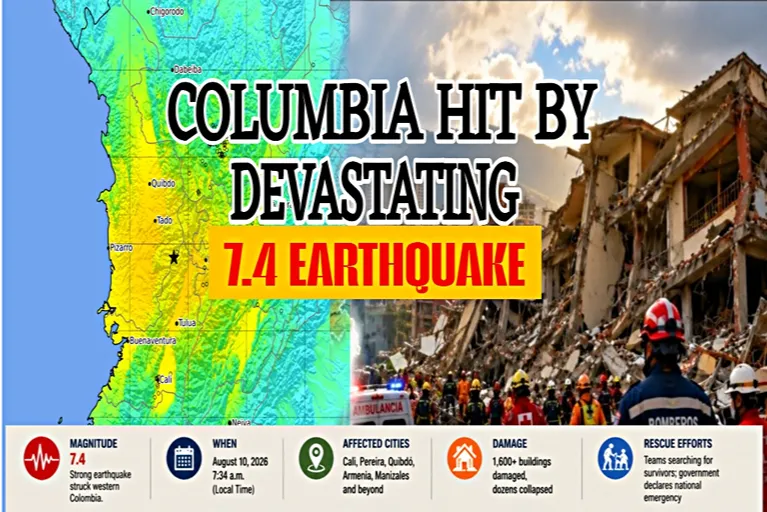

The Colombia earthquake 2026 has triggered a major humanitarian and rescue crisis across western parts of the country. A powerful magnitude 7.4 earthquake struck on August 10, causing buildings to collapse and infrastructure to be damaged. The earthquake was felt far beyond its epicentre. Moreover, rescue operations have been expanded as authorities assess the scale of destruction.
The death toll has continued to rise as damaged areas are reached. Reuters reported at least 164 deaths on August 11, while warning that the toll could increase further. The disaster has therefore become more than a regional emergency. It is also an early test of Colombia’s disaster-response capacity and the country’s new political leadership.
Colombia Earthquake 2026: When and Where Did It Strike?
The earthquake struck at about 7:34 a.m. local time on August 10. Its epicentre was located near San José del Palmar in Chocó Department, roughly 400 kilometres west of Bogotá. The earthquake was recorded at magnitude 7.4.
The quake was particularly significant because it struck a seismically active part of Colombia. The country’s geological authorities have previously described Colombia as exposed to substantial seismic risk. Its national seismic hazard model is designed to estimate potential earthquake impacts on people, buildings and infrastructure.
Colombia Earthquake 2026: Areas Affected and Damage
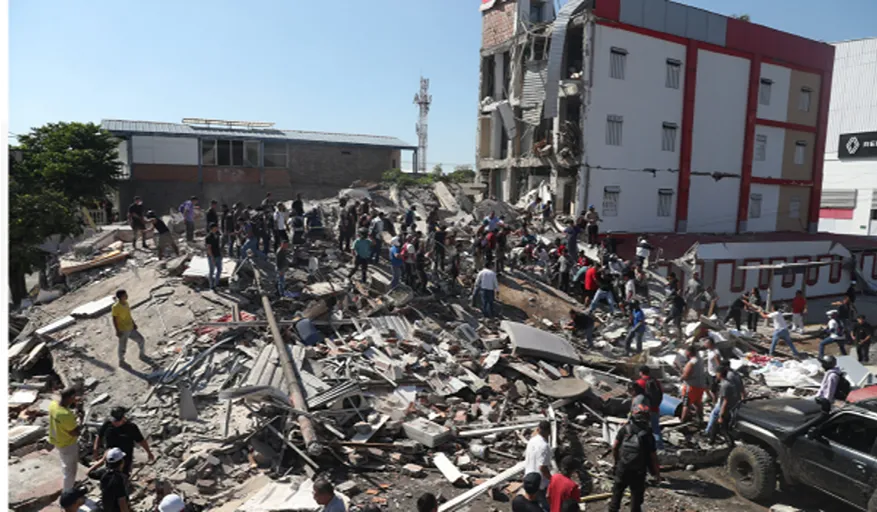
The Colombia earthquake 2026 caused widespread damage across western and central-western parts of the country. Cali, Pereira, Manizales and Quibdó were among the areas where serious damage and casualties were reported. Cali suffered particularly severe consequences. Parts of a hospital were damaged, forcing patients to be treated outside. Pereira also recorded heavy casualties and structural destruction. In Manizales, a tower of the city’s historic cathedral was damaged. Meanwhile, the remote terrain around Chocó made damage assessments and rescue operations more difficult.
According to reports, more than 1,600 buildings were damaged, while at least 61 structures completely collapsed. Hospitals, schools, roads and other public facilities were also affected. Disrupted communications further complicated efforts to gather reliable information from remote communities.
The human cost of the Colombia earthquake 2026 has also been severe. By August 11, reported that at least 164 people had died, with the hardest-hit areas including Cali, Pereira and Chocó. Hundreds of people were also reported injured, while rescue teams continued searching damaged and collapsed structures.
However, the casualty and damage figures remain provisional. The final impact may take time to establish, particularly in isolated communities that are difficult to reach. As rescue teams reach more affected areas, authorities are expected to provide updated assessments of the disaster.
Colombia’s Long History of Major Earthquakes
The latest disaster has revived memories of several devastating earthquakes in Colombia’s history.
| Year | Earthquake | Key Impact |
|---|---|---|
| 1979 | Tumaco earthquake | Magnitude 8-class quake; tsunami and severe coastal damage |
| 1983 | Popayán earthquake | Major destruction in Popayán; hundreds killed |
| 1994 | Páez earthquake | Severe damage and landslides in southern Colombia |
| 1999 | Armenia earthquake | 921 deaths recorded in the official Colombian seismic record |
| 2026 | Western Colombia earthquake | Magnitude 7.4; widespread casualties and structural damage |
The 1979 Tumaco earthquake was especially destructive. According to the U.S. Geological Survey, the magnitude 8 earthquake caused ground deformation, liquefaction and a tsunami along Colombia’s Pacific coast. The 1999 Armenia earthquake also remains a major reference point. Colombia’s Geological Service records 921 deaths, 5,377 injuries and more than 21,000 damaged or destroyed homes in that disaster.
The comparison is important because it shows that seismic disasters have repeatedly tested Colombia’s urban planning and emergency systems.
The Political Impact of Colombia’s Earthquake
The Columbia earthquake 2026 is primarily a humanitarian disaster. Nevertheless, it carries several wider political implications.
A Test for Colombia’s New Government
The earthquake has occurred only days after President Abelardo de la Espriella took office. Therefore, the government’s handling of the crisis could influence public confidence in its early leadership. A rapid response will be politically important. At the same time, delays in rescue operations or aid distribution could increase public pressure.
Regional Cooperation Could Expand
Earthquake recovery can also encourage closer cooperation across Latin America. Emergency teams, medical assistance and technical support can be shared between neighbouring countries. International assistance has already been offered. The United States has pledged financial support, while other countries have offered help and rescue resources. Such cooperation could become important during the longer rebuilding phase.
Infrastructure Will Become a Political Issue
The earthquake has exposed vulnerabilities in hospitals, schools, transport networks and other public infrastructure. Consequently, rebuilding is likely to become a major policy issue. Government spending could shift toward earthquake-resistant construction and stronger emergency systems. In addition, pressure may increase for stricter enforcement of building standards.
The Wider Impact Beyond Colombia
The immediate effects will remain concentrated in Colombia. However, several consequences could extend beyond its borders. First, international humanitarian agencies may face increased demand for financial and technical assistance. Second, regional governments could review their own earthquake preparedness.
The economic impact may also become significant. Western Colombia is an important agricultural and commercial region. Damage to roads, airports and local businesses could disrupt the movement of goods. Moreover, Colombia’s international partners may become more involved in reconstruction. Financial institutions, humanitarian organisations and foreign governments could contribute to recovery projects.
The disaster could therefore become a test of how effectively regional and international institutions coordinate after a major natural disaster.
Conclusion
The Colombia earthquake 2026 has produced a devastating human and infrastructure crisis in western Colombia. Its magnitude, widespread damage and rising death toll have placed enormous pressure on emergency services. Yet the next phase will be equally important. Rescue operations must be followed by effective relief, transparent reconstruction and stronger disaster preparedness.
For Colombia, the earthquake is not only a tragedy. It is also a critical test of government response, infrastructure resilience and regional cooperation.
FAQ
How strong was the Colombia earthquake in 2026?
The earthquake was recorded at magnitude 7.4 and struck western Colombia on August 10, 2026.
Where was the Colombia earthquake 2026 epicentre?
The epicentre was located near San José del Palmar in Chocó Department, western Colombia.
How many people died in the Colombia earthquake 2026?
The death toll has continued to change. Reuters reported at least 164 deaths on August 11, with authorities expecting the figure to rise.
Which areas were most affected?
Cali, Pereira, Manizales, Quibdó and areas around Chocó were among the hardest-hit locations.
What happens after the Colombia earthquake 2026?
Rescue operations will be followed by medical assistance, temporary housing, infrastructure inspections and longer-term reconstruction.