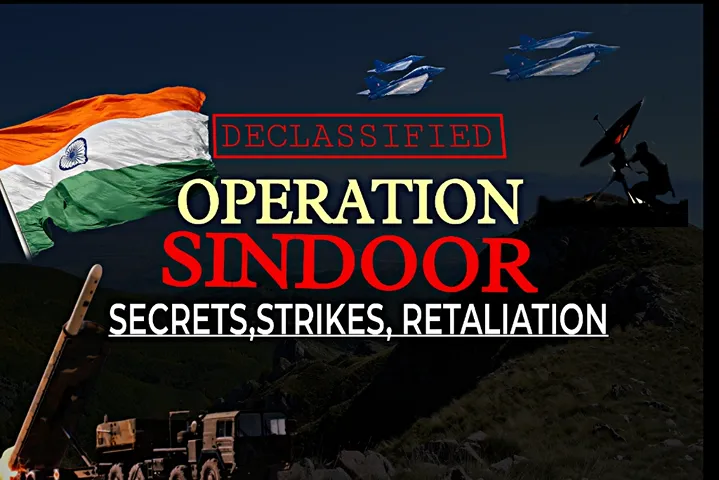

The story of Operation Sindoor is being revisited through a new lens. Discovery’s Declassified: Operation Sindoor has now brought previously unseen decision-making into public view. Most importantly, the series shows how a much larger target list was narrowed before India’s opening strikes. The two-part documentary premiered on 15 August 2026. It features military leaders, operational personnel, defence experts and journalists.
The series examines the planning and execution of the 88-hour military confrontation. For readers who already know the basic story of Operation Sindoor, the significance lies elsewhere. The documentary focuses on what happened before the missiles were launched and how India’s response was calibrated.
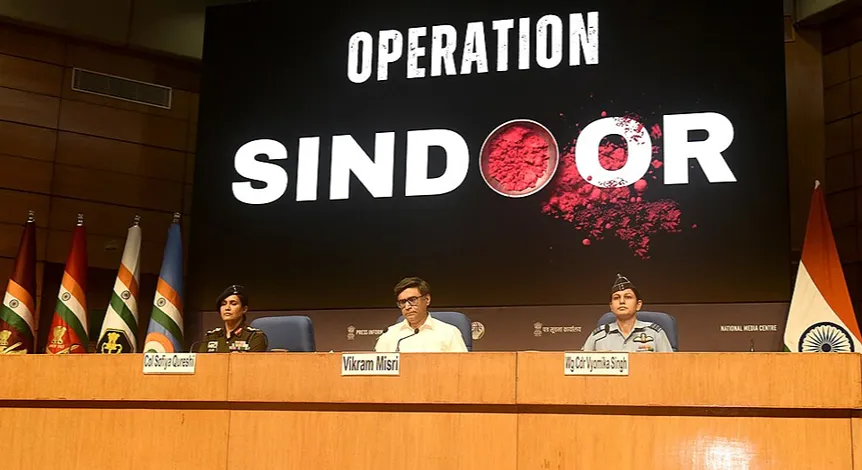
Credit: Wiki Commons/Ministry of Defence
What the Operation Sindoor Declassified Series Reveals
Declassified: Operation Sindoor moves beyond the familiar account of India’s May 2025 strikes to examine the decisions made before, during and after the 88-hour confrontation. The documentary brings together senior military leaders, operational personnel, defence experts and journalists, offering a closer look at India’s war rooms, the coordination among the three services and the final stages of preparation before the strikes. One of its most significant revelations is the reported narrowing of an initial pool of 34 potential targets to nine that were ultimately selected.
The series also follows the rapid escalation after the May 7 strikes, including Pakistan’s retaliatory attacks, India’s air-defence response and the pressure on commanders as the confrontation expanded. Another striking episode concerns communication between the two sides, including the reported conversation involving the Pakistani and Indian Directors General of Military Operations as both sides moved toward ending the fighting. Taken together, these accounts shift the focus from missiles and targets to the decisions behind them — what India chose to strike, what it chose not to strike, how military secrecy was maintained, and how commanders managed the risk of a wider India-Pakistan escalation.
From Pahalgam to the War Room
The documentary also shifts attention back to the days between the April 22, 2025 Pahalgam attack and the May 7 strikes. The attack took place at Baisaran Valley, a secluded meadow about 6–7 km from Pahalgam town in Anantnag district, Jammu and Kashmir. Opened fire started on tourists at the popular mountain meadow, killing 26 people, including one Nepali citizen. According to Indian authorities and survivor accounts, the attackers questioned victims about their religious identity before opening fire. That detail transformed the attack into more than another episode of terrorism. It became the immediate trigger for India’s military response. The government later stated that Operation Sindoor struck nine terrorist camps in Pakistan and Pakistan-occupied Jammu and Kashmir.

Why Were 34 Targets Reduced to Nine?
The 34-to-9 revelation is one of the most significant details in the Operation Sindoor declassified series. It shows that India’s response was shaped not simply by the number of available targets, but by careful military selection. The documentary raises a key question: What changed between the initial planning stage and the final target list?
Several factors would have influenced that decision:
- Intelligence confidence: Targets had to be sufficiently verified before selection.
- Operational priorities: Greater importance was given to sites considered strategically significant.
- Escalation risks: With India and Pakistan both being nuclear-armed states, wider escalation had to be considered.
- Civilian safety: Potential civilian casualties and collateral damage also had to be taken into account.
The Indian government later described the operation as focused on causing maximum damage to terrorist infrastructure while minimising civilian harm. It also highlighted the joint capabilities of India’s armed forces.Therefore, the importance of the 34-to-9 reduction lies in what it says about military choice. India may have had a much wider range of potential targets, but only nine were ultimately selected.
The weapons and strikes became the most visible part of Operation Sindoor. However, the decision about what not to strike may reveal just as much about India’s strategy. In that sense, the Operation Sindoor declassified revelation is not merely about reducing 34 targets to nine. It offers a glimpse into the planning, restraint and strategic calculations that took place before the operation was launched.
Behind the Secrecy and Air-Defence Battle
The Operation Sindoor declassified series also highlights the secrecy surrounding India’s preparations and the intense defensive battle that followed the initial strikes. The documentary provides accounts from India’s war rooms and personnel involved in the operation. Such secrecy was crucial because revealing plans, timings or capabilities could have compromised the mission. However, the operation soon moved beyond India’s initial strikes. Pakistan launched drones and missiles toward Indian territory, placing India’s air-defence network under significant pressure.
One reported episode involved an Indian Air Force unit at Sirsa, Haryana, intercepting a Pakistani ballistic missile. Reports said the missile was believed to be heading towards Delhi and was intercepted using the Barak-8 air-defence system. The episode adds an important dimension to the Operation Sindoor declassified story. While the initial strikes demonstrated India’s offensive capability, the subsequent interceptions highlighted the importance of air defence, surveillance, rapid decision-making and coordinated military response.
Together, these events show that Operation Sindoor was not simply about the strikes launched by India. It also involved maintaining operational secrecy and defending Indian territory against the retaliation that followed.
What the Documentary Says About India’s Military Strategy
The broader lesson is the importance of calibrated force. The official Indian account describes Operation Sindoor as a multi-domain operation involving land, maritime and air capabilities. It also highlights cyber, space and information warfare as part of the wider operational environment. The documentary adds a human dimension to that description. Instead of showing only weapons and explosions, it focuses on commanders, personnel and the decisions made under pressure.
That matters strategically because modern warfare is increasingly about coordination. Sensors must identify threats. Intelligence must be processed. Commanders must make decisions quickly. Different military branches must then execute those decisions together. Operation Sindoor therefore became a test of India’s ability to integrate those capabilities during a rapidly changing crisis.
Pakistan’s Retaliation: Operation Bunyan-ul-Marsoos and Civilian Sites
The story of Operation Sindoor did not end with India’s initial strikes. Pakistan responded with Operation Bunyan-ul-Marsoos, involving drones, missiles and artillery attacks against Indian territory. Pakistan presented Bunyan-ul-Marsoos as a military response to India’s strikes on May 7, 2025. The confrontation then expanded beyond the original exchange, with threats directed toward several locations across northern and western India. According to India’s official account, Pakistani drones and missiles targeted areas including Srinagar, Jammu, Amritsar and Pathankot. India’s Ministry of Defence said these threats were countered by its integrated air-defence and counter-drone systems.
The retaliation also reportedly affected civilian and religious sites. India said the Shambhu Temple in Jammu, a gurdwara in Poonch and Christian convents came under attack during the escalation. Heavy Pakistani artillery and mortar fire was also reported along the Line of Control. According to the Ministry of Defence, 16 civilians were killed, including three women and five children, in the shelling. These incidents added a significant civilian dimension to the military confrontation.
The contrast became central to India’s presentation of the conflict. India described its initial strikes as focused and measured, with terrorist infrastructure selected as the target. Pakistan, meanwhile, presented Bunyan-ul-Marsoos as retaliation for those strikes. The exchange therefore became more than a nine-target operation. It developed into a broader confrontation involving missiles, drones, air defence, artillery and civilian areas.
A New Deterrence Message to Pakistan
The geopolitical significance extends beyond the operation itself. India’s response established a different strategic message. Terrorist infrastructure across the border could no longer automatically be treated as outside the scope of India’s military response. At the same time, the narrowing of targets indicated an effort to avoid uncontrolled escalation. That combination creates a difficult deterrence model.
India seeks to make retaliation credible. However, it also needs to prevent each retaliation from becoming an open-ended military confrontation. This is especially significant in South Asia. Both India and Pakistan possess nuclear weapons. Therefore, even limited conventional operations carry escalation risks.
Operation Sindoor’s Second Story
Declassified: Operation Sindoor adds a new layer to the story by looking beyond the initial nine strikes. It reveals details about target selection, military planning, secrecy and the decisions made during the wider confrontation. The 34-to-9 target reduction, Pakistan’s Operation Bunyan-ul-Marsoos, air-defence operations and reported attacks affecting civilian and religious sites all form part of this larger picture.
Together, they show that Operation Sindoor was not simply a series of strikes. It became a broader military confrontation shaped by deterrence, retaliation and escalation control.
FAQ
What is Declassified: Operation Sindoor?
Declassified: Operation Sindoor is a Discovery documentary that examines the planning, execution and wider military confrontation surrounding Operation Sindoor.
Why were 34 targets reduced to nine?
The documentary reportedly reveals that 34 potential targets were initially considered, before the final list was reduced to nine. The decision reflected the strategic choices made before the strikes.
What was Operation Bunyan-ul-Marsoos?
Operation Bunyan-ul-Marsoos was Pakistan’s military response to India’s Operation Sindoor strikes. It involved missile, drone and artillery attacks against Indian targets.
Were civilians and religious sites affected during the conflict?
According to India’s official account, Pakistani attacks affected civilian areas and religious sites, including the Shambhu Temple in Jammu, a gurdwara in Poonch and Christian convents. India also reported civilian deaths from Pakistani shelling.
What makes the documentary different from earlier Operation Sindoor coverage?
The documentary focuses more closely on behind-the-scenes decisions, target selection, military planning, air-defence operations and the subsequent Pakistan-India escalation, rather than only describing the initial strikes.