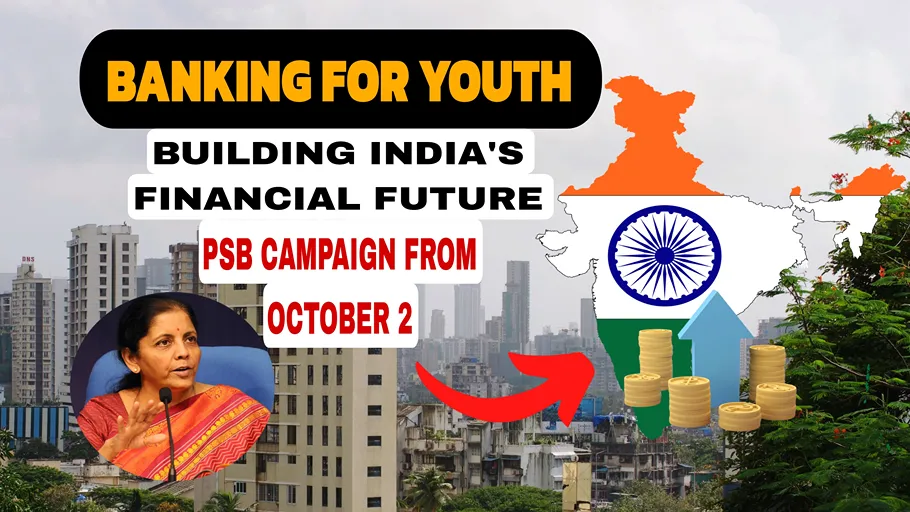

Banking for Youth: Sitharaman’s Big Push to Empower India’s Young Generation
India’s young population is becoming an increasingly important force in the country’s economic and financial future, and public sector banks are being asked to engage with this generation much earlier. Union Finance Minister Nirmala Sitharaman has called on public sector banks (PSBs) to strengthen their connection with young customers and build relationships that can continue from the academic years into professional life. The proposed Banking for Youth campaign from October 2, 2026, places financial awareness, accessibility and youth-focused banking at the centre of that effort. Recent reporting on Sitharaman’s August 18 meeting with PSB leadership says she urged state-owned lenders to use their geographical reach, customer relationships, technology and sector expertise more strategically while developing youth-focused approaches.
The emphasis is significant because young Indians are entering a financial environment that is increasingly digital, fast-moving and complex. For students and first-time earners, understanding savings, digital payments, credit, insurance, investments, fraud prevention and responsible borrowing can make a substantial difference to their financial future. Banking for Youth is therefore not simply about opening more accounts. It is about creating an early relationship between young citizens and formal financial institutions. Sitharaman’s message also reflects a broader shift in the role of PSBs. Banks are no longer expected only to provide traditional branch-based services; they must also offer convenient digital experiences and understand changing customer expectations.
The Finance Minister has specifically highlighted the need for simpler and round-the-clock banking services for younger customers. The government already has experience using banks as vehicles for wider financial inclusion. Earlier initiatives around digital banking and financial awareness have sought to bring young people into the formal financial system. The Press Information Bureau, for example, documented a youth-focused mobile-banking training initiative aimed at improving understanding of online banking and cashless transactions. For the new Banking for Youth push, the challenge will be turning awareness into lasting financial habits.
The Banking for Youth initiative could also encourage PSBs to develop more practical programmes for students, first-time earners and young entrepreneurs. These programmes may focus on savings, digital payments, responsible borrowing, cybersecurity and basic investment awareness. By making financial education easier to access, Banking for Youth can help young customers make informed decisions before they enter major financial commitments. The wider objective of Banking for Youth is therefore to create a stronger connection between India’s young population and the formal banking system, while helping PSBs adapt to the expectations of a digitally confident generation.

- Ayush Shetty Stuns World No. 1 Shi Yuqi: India’s New Badminton Star Rises
- India’s Dog Bite Cases Reveal a Growing Public-Health Challenge
- India’s Wars and Border Conflicts: The Two-Front Challenge
- India vs China: 5 Turning Points That Changed the Himalayan Border Forever
- India vs Pakistan: 4 Wars That Changed the Power Balance Forever
What the Banking for Youth Campaign Means for India’s Young Generation
At its core, Banking for Youth is about making financial services easier to understand and more relevant to young Indians. A student opening a first bank account may initially need only basic savings and payment facilities, but that relationship can evolve as the individual enters higher education, starts earning, launches a business, takes an education loan or begins investing. Sitharaman’s call for PSBs to build relationships from the campus stage through the career stage reflects precisely this long-term approach.
The campaign can potentially bring banks closer to colleges, universities, skill centres and youth communities. Instead of waiting for young people to approach branches when they need a loan or another financial product, banks can proactively explain how the financial system works. Workshops could cover budgeting, saving, responsible use of credit cards, digital payments, cybersecurity, insurance and basic investment principles. Such programmes could be particularly valuable for first-generation banking customers.
A strong Banking for Youth strategy must also recognise that young customers are not a single group. A school-leaver, a university student, a first-time employee, a rural entrepreneur and a technology professional have very different financial requirements. PSBs have a major advantage here because of their nationwide networks and experience serving diverse communities. The Finance Minister has asked banks to identify and build on their individual strengths, including geographical presence, technology, sector knowledge and established customer relationships.
The importance of Banking for Youth also extends beyond individual customers. Young people are increasingly comfortable with smartphones, online payments and digital platforms. If PSBs can combine that digital familiarity with sound financial education, they can create customers who understand not only how to transact but also how to manage money responsibly. The country’s digital-payment transformation has already changed everyday financial behaviour, with the government describing India’s movement from traditional cash-based transactions toward faster and more inclusive digital payments.

Why Youth Participation Is Critical to India’s Economic Growth
The case for Banking for Youth goes far beyond customer acquisition. India’s economic expansion depends heavily on how effectively it can convert its large young population into productive workers, entrepreneurs, consumers and investors. Financial inclusion is an important part of that transition because access to formal financial services gives people greater ability to save, borrow, invest and manage economic risks. For a young person, early financial knowledge can prevent costly mistakes later. Understanding interest rates before taking a loan, recognising fraudulent messages before sharing banking credentials, maintaining emergency savings and distinguishing between productive and unnecessary borrowing are basic skills with long-term consequences.
A successful Banking for Youth campaign could make these lessons part of the transition from education to employment. Youth participation is particularly important for entrepreneurship. India’s startup ecosystem, digital economy and small-business sector require young entrepreneurs to have access to formal banking, payments and credit. PSBs already operate across sectors and regions, giving them an opportunity to connect young entrepreneurs with appropriate financial products and government-backed programmes. The objective should not be simply to increase lending, but to improve the quality of financial decisions and make credit more sustainable.
There is also a strong regional dimension. A youth-focused campaign cannot succeed if it is designed only for metropolitan India. Young people in smaller towns, rural areas and economically emerging regions need equal access to financial education and digital banking. PSBs’ physical networks can complement digital channels in places where customers may still prefer face-to-face guidance. The broader economic logic is straightforward: financially informed young citizens are better positioned to participate in formal economic activity.
More savings can support investment; responsible credit can support businesses; digital payments can improve transaction efficiency; and greater awareness can reduce vulnerability to fraud. The Banking for Youth initiative can therefore become an important bridge between financial inclusion and economic growth. Its success, however, will depend on implementation. Banks will need youth-friendly products, simple communication, responsive digital services and measurable outreach rather than merely conducting a symbolic month-long campaign.
How Banking for Youth Could Strengthen India’s Growth Story
The long-term potential of Banking for Youth lies in creating a financial relationship before major financial decisions arrive. A student who learns to save today could become a responsible borrower tomorrow and an investor or entrepreneur later. That progression is valuable not only to the individual but also to banks and the wider economy.
The October 2 launch date gives PSBs an opportunity to create a concentrated national outreach effort while establishing programmes that continue beyond the campaign. Branches could work with educational institutions, youth organisations and local communities. Digital platforms could provide short financial-literacy modules, while bank officials could conduct sessions on fraud prevention, budgeting and responsible borrowing. The most effective version of Banking for Youth would make financial education practical rather than theoretical.
The campaign could also encourage banks to compete on service quality. Young customers are accustomed to fast digital experiences, and public sector lenders will have to demonstrate that scale does not have to mean complexity. Sitharaman’s call for simpler, round-the-clock banking reflects this changing expectation.
For PSBs, Banking for Youth could ultimately become a test of how successfully traditional institutions adapt to a younger, digitally confident customer base. The opportunity is substantial, but the campaign should avoid becoming a short-term publicity exercise. Its real value will be measured by how many young people gain useful financial knowledge, adopt responsible banking habits and remain connected to formal finance.
A successful Banking for Youth campaign could also help young Indians understand how everyday financial choices influence long-term economic security. Early exposure to savings, digital payments, credit management and investment planning can encourage greater financial discipline. It could also help banks identify the changing needs of first-time customers and develop services that are simpler, safer and more accessible. For India, stronger youth participation in formal banking can support entrepreneurship, employment, consumption and investment. If implemented effectively, the campaign could become more than an October initiative, creating a lasting bridge between India’s young population, financial institutions and the country’s broader growth ambitions.
What is Banking for Youth?
Banking for Youth is the youth-focused outreach approach being pushed by Finance Minister Nirmala Sitharaman for public sector banks, with an emphasis on building stronger relationships with young customers and improving access to simpler banking services.
When is the PSB campaign expected to begin?
The proposed Banking for Youth campaign is expected to begin on October 2, 2026, according to current reports concerning the Finance Minister’s direction to public sector banks.
Why is youth financial literacy important?
Banking for Youth can help young people understand savings, credit, digital payments, investment basics and fraud prevention before they begin making larger financial decisions.
How can the campaign help India’s economy?
A stronger Banking for Youth ecosystem can support financial inclusion, responsible credit, entrepreneurship, digital transactions and long-term savings, helping young citizens participate more effectively in the formal economy.
What should PSBs focus on?
The strongest Banking for Youth model would combine simple digital services, campus outreach, financial education, cybersecurity awareness and youth-friendly products while maintaining responsible lending standards.
By Sahil Koul | National Affairs Analyst covering Indian politics, governance, public policy, and major developments shaping the nation.