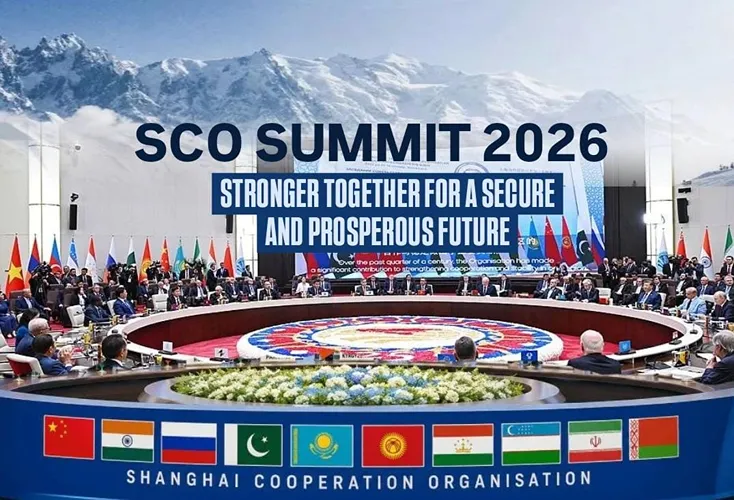

The SCO Summit 2026 in Bishkek was more than a routine diplomatic gathering. Held on 31 August and 1 September, the summit marked 25 years of the Shanghai Cooperation Organisation and came as Eurasia faces growing strategic competition, wars, sanctions and pressure to build alternative economic and security arrangements.
Hosted by Kyrgyz President Sadyr Japarov, the summit brought together the SCO’s ten full members around security, economic cooperation, energy, connectivity and institutional reform. For India, however, the most important messages came from Prime Minister Narendra Modi, who used the forum to press for a united stand against terrorism, dialogue over conflict and respect for sovereignty in connectivity projects.
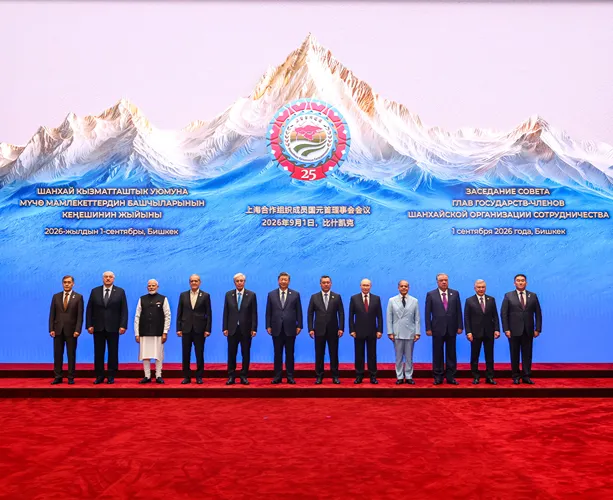
Photo: Prime Minister’s Office (GODL-India)
What Is the SCO Summit and Why Does It Matter?
The Shanghai Cooperation Organisation was established in 2001 by China, Russia, Kazakhstan, Kyrgyzstan, Tajikistan and Uzbekistan. India and Pakistan joined as full members in 2017, Iran in 2023 and Belarus in 2024, taking the organisation to ten permanent members. The SCO Summit is the annual meeting of the organisation’s Council of Heads of State. It provides a platform for discussions on terrorism, extremism, regional security, trade, energy, transport, digital cooperation and sustainable development.
Unlike NATO, the SCO is not a formal military alliance. Its members have major differences. India and China remain strategic competitors, India and Pakistan have deep security tensions, while Russia and China have moved closer in recent years. Yet all three major powers remain inside the same institution. That makes the SCO useful for India. New Delhi can engage China, Russia and Central Asian states in one forum while maintaining wider relationships with the United States, Europe, Japan and other partners.
| Indicator | 2026 |
|---|---|
| Founded | 2001 |
| Full members | 10 |
| India joined | 2017 |
| Iran joined | 2023 |
| Belarus joined | 2024 |
| 25th anniversary | 2026 |
| SCO Summit venue | Bishkek, Kyrgyzstan |
| SCO Summit dates | 31 August–1 September |
| 2026 chair | Kyrgyzstan |
| 2027 chair | Pakistan |
What Happened at the SCO Summit 2026?
The summit was held under the theme, “25 Years of the SCO: Together for Sustainable Peace, Development and Prosperity.” Discussions went beyond traditional security concerns and reflected the growing importance of energy, connectivity, trade and institutional cooperation. One of the most notable developments was the decision to add English to the SCO’s official working framework, alongside Russian and Chinese. The change reflects the organisation’s expanding international profile and could make communication easier for members such as India and Pakistan.
The summit also concluded with the Bishkek Declaration and 27 collaborative agreements. These covered a broad range of areas, reinforcing the organisation’s effort to deepen cooperation beyond counter-terrorism. Energy was another major issue. Member states reaffirmed Iran’s right to peaceful nuclear energy and opposed unilateral economic sanctions and external military intervention. The position matters because energy security is central to Eurasian geopolitics, where oil, gas, nuclear power and strategic transport routes are increasingly linked. At the end of the meeting, Pakistan assumed the rotating chairmanship for 2027 and is set to host the next Council of Heads of State summit. That transition could make the next SCO meeting especially sensitive for India because of the two countries’ strained relationship.
Modi’s Key Messages: Terrorism, Dialogue and Sovereignty
Prime Minister Narendra Modi’s intervention was one of the most significant parts of the summit for India. His strongest message concerned terrorism. Modi told the gathering: “We must speak in one voice that there can be no place for double standards in dealing with terrorism.”
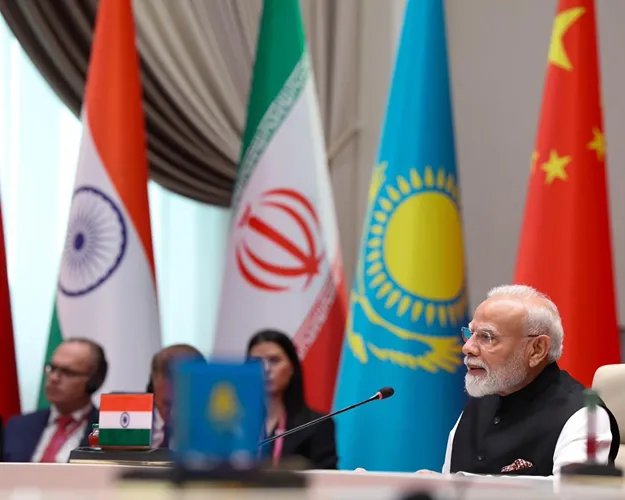
The statement reflects India’s longstanding demand that terrorism should not be judged selectively. Modi called for action against the wider terror ecosystem, including safe havens, financing networks and other forms of support that allow extremist organisations to operate. The issue carried extra political weight in light of the Pahalgam terror attack and India’s subsequent military response, Operation Sindoor. By placing terrorism prominently before the SCO, Modi sought to push the organisation towards a more consistent regional security approach.
Modi also stressed dialogue and diplomacy as the way forward for conflicts. His broader message was that lasting solutions cannot be achieved on battlefields alone. Connectivity was another important part of his address. Modi emphasised that infrastructure initiatives must respect the sovereignty and territorial integrity of all countries. The point is particularly relevant to India’s objections to projects that pass through territory it considers its own.
India also proposed an SCO Civilisation Dialogue Forum. The proposal seeks to deepen cooperation through the shared cultural and historical links of Eurasia, moving the organisation’s agenda beyond security and economics. The first session is expected to be hosted by India later in 2026. Together, Modi’s messages were built around four themes: a united fight against terrorism, dialogue over conflict, sovereign connectivity and civilisational engagement.
The Big Decisions: Security, Energy, Connectivity and Reform
Security remains at the heart of the SCO, particularly through cooperation against terrorism, extremism and separatism. India wants such cooperation to move beyond declarations and include practical coordination against terrorist financing, recruitment and cross-border networks. The energy discussion showed the organisation’s growing interest in strategic autonomy. Support for Iran’s peaceful nuclear rights and opposition to unilateral sanctions fit into a wider Eurasian debate over national control of energy resources and economic decision-making.
Connectivity is equally significant. The SCO’s geographic reach creates opportunities to link major markets and energy producers, but competing corridor projects also carry geopolitical consequences. India supports stronger links with Central Asia and Eurasia while insisting that routes respect sovereignty.
The Bishkek Declaration and 27 agreements also showed that the SCO wants to expand cooperation in sustainable development and economic matters. The real test, however, will be implementation. Regional organisations often produce ambitious declarations; their influence depends on whether commitments become functioning projects and practical security mechanisms. The 2026 summit therefore showed an SCO attempting to evolve from a predominantly security-focused grouping into a wider platform for Eurasian cooperation.
What the SCO Summit 2026 Means for India and the World
For India, the SCO remains valuable because it provides access to a strategically critical region without requiring New Delhi to join a formal geopolitical bloc. India needs stable relations with China, retains deep strategic links with Russia and wants stronger partnerships with Central Asia. Pakistan, however, remains a major security concern. The SCO places these relationships under one diplomatic roof. The Modi-Xi equation will remain particularly important. Dialogue does not eliminate competition, but communication can help prevent bilateral tensions from damaging wider regional stability. For India, progress with China must still be accompanied by attention to border security and sovereignty.
Russia presents a different challenge. Moscow remains important to India in defence, energy and strategic cooperation, even as its relationship with Beijing has grown stronger. India’s approach is therefore based on maintaining an independent relationship with Russia rather than allowing great-power rivalry to dictate New Delhi’s choices. For the wider world, the 2026 SCO Summit highlighted the emergence of a more competitive Eurasian order. China, Russia, India and the Central Asian states do not form a perfectly united bloc. Their interests often diverge. But continued coordination shows that many states want greater influence over the rules governing regional security, energy, trade and connectivity.
That is the broader significance of Bishkek. The SCO is not replacing the existing international system, but it is becoming an important arena in which the future shape of Eurasia is being negotiated. For India, Modi’s intervention made the priorities clear. Terrorism must not receive selective treatment, conflicts require diplomacy, connectivity must respect sovereignty and Eurasian cooperation should include a stronger civilisational dimension. The SCO Summit 2026 therefore ended not with a single geopolitical alignment, but with India trying to shape a multipolar Eurasia while preserving strategic autonomy.
What is the SCO Summit 2026?
The SCO Summit 2026 was the annual meeting of the Shanghai Cooperation Organisation’s heads of state, held in Bishkek, Kyrgyzstan, on 31 August and 1 September 2026.
What was the theme of the SCO Summit 2026?
The summit was held under the theme “25 Years of the SCO: Together for Sustainable Peace, Development and Prosperity.”
What did Narendra Modi say at the SCO Summit 2026?
Modi called for a united approach against terrorism, stating that there should be “no place for double standards” in dealing with terrorism. He also stressed dialogue, diplomacy and respect for sovereignty in connectivity projects.
What major institutional change was announced?
The SCO approved the inclusion of English in its official working framework, alongside Russian and Chinese.
Which country will chair the SCO in 2027?
Pakistan will take over the rotating chairmanship and is expected to host the next Council of Heads of State summit. and is expected to host the next meeting of the Council of Heads of State in 2027.