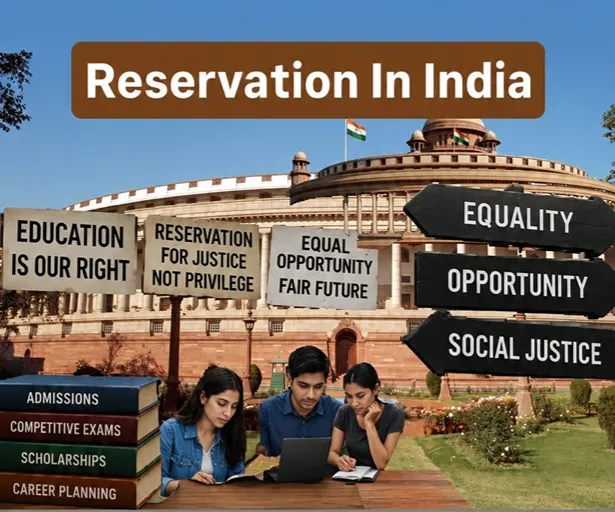

Reservation in India has once again become the center of national discussion. What began as protests over education and governance has evolved into a wider debate involving students, educational institutions, policymakers, and civil society. The CJP protest gained national attention after activist Sonam Wangchuk began a hunger strike while demanding the resignation of Union Education Minister Dharmendra Pradhan. As the movement progressed, similar demands were also directed at Punjab Education Minister Harjot Singh Bains, further intensifying public debate over education policy and reservation.
The controversy now extends far beyond admissions and government jobs. It raises broader questions about social justice, constitutional equality, and educational opportunity. Dr. B.R. Ambedkar, one of the principal architects of the Indian Constitution, played a key role in establishing the reservation framework to address historical discrimination against marginalized communities. While political reservations in legislatures were originally introduced as a temporary constitutional provision, Parliament has extended them through successive amendments. Today, as discussions continue across social media and public forums, students remain at the center of the debate over the future of reservations in India.
Reservation: Historical Background
Reservation in India is one of the country’s most important affirmative action policies, introduced to address the historical discrimination faced by Scheduled Castes (SCs), Scheduled Tribes (STs), and later Other Backward Classes (OBCs). Over the years, it has expanded beyond education to include government employment and political representation, making it a key pillar of India’s social justice framework.
Backed by Articles 15, 16, 46, 330, and 332 of the Constitution, the policy aims to promote equal opportunities for historically disadvantaged communities. However, reservation has remained one of India’s most debated issues, with every major reform sparking political discussions, legal challenges, and nationwide debates over balancing social justice, equality, and merit.
Reservation in India Timeline: Year-by-Year Developments
| Year | Major Event | Significance |
|---|---|---|
| 1950 | Constitutional reservation implemented | Protection for SCs and STs |
| 1990 | Mandal Commission implemented | OBC reservation introduced in central services |
| 1992 | Supreme Court (Indra Sawhney Case) | Upheld OBC reservation with 50% ceiling |
| 2006 | OBC reservation in higher education | Expanded reservation in central educational institutions |
| 2019 | 10% EWS Reservation introduced | Reservation for economically weaker sections |
| 2023 | Women’s Reservation Act (106th Constitutional Amendment) | Increased women’s political representation; implementation will begin after the next Census and delimitation exercise. |
| 2023–2025 | Continued debates over caste census and reservation reforms | Renewed political discussions |
| Recent Developments | CJP protest concludes; Dharmendra Pradhan resigns; online reservation protests emerge | Public debate shifts toward education policy and student concerns |
Reservation Debate After CJP
The conclusion of the CJP protest marked a turning point in the national conversation on Reservation in India. Public attention quickly shifted toward reservation policies, and the debate gained further momentum following the resignation of Dharmendra Pradhan. As discussions moved online, social media became the primary platform for competing views, with students, educators, activists, and political leaders driving nationwide conversations about the future of reservation and its impact on education.
Growing Reservation Debate
Reservation has returned to the national spotlight due to growing uncertainty over education policies, political developments, and increasing public debate. Political parties are also making reservation a key part of their broader electoral strategies.
At the same time, students remain concerned about admissions, competitive examinations, and future employment opportunities. Social media has further amplified every policy proposal and political statement, turning the issue into a nationwide debate that now extends well beyond classrooms.
What Has Changed?
Reservation has returned to the national spotlight due to growing uncertainty over education policies, political developments, and increasing public debate. Political parties are also making reservation a key part of their broader electoral strategies. Students remain concerned about its impact on admissions, competitive examinations, and future employment opportunities. These concerns have fueled widespread discussions across the country.
Meanwhile, social media has amplified every policy proposal and political statement, transforming the issue into a nationwide debate that now extends far beyond classrooms.
Impact on Students
Students remain at the heart of the Reservation in India debate, as any policy changes can directly influence university admissions, government recruitment, competitive examinations, scholarships, and long-term career opportunities. Uncertainty surrounding reservation policies often creates confusion during admission and recruitment cycles, making timely policy clarity essential.
Candidates preparing for UPSC, SSC, NEET, JEE, CUET, and other state and central-level examinations closely follow every government announcement. Any significant reform could require universities, examination authorities, and educational institutions to revise admission and recruitment procedures, affecting millions of aspirants across the country.
What Comes Next?
The coming months will determine whether Reservation in India evolves into a major legislative issue or remains a political debate. Parliamentary discussions, judicial reviews, education policy reforms, student consultations, and state-level initiatives could all shape its future.
Ultimately, the direction of reservation policy will depend on political consensus, legal interpretation, and public opinion, with any significant changes likely to have a lasting impact on students and the education system.
Conclusion
Reservation in India has always been more than a policy issue. It reflects the country’s ongoing effort to balance equality, opportunity, and social justice while addressing the needs of diverse communities.
Recent developments following the CJP protest have brought reservation back into the national spotlight, with online campaigns playing a growing role in shaping public debate. As discussions continue, students, educational institutions, and policymakers will remain at the center of decisions that shape the future of India’s reservation system.
What is Reservation in India?
Reservation in India is a constitutional affirmative action system providing quotas in education, public employment, and political representation for specified social groups.
Why is reservation being discussed again?
The debate has intensified following recent political developments, online protests, and growing public discussion surrounding education and reservation policies.
How could students be affected?
Students may experience changes in admissions, recruitment, scholarship opportunities, and competitive examination planning if policy reforms occur.
Can reservation policies be changed?
Yes. However, significant changes generally require constitutional, legislative, or judicial processes.
Why is reservation politically important?
Reservation affects education, employment, elections, and social justice. Therefore, it remains one of India’s most influential public policy issues.