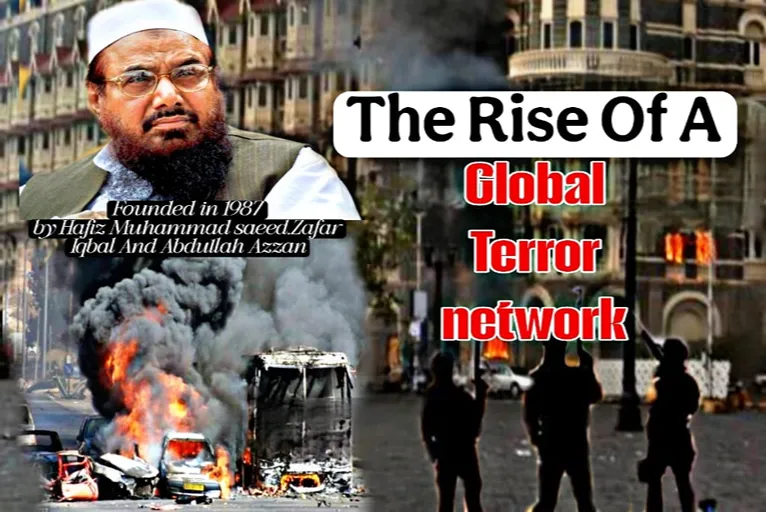

Few militant organisations have influenced South Asia’s security landscape as deeply as Lashkar-e-Taiba History reveals. What began as a small armed movement during the closing years of the Soviet-Afghan War later evolved into one of the world’s most scrutinised terrorist organisations. Over nearly four decades, the group has shaped counterterrorism policies, intensified India-Pakistan tensions, and drawn sustained international attention.
Its evolution also reflects broader geopolitical shifts. Regional conflicts, ideological movements, and international security responses have all played a role in its growth and transformation. Understanding Lashkar-e-Taiba’s history therefore provides important context for many of today’s security challenges.
History Of LeT
Lashkar-e-Taiba, meaning “Army of the Pure,” was established in 1987 by Hafiz Muhammad Saeed, Zafar Iqbal, and the Palestinian scholar Abdullah Azzam. The organisation emerged through Markaz al-Dawa wal-Irshad (MDI), a religious and missionary organisation founded near Lahore, Pakistan.
Its creation coincided with the final years of the Soviet-Afghan War. During that conflict, thousands of foreign volunteers joined the Afghan resistance against Soviet forces. After the Soviet withdrawal, several militant groups redirected their attention toward other regional conflicts. Lashkar-e-Taiba gradually shifted its operational focus toward Jammu and Kashmir, where an armed insurgency had intensified after 1989.
Unlike some militant organisations that focused on local political grievances, Lashkar-e-Taiba combined territorial objectives with a broader religious ideology rooted in the Ahl-e-Hadith tradition. According to its own publications over the years, the organisation viewed armed jihad as a central part of its mission.
LeT’s Goals and Ideology?
The organisation’s primary declared objective has long been opposing Indian control over Jammu and Kashmir. However, its ideological literature has also expressed broader ambitions extending beyond the region.
Several themes have consistently appeared throughout its history:
- Promotion of Ahl-e-Hadith religious teachings.
- Armed jihad as a strategic tool.
- Opposition to Indian administration in Jammu and Kashmir.
- Expansion of its religious and political influence.
Although analysts often compare Lashkar-e-Taiba with organisations such as al-Qaeda or ISIS, important differences exist. Al-Qaeda has traditionally focused on global attacks against Western interests, while ISIS sought to establish a territorial caliphate. In contrast, Lashkar-e-Taiba has historically concentrated most of its military operations on India, particularly Jammu and Kashmir.
The Expansion of LeT
During the 1990s, the organisation expanded rapidly. It developed recruitment networks, training camps, religious institutions, and charitable activities. These parallel structures helped increase its influence while strengthening logistical support.
Following Pakistan’s ban on Lashkar-e-Taiba in 2002, much of its public activity became associated with Jamaat-ud-Dawa (JuD). India, the United States, and the United Nations have described JuD as an organisation linked to or operating on behalf of Lashkar-e-Taiba. Pakistan has maintained that JuD functioned separately as a charitable organisation, although it later imposed restrictions following international pressure.
International counterterrorism agencies have also identified Falah-e-Insaniat Foundation (FIF) as another associated entity. Consequently, both organisations became subject to United Nations sanctions.
Major Terrorist Attacks
Lashkar-e-Taiba has been linked to numerous attacks over the past three decades. While responsibility for some incidents remains disputed, investigators have attributed several major operations to the organisation or its operatives.
Below are the most significant operations associated with LeT.
| Year | Operation / Attack | Location | Outcome |
|---|---|---|---|
| 1990s | Cross-border infiltration campaign | Jammu & Kashmir | Supported the insurgency through infiltration, attacks on security forces, and recruitment. |
| 1998 | Wandhama massacre | Ganderbal, Kashmir | 23 Kashmiri Pandits killed; India attributed the attack to LeT. |
| 2000 | Red Fort attack | Delhi | Three people killed after militants attacked the historic Red Fort. |
| 2001 | Indian Parliament attack* | New Delhi | India attributed the attack jointly to LeT and Jaish-e-Mohammed; it triggered a major India-Pakistan military standoff. |
| 2002 | Kaluchak massacre | Jammu | Militants attacked a bus and military family quarters, killing 31 people, including women and children. |
| 2005 | Ayodhya attack | Uttar Pradesh | Security forces repelled the attack; all attackers were killed. India linked the attackers to Pakistan-based groups, including LeT. |
| 2006 | Mumbai suburban train bombings | Mumbai | More than 180 people were killed. India accused LeT of involvement alongside other militant networks. |
| 2008 | 26/11 Mumbai attacks | Mumbai | Ten LeT gunmen killed 166 people in coordinated attacks across the city. This is LeT’s deadliest and most internationally recognised operation. |
| 2015 | Gurdaspur attack | Punjab | India alleged LeT involvement; attribution has been debated. |
| 2016 | Uri attack | Uri, Jammu & Kashmir | India attributed the attack to Pakistan-based militants; LeT was among the groups investigated, though Jaish-e-Mohammed was also considered in public reporting. |
| 2018–2020 | Infiltration attempts and encounters | Jammu & Kashmir | Numerous gun battles, infiltration attempts, targeted killings, and arrests involving alleged LeT militants. |
| April 2025 | Pahalgam attack (through TRF, according to India) | Jammu & Kashmir | India alleges The Resistance Front (TRF), which it describes as an LeT proxy, carried out the attack that killed 26 civilians. |
The 26/11 Mumbai attacks remain the organisation’s most notorious operation. Ten gunmen arrived by sea and targeted hotels, transport hubs, and public locations across Mumbai. The attack lasted nearly three days and transformed international counterterrorism cooperation.
Investigations by India, the United States, and several international agencies concluded that Lashkar-e-Taiba members planned and directed the operation. The testimony of David Headley and the capture of Ajmal Kasab became key elements in the investigation.
How the Organisation Has Evolved
Over time, Lashkar-e-Taiba has adapted to changing political and security conditions. Rather than operating solely as an armed organisation, it developed networks involving education, charity, recruitment, and public outreach.
Analysts have also observed the emergence of newer groups, including The Resistance Front (TRF). Indian authorities and several international governments describe TRF as an offshoot or proxy of Lashkar-e-Taiba. TRF gained international attention after claiming responsibility for the 2025 Pahalgam attack, although it later withdrew the claim.
Meanwhile, the 2019 Pulwama suicide bombing was claimed by Jaish-e-Mohammed (JeM) rather than Lashkar-e-Taiba. Distinguishing between these organisations remains important because they have different leadership structures despite sharing similar operational theatres.
What Could the Future Hold?
Although Lashkar-e-Taiba faces international sanctions and domestic restrictions, security analysts generally agree that its ideology and organisational networks continue to influence militant activity in South Asia. Future challenges will likely involve digital recruitment, encrypted communications, financial monitoring, and the identification of proxy groups. Therefore, regional intelligence cooperation will remain essential to counter evolving threats.
At the same time, diplomatic engagement between India and Pakistan will continue to shape the broader security environment surrounding cross-border militancy.
Conclusion
The story of Lashkar-e-Taiba is not only the story of one militant organisation. It also reflects decades of regional conflict, ideological mobilisation, and evolving counterterrorism strategies. Since its formation in 1987, the organisation has transformed from a Kashmir-focused militant group into a globally sanctioned terrorist network whose actions have influenced security policies across continents.
Although governments have strengthened legal frameworks and intelligence cooperation, the organisation’s legacy continues to affect regional stability. Understanding its history therefore remains essential for analysing South Asia’s security challenges and the wider fight against transnational terrorism.
FAQ
Who founded Lashkar-e-Taiba?
Lashkar-e-Taiba was founded in 1987 by Hafiz Muhammad Saeed, Zafar Iqbal, and Abdullah Azzam through Markaz al-Dawa wal-Irshad.
What does Lashkar-e-Taiba mean?
The name translates to “Army of the Pure.”
What was Lashkar-e-Taiba’s deadliest attack?
The 2008 Mumbai attacks (26/11) remain its deadliest and most internationally significant operation, killing 166 people.
Is Lashkar-e-Taiba still active?
The organisation remains banned and subject to international sanctions. However, security agencies continue to monitor individuals and groups alleged to be linked to its network.
How has the international community responded?
The United Nations and numerous countries have imposed sanctions, designated the group as a terrorist organisation, and strengthened intelligence cooperation to disrupt its operations.