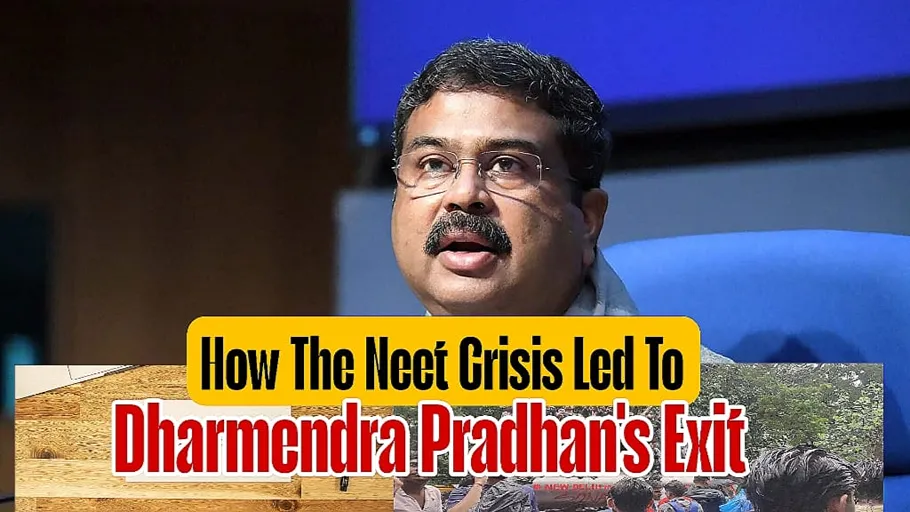

The Dharmendra Pradhan Resignation has become one of the biggest political developments in India’s education sector. His departure followed weeks of student protests, growing pressure over the NEET-UG 2026 controversy, and renewed debate over examination reforms. More importantly, the resignation has shifted attention from one minister to the broader challenge of restoring confidence in India’s competitive examination system.
For years, India’s education system has been viewed as a pillar of social mobility. However, recent examination controversies have raised serious questions about governance and institutional accountability. As a result, Dharmendra Pradhan’s resignation is being seen not only as a political decision but also as a test of the government’s ability to rebuild public trust.
Who Is Dharmendra Pradhan?
Dharmendra Pradhan is a senior Bharatiya Janata Party (BJP) leader from Odisha. Over the years, he has held several important ministerial portfolios. Before leading the Education Ministry, he served as Petroleum and Natural Gas Minister and later handled Skill Development and Entrepreneurship.
In July 2021, he became India’s Union Education Minister during a Cabinet reshuffle. His appointment came when the government was pushing major education reforms under the National Education Policy (NEP) 2020. Consequently, expectations were high that his tenure would modernise India’s education system while improving access and quality.
When Did He Become Union Education Minister?
Dharmendra Pradhan assumed office as Union Education Minister on 7 July 2021. Soon afterwards, he focused on implementing the National Education Policy across schools and universities. His ministry promoted digital learning platforms, encouraged multidisciplinary higher education, strengthened vocational education, and expanded international academic partnerships. Furthermore, reforms were introduced to improve research, innovation, and institutional autonomy.
Initially, these initiatives received positive attention. Nevertheless, examination management later became the defining issue of his tenure.
Key Achievements During His Tenure
During his time in office, several education reforms were introduced.
Some of his notable achievements included:
- Accelerating the implementation of the National Education Policy 2020.
- Expanding digital education through government learning platforms.
- Promoting multilingual education.
- Supporting research through higher education initiatives.
- Encouraging greater collaboration between Indian and foreign universities.
- Strengthening vocational and skill-based education.
Although these reforms shaped long-term policy, they were eventually overshadowed by repeated examination controversies.
The NEET Controversy That Triggered the Crisis
The turning point came with the NEET-UG 2026 controversy. However, concerns over the examination had already grown after the NEET-UG 2024 paper leak, when allegations of question paper leaks and examination irregularities triggered nationwide protests, court proceedings, and multiple investigations. The episode raised serious questions about the security of India’s competitive examinations. Despite reforms introduced after 2024, fresh allegations emerged following the NEET-UG 2026 examination. Authorities alleged that confidential examination material had circulated before the test, prompting renewed concerns over examination integrity. Consequently, demands for transparency and accountability intensified.
The Ministry of Education referred the matter for investigation, while central agencies examined allegations of criminal conspiracy, cheating, theft of confidential material, and destruction of evidence. The examination was eventually cancelled, and a fresh test was ordered. Although the investigation continued, many students argued that repeated examination controversies had weakened public trust in the system. As a result, the issue grew beyond an examination dispute and intensified calls for the Dharmendra Pradhan Resignation.
How the CJP Movement Expanded the Protests
The examination controversy soon evolved into a much broader movement.Initially, students demanded fair examinations and greater transparency. However, the CJP movement gradually expanded its demands to include institutional accountability, governance reforms, and stronger protection against future examination irregularities.
Large demonstrations were organised in several cities. Peaceful protests attracted students, parents, and education activists. As public attention increased, opposition parties also criticised the government’s handling of the crisis. Therefore, pressure shifted directly towards the Education Ministry and its leadership.
Why Students Demanded the Dharmendra Pradhan Resignation
Many students argued that ministerial accountability was necessary regardless of whether investigations ultimately identified individual offenders.
Their major demands included:
- Greater transparency in examination administration.
- Independent investigations into examination irregularities.
- Stronger safeguards against paper leaks.
- Institutional reforms within testing agencies.
- Political accountability for repeated examination controversies.
As protests continued, calls for the Dharmendra Pradhan Resignation became increasingly prominent. Eventually, the minister stepped down, stating that he accepted responsibility and did not want the controversy to continue affecting students’ futures.
Dharmendra Pradhan Resignation: Timeline of Key Events
| Date | Development |
|---|---|
| 7 July 2021 | Dharmendra Pradhan became Union Education Minister. |
| 2021–2025 | Implementation of major education reforms under NEP 2020 continued. |
| May 2026 | NEET-UG 2026 examination conducted. |
| Following weeks | Allegations regarding examination integrity emerged. |
| Government action | Investigation was initiated and the examination was cancelled. |
| Student protests | Demonstrations expanded across several cities. |
| July 2026 | Dharmendra Pradhan submitted his resignation as Education Minister. |
Government Response After the Resignation
Following the resignation, the government stated that investigations into the examination controversy would continue. At the same time, officials reiterated their commitment to improving examination security and strengthening institutional oversight. Discussions also began regarding additional safeguards for future competitive examinations. Consequently, attention has shifted from political accountability to long-term structural reform.
What Did Dharmendra Pradhan Write in His Resignation Letter?
In his resignation letter, Dharmendra Pradhan said he had accepted responsibility from the beginning of the controversy. He emphasised that students’ interests should remain the highest priority. He also argued that misinformation had influenced parts of the public debate. Nevertheless, he concluded that stepping down would allow the government to focus on restoring confidence in the education system.
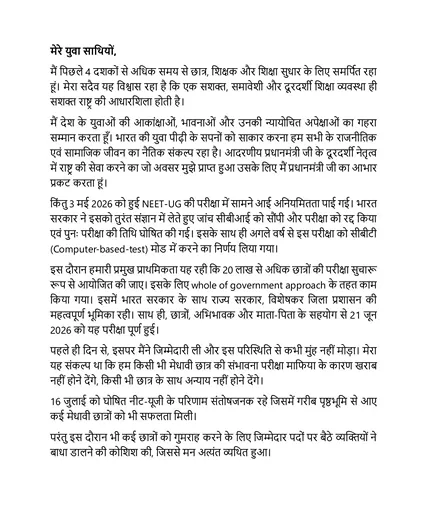
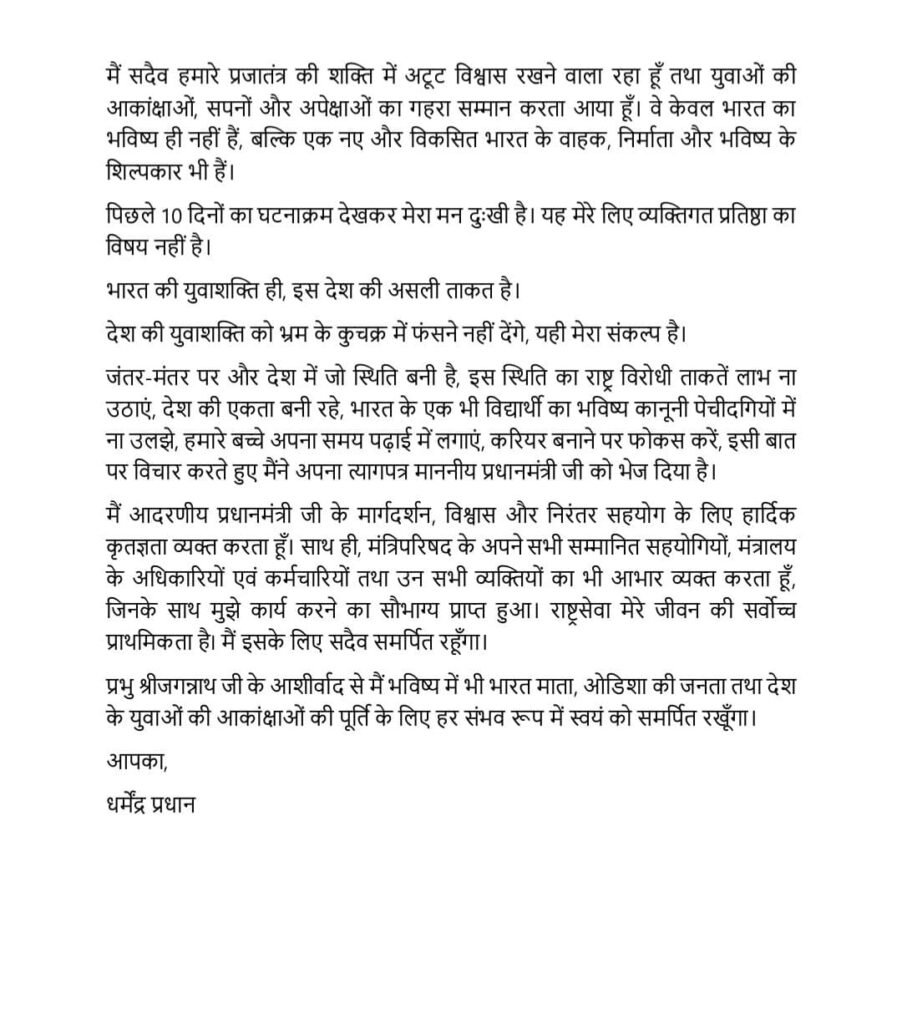
His letter attempted to balance political responsibility with reassurance for students awaiting reforms.
Geopolitical Implications of the Dharmendra Pradhan Resignation
Although the resignation concerns domestic politics, its implications extend beyond India’s borders. India hosts one of the world’s largest higher education systems and attracts increasing numbers of international academic partnerships. Consequently, examination credibility influences India’s global educational reputation.
Furthermore, international universities increasingly collaborate with Indian institutions. A transparent examination system supports academic mobility, student exchanges, and research partnerships. At the same time, multinational employers closely monitor the reliability of India’s education and recruitment systems. Therefore, maintaining examination integrity also supports India’s economic competitiveness.
Conclusion
The Dharmendra Pradhan Resignation represents more than the departure of one minister. Instead, it reflects the growing expectation that governments must remain accountable when public institutions face serious credibility challenges.
Although leadership has changed, the larger challenge remains unresolved. The government must now restore trust in competitive examinations while protecting the aspirations of millions of students. If meaningful reforms follow, this political crisis could become a turning point for India’s education system. Otherwise, public confidence may take much longer to recover.
FAQ
Why did Dharmendra Pradhan resign?
He resigned after sustained pressure following the NEET-UG 2026 controversy and widespread student protests demanding accountability.
When did Dharmendra Pradhan become Education Minister?
He became India’s Union Education Minister on 7 July 2021.
What was the NEET-UG 2026 controversy?
The controversy involved allegations that confidential examination material had circulated before the test, leading to investigations and cancellation of the examination.
What is the CJP movement?
The CJP movement is a student-led protest campaign that expanded from examination-related concerns to broader demands for education governance and institutional reforms.
What happens after Dharmendra Pradhan’s resignation?
The government is expected to appoint a new Education Minister while continuing investigations and pursuing examination reforms.
Author
I’m Gurmeet, a writer with over 1 years of writing experience. I have a deep interest in geopolitics, international affairs, and current events, and I enjoy exploring the stories and decisions that shape our world. Thank you for reading my work—I hope you find it informative and engaging.