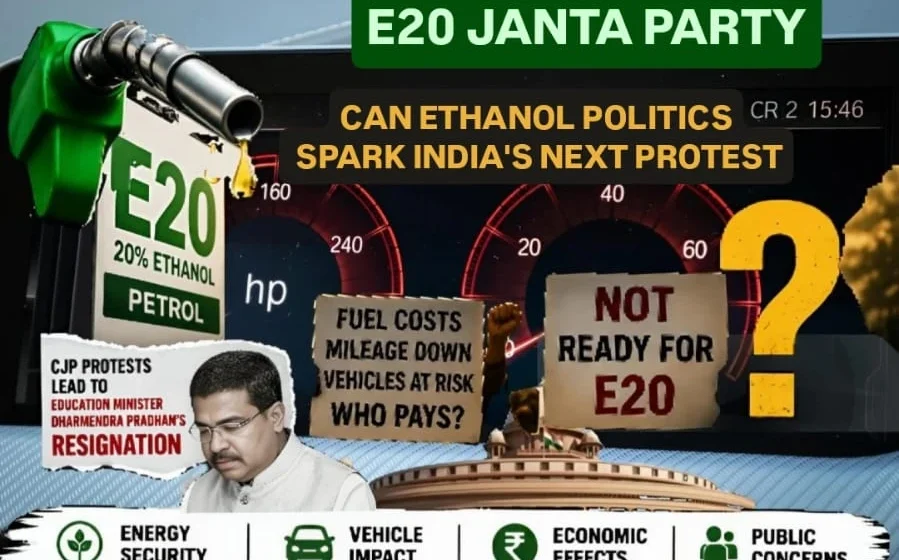

India’s fuel landscape is undergoing one of its biggest transformations, but the shift has also created a new public debate. As petrol stations across the country move towards E20 fuel, a blend containing 20% ethanol and 80% petrol, questions around affordability, vehicle compatibility, and long-term impact have started gaining attention.
The term E20 Janta Party has emerged in public discussions as a reference to growing concerns and conversations around ethanol-blended fuel. Unlike a traditional political party, it does not represent a registered organization. Instead, the phrase reflects a wider debate among citizens questioning whether India’s ethanol transition will benefit consumers or create new challenges.
After the Cockroach Janta Party (CJP) protests gained public attention and became a major political conversation leading to resignation of Education Minister Dharmendra Pradhan, some observers are asking whether fuel-related concerns could create another large-scale public movement. However, whether the E20 Janta Party debate becomes as influential as CJP will depend on how strongly public concerns develop, how consumers respond to the ethanol transition, and how effectively governments address these issues.
What Is E20 Janta Party?
The E20 Janta Party is not an officially registered political party. The term is being used online and in public discussions to describe the growing debate around India’s E20 ethanol fuel policy. At the center of the discussion is the government’s decision to increase ethanol blending in petrol. The policy aims to reduce dependence on imported crude oil, lower carbon emissions, and create additional income opportunities for farmers.
According to India’s Ministry of Petroleum and Natural Gas, the country has been working towards increasing ethanol blending under the Ethanol Blended Petrol (EBP) Program. Supporters argue that E20 is an important step towards energy security. Critics, however, have raised concerns about fuel efficiency, older vehicles, and whether consumers will bear hidden costs during the transition.
India’s Ethanol Fuel Timeline
India’s ethanol journey has developed gradually over several years.
| Year | Development |
|---|---|
| 2003 | India launched the Ethanol Blended Petrol Programme on a pilot basis |
| 2006 | Ethanol blending was expanded to more states |
| 2018 | National Policy on Biofuels was introduced with higher blending targets |
| 2020–21 | Government accelerated ethanol blending plans |
| 2022 | India achieved around 10% ethanol blending target ahead of schedule |
| 2023 | E20 petrol was launched at selected fuel stations |
| 2025–26 | E20 availability expanded across more parts of India |
The government originally planned to achieve 20% ethanol blending by 2030, but the target was advanced to 2025–26 due to faster progress in ethanol production.
Why Is India Moving Towards E20 Fuel?
India is promoting E20 fuel as part of its strategy to reduce dependence on imported crude oil and strengthen energy security. Since India imports a large share of its oil requirements, ethanol blending can help lower fuel import costs and reduce exposure to global crude oil price fluctuations.
The policy also aims to support farmers by creating additional demand for crops such as sugarcane and grains used in ethanol production. Along with economic benefits, the government highlights ethanol as a cleaner fuel option that can help reduce emissions and build a stronger domestic biofuel ecosystem.
Countries Using Ethanol-Blended Fuel
India is not the only country using ethanol blends in vehicles.
| Country | Common Ethanol Blend Usage |
| Brazil | E27 petrol is widely used; higher ethanol blends are also common |
| United States | E10 is widely available; E15 and E85 exist in certain markets |
| Canada | E10 and other ethanol blends are used |
| Argentina | Ethanol blending is used in petrol |
| Thailand | Ethanol-blended fuels such as E10 and E20 are available |
Brazil is often considered one of the leading examples of ethanol fuel adoption because of its long history with sugarcane-based ethanol.
E20 Fuel Impact on Indian Vehicles
One of the biggest concerns around E20 fuel is its impact on vehicles. While automobile manufacturers have developed newer models compatible with E20 standards, questions remain about older vehicles that were not designed for higher ethanol blends.
Ethanol has lower energy content than petrol, which may lead to a slight reduction in mileage. Experts have also raised concerns about possible effects on fuel system components, engine parts, and long-term maintenance in older vehicles. However, manufacturers maintain that E20-compatible vehicles are safe to use, and most concerns are focused on vehicles manufactured before the transition to higher ethanol blends.
Can E20 Janta Party Match CJP’s Impact?
The E20 Janta Party debate has drawn comparisons with the Cockroach Janta Party (CJP) because both gained attention through public discussions and online conversations. However, their foundations are different. While CJP emerged from political and social dissatisfaction, the E20 debate is centred around fuel policy, vehicle concerns, and economic impact.
For E20 to become as influential as CJP, it would need to move beyond online discussions and connect with the daily experiences of millions of vehicle owners. Concerns over mileage, fuel costs, and compatibility of older vehicles could increase public attention if they become widespread.
Since fuel directly affects commuters, transport workers, and businesses, any major consumer impact could turn the issue into a larger public debate. Social media discussions and political involvement could further shape its reach.At present, E20 Janta Party remains a policy debate rather than a mass movement. Whether it can become as big as CJP will depend on how consumers experience the E20 transition and how the government addresses public concerns.
Conclusion
The rise of the term E20 Janta Party reflects a growing public conversation around one of India’s biggest fuel policy changes. While E20 is designed to improve energy independence and support domestic ethanol production, its success will depend on how smoothly the transition affects ordinary consumers.
Unlike the CJP protests, which developed around political and social grievances, the E20 debate is currently centred on economic and practical concerns. Whether it becomes a major public movement will depend on future fuel prices, vehicle experiences, and public trust in the policy.
What is E20 Janta Party?
E20 Janta Party is a term used in public discussions around India’s E20 ethanol fuel transition. It is not an officially registered political party.
Is E20 fuel harmful for vehicles?
E20 fuel is designed for compatible vehicles. Concerns mainly exist regarding older vehicles that were not manufactured for higher ethanol blends.
Which countries use E20 fuel?
Countries including Brazil, Thailand, and some markets in other regions use ethanol-blended fuels, though exact blends vary.
Why is India introducing E20 petrol?
India aims to reduce crude oil imports, support farmers, promote biofuels, and improve energy security.
Can E20 become a major protest issue?
It depends on public reaction, vehicle-related concerns, economic impact, and how effectively the transition is managed.