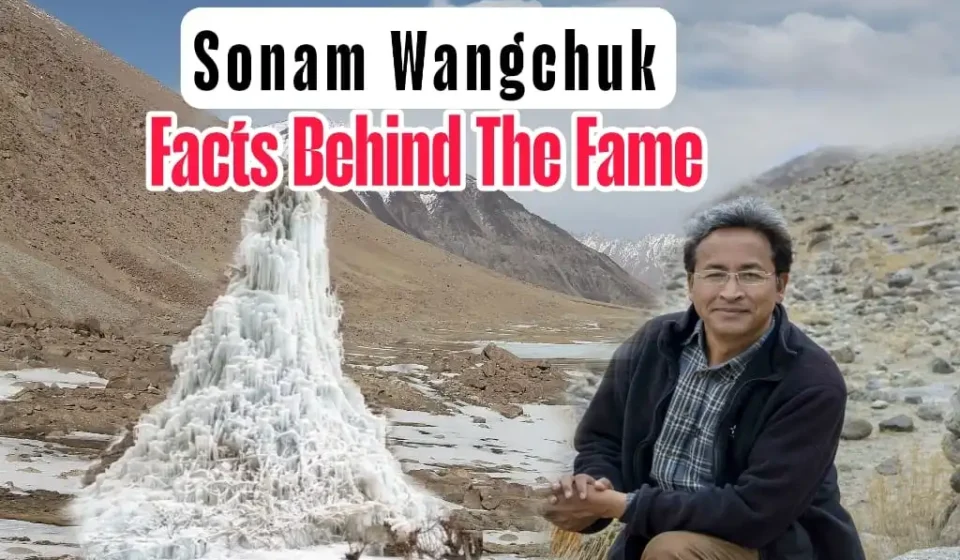

Sonam Wangchuk is one of India’s most recognized innovators, known for his work in education reform, sustainable development, and climate solutions for Ladakh. His image as the inspiration behind Rancho from 3 Idiots, the creator of artificial glaciers, and a revolutionary technologist has made him a household name.
However, the Sonam Wangchuk Reality is more detailed than the viral image surrounding him. While he has made important contributions through practical innovation and grassroots solutions, several popular claims about his work have been simplified or exaggerated over time.
From the Ice Stupa project to discussions around Li-Fi technology, understanding the difference between inventing an idea and adapting it for a specific purpose is important to understand his actual contribution.
Who Is Sonam Wangchuk?
Sonam Wangchuk is a Ladakh-based engineer, education reformer, innovator, and social activist. Born on September 1, 1966, in Ladakh, he grew up in a region where harsh climate conditions and limited resources influenced his approach toward problem-solving.
He studied mechanical engineering at the National Institute of Technology, Srinagar. In 1988, he founded the Students’ Educational and Cultural Movement of Ladakh (SECMOL), an organization focused on improving education methods for students in the region. SECMOL was created because Wangchuk believed that the existing education system often failed to connect with the social and environmental realities of Ladakh. The organization introduced practical learning methods where students gained skills beyond traditional classroom education.
Career Journey
Before becoming famous for environmental projects, Wangchuk’s primary focus was education reform. Through SECMOL, he worked on creating an alternative education model that encouraged creativity, responsibility, and practical learning. The organization became known for supporting students who struggled with conventional examination-based education.
His approach focused on making education more connected with real-life challenges, especially those faced by communities living in remote Himalayan regions. Over time, his work expanded from education to sustainability, climate adaptation, and local innovation.
Ice Stupa: Innovation Beyond the Myth
A common perception is that Sonam Wangchuk invented artificial glaciers, but the concept existed before his work. Ladakhi engineer Chewang Norphel had earlier developed artificial glacier techniques by diverting winter water into shaded areas where it froze and later melted during spring.
Wangchuk and his team adapted this idea into the Ice Stupa design — vertical cone-shaped ice structures that store winter water and release it slowly during warmer months. His contribution was not inventing artificial glaciers, but developing and popularizing a new approach suited to Ladakh’s water challenges.
However, the project has also faced criticism from some local residents in Ladakh. In certain areas, people raised concerns about issues such as water diversion, maintenance difficulties, and whether Ice Stupas were suitable for every location. Some local protests and opposition highlighted that community participation, and traditional water systems must be considered while implementing such projects.
Li-Fi: Innovation vs Attribution
A common misconception is that Sonam Wangchuk invented Li-Fi technology, but this is not accurate. Li-Fi (Light Fidelity) is a wireless communication technology that uses visible light to transmit data. The modern development of Li-Fi is widely associated with Professor Harald Haas of the University of Edinburgh, who demonstrated its potential using LED-based communication in 2011.
The concept of optical communication existed much earlier, with examples like Alexander Graham Bell’s Photophone (1880), which used light to transmit sound. Later developments in LEDs, fiber optics, and semiconductor technology contributed to modern Li-Fi.
Sonam Wangchuk’s connection with Li-Fi comes from his interest in applying emerging technologies to solve practical problems, especially in remote areas. His role has been more focused on adapting and using available technologies for community needs rather than inventing Li-Fi itself. The distinction highlights that innovation is often about applying existing ideas creatively to real-world challenges.
Awards and Recognitions
| Year | Award / Honour | Entity / Organisation |
|---|---|---|
| 1996 | Governor’s Medal for Educational Reform | Government of India |
| 2001 | Man of the Year | The Week |
| 2002 | Fellowship for Social Entrepreneurship | Ashoka |
| 2004 | Green Teacher Award | Sanctuary Asia |
| 2008 | Real Heroes Award | CNN-IBN |
| 2016 | Fred M. Packard Award | International Union for Conservation of Nature (IUCN) |
| 2016 | Rolex Awards for Enterprise | Rolex |
| 2017 | State Award for Outstanding Environmentalist | Government of Jammu and Kashmir |
| 2017 | Global Award for Sustainable Architecture | UNESCO |
| 2017 | Men of the Year Award – Social Entrepreneur of the Year | GQ |
| 2017 | Honor Award | Indians for Collective Action, San Francisco |
| 2018 | Eminent Technologist of the Himalayan Region | IIT Mandi |
| 2018 | Honorary D.Litt | Symbiosis International University |
| 2018 | Ramon Magsaysay Award | Ramon Magsaysay Award Foundation |
These awards helped establish Wangchuk as one of India’s most recognised social innovators.
The “Real Rancho” Connection
Sonam Wangchuk’s popularity increased significantly after people connected him with Rancho, the character played by Aamir Khan in 3 Idiots. The belief grew because of similarities between Wangchuk’s education philosophy and Rancho’s character.
However, Aamir Khan has clarified that Rancho was not based on Sonam Wangchuk and that the character was a fictional creation. While Wangchuk’s work reflects similar ideas of creative learning and innovation, his achievements stand independently of the film’s popularity.
Political Background
Sonam Wangchuk has never contested elections or held political office. His father, Sonam Wangyal, was a politician who served as a minister in the Jammu and Kashmir government and was involved in Ladakh’s political affairs.
Although Wangchuk chose education and innovation over electoral politics, he later became involved in public debates around Ladakh’s statehood, constitutional safeguards, environmental protection, and local representation.
Controversies and Activism
Sonam Wangchuk’s journey from innovation to activism has placed him at the centre of debates around Ladakh’s political demands, environmental concerns, and public protests.
2019 onwards: After Ladakh became a Union Territory without a legislative assembly, Wangchuk supported demands for statehood and Sixth Schedule protections, arguing they were needed to protect local rights, culture, and the fragile Himalayan ecosystem.
2023–2024: His organization SECMOL faced an FCRA controversy after its foreign funding registration was suspended by the government over alleged regulatory issues. SECMOL disputed the action and maintained that it had complied with the rules. The controversy also drew attention amid broader debates around India’s foreign funding regulations and the proposed FCRA 2026 amendments, which could introduce further changes to the framework governing foreign contributions.
March 2024: Wangchuk held a 21-day hunger strike at Delhi’s Jantar Mantar demanding constitutional safeguards for Ladakh. The protest was separate from the NEET-UG protests, which focused on exam irregularities and paper leak allegations.
September 2024: During the “Delhi Chalo” march, Wangchuk and other protesters were detained by Delhi Police over public gathering restrictions, leading to debate over the handling of peaceful demonstrations.
Ice Stupa Debate: Although globally recognised, the Ice Stupa project faced criticism from some local voices over maintenance, water management, and long-term effectiveness, while supporters defended it as a targeted climate solution.
Public Protest Debates: Movements and protests around issues such as education, youth concerns, and government accountability — including NEET-related demonstrations and satirical movements like the Cockroach Janta Party — contributed to wider discussions about public activism, although these were separate from Wangchuk’s Ladakh campaign. The protests became a turning point, eventually leading to the resignation of Education Minister Dharmendra Pradhan.
Together, these controversies show the broader debate around Ladakh’s future, environmental protection, governance, and the role of activists in public life.
1. Did Sonam Wangchuk invent artificial glaciers?
No. Artificial glacier concepts existed before his work. His contribution was developing and promoting the Ice Stupa technique for Ladakh’s conditions.
2. Who invented Li-Fi technology?
Modern Li-Fi development is widely associated with Professor Harald Haas. The technology also has roots in earlier optical communication research.
3. Why is Sonam Wangchuk famous?
He is known for education reform through SECMOL, the Ice Stupa project, sustainability work, and activism related to Ladakh.
4. Did Sonam Wangchuk inspire Rancho from 3 Idiots?
He is widely believed to have influenced some aspects of Rancho’s character, but Rancho is a fictional creation.
5. Is Sonam Wangchuk a politician?
No. He has not joined electoral politics but participates in public discussions and movements related to Ladakh.