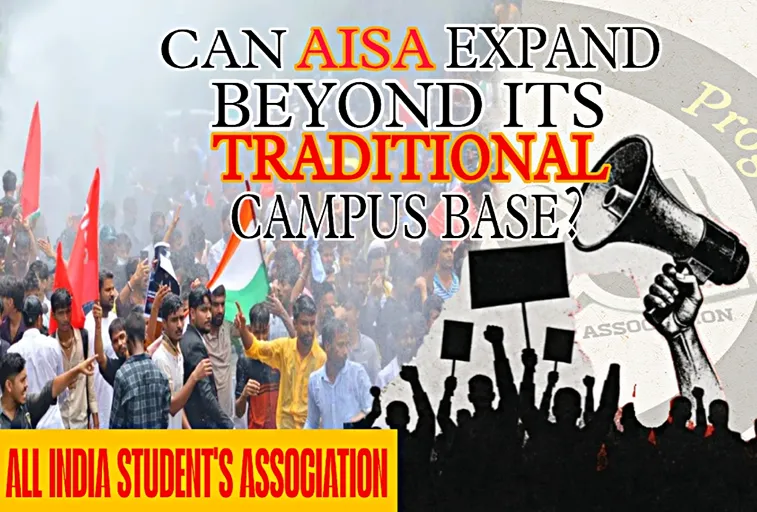

Student politics can often become a testing ground for India’s wider political battles. The All India Students Association has built its identity through campus activism. Now, its growing presence in public protests is raising a larger question. Can a campus-based organisation turn student mobilisation into wider political influence?
The question has gained fresh relevance in 2026. AISA has appeared in protests over examination irregularities, education policy and democratic rights. Its leadership has also become more visible outside university campuses.
AISA’s Origins and Political Identity
The All India Students Association (AISA) was founded on August 9, 1990, at Allahabad University. It emerged during a period of major political and economic change in India. The organisation describes itself as a revolutionary student movement. Its stated programme focuses on public education, campus democracy and opposition to privatisation. It also connects student issues with wider social and political struggles.
AISA is affiliated with the Communist Party of India (Marxist-Leninist) Liberation. Therefore, its politics have traditionally been rooted in India’s broader Left movement. According to its official programme, AISA opposes the commercialisation of education. It also supports education and employment as fundamental rights. These positions have shaped its campaigns across universities.
AISA’s Development: From Campus Politics to Wider Influence
| Year | Key Development | Why It Matters |
|---|---|---|
| 1990s | AISA began expanding its student network across universities after its formation. | Its focus on education, student rights and campus democracy helped establish its political identity. |
| Early 2000s | AISA strengthened its presence in politically active universities, particularly JNU. | JNU became an important platform for the organisation’s Left-oriented student politics. |
| 2010s | Campus campaigns increasingly addressed wider issues such as social justice, education policy and democratic rights. | AISA’s activism began connecting university concerns with broader national debates. |
| Late 2010s–Early 2020s | Student politics became increasingly shaped by debates over education reforms, fees, employment and political rights. | AISA sought to position student concerns within larger national political movements. |
| 2020s | Digital platforms became increasingly important for political communication and student mobilisation. | Online outreach created opportunities to engage students beyond AISA’s traditional campus networks. |
| 2025 | AISA remained an important force in JNU student politics while facing competition from ABVP and other student organisations. | The competition highlighted the changing balance of power within India’s major university campuses. |
| 2025 | AISA and its allies continued attempting to build influence beyond traditional Left strongholds, including campuses such as Punjab University. | Expansion became a test of whether its political appeal could travel to different student communities. |
| 2025–26 | The organisation continued raising issues involving examinations, education, employment and democratic rights. | These concerns provided potential links between campus activism and the wider problems facing young Indians. |
| 2026 | AISA faces the challenge of adapting its traditional Left politics to a younger and increasingly digital student population. | Its future influence will depend on whether it can broaden its appeal beyond established political campuses. |
JNU Became AISA’s Major Political Platform
Few campuses have shaped AISA’s public identity as strongly as Jawaharlal Nehru University. JNU has historically been one of India’s most politically active universities. Left organisations have maintained a strong presence there for decades. AISA has consequently used the campus as an important platform for student mobilisation. However, JNU politics have never remained static.
In the April 2025 JNUSU elections, AISA and the Democratic Students’ Front formed an alliance. The alliance won three of the four central posts. An AISA candidate, Nitish Kumar, became president. At the same time, ABVP returned to the central panel after a long absence.
The November 2025 JNUSU election produced another important development. A Left alliance secured all four central panel positions, with AISA’s Aditi Mishra becoming president. These results show that AISA remains politically relevant at JNU. Yet, national influence cannot be measured through one university alone.
The Battle for AISA’s Next Generation of Support
AISA’s future will depend not only on its ideological identity, but also on how effectively it responds to changing student priorities. Young Indians are increasingly concerned with employment, competitive examinations, education costs, technology and career opportunities. These concerns can create a wider political base if they are addressed through practical and accessible campaigns.
At the same time, AISA faces strong competition from organisations such as ABVP, SFI and NSUI, along with independent student groups. Each has its own political networks and methods of mobilisation. At JNU, competition within the Left has also affected student politics. AISA and SFI have contested separately at times, although broader alliances have also been formed.
This competitive environment could push AISA toward a more issue-driven approach. Instead of relying mainly on ideological messaging, campaigns focused on examinations, employment and access to education could help the organisation connect with students who are less politically aligned.
Digital mobilisation will be another important factor. Social media has changed how student organisations communicate, organise protests and reach audiences beyond university campuses. AISA already uses online platforms for campaigns and membership outreach. However, simply maintaining a digital presence may not be enough. Its messaging will need to compete with rival organisations in an increasingly crowded online political space.
The larger challenge is therefore one of adaptation. AISA must preserve the political identity that has sustained it while finding ways to engage students whose priorities are increasingly shaped by careers, economic pressures and digital culture.
If it can balance ideological continuity with practical student concerns, AISA could strengthen its position beyond traditional Left strongholds. If not, competition from better-established student organisations could limit its ability to expand.
From Campus Activism to National Political Influence
AISA’s significance extends beyond student union elections. Its campus activism can also serve as a pathway into wider political and public life. JNU has historically provided an important platform for student leaders who later entered mainstream politics. Former JNU Students’ Union president Dhananjay, for example, contested the 2025 Bihar Assembly election on a CPI(ML) Liberation ticket. His political journey illustrates how experience gained through student organisations can later be carried into electoral politics.
However, AISA’s influence is not limited to producing political leaders. Its campaigns have increasingly addressed issues that connect campus concerns with national and international debates. The organisation has taken positions on subjects such as the Palestine conflict, democratic rights and international student movements. Such positions place AISA within a broader tradition of student activism that links domestic politics with global developments.
This matters because universities are increasingly becoming spaces where young people debate war, human rights, nationalism, inequality and foreign policy. Student organisations can help shape these discussions, particularly among politically engaged sections of the younger generation. For AISA, this creates both an opportunity and a challenge. Its international and domestic campaigns can increase its visibility beyond campuses. However, broader influence will depend on whether those positions can be connected with issues that directly affect students, including education, employment, examinations and economic opportunity.
The organisation’s future influence, therefore, should not be measured only through election victories. Its ability to build political networks, develop future leaders and participate in wider public debates could prove equally important. If AISA succeeds in connecting campus concerns with the priorities of a new generation, its role could extend well beyond traditional student politics.
Can AISA Move Beyond Its Traditional Base?
The answer will depend on three factors.
- Issue expansion will be crucial. Education must remain central, but employment and examination reform could provide wider entry points.
- Digital outreach will determine whether AISA can compete for attention beyond politically active campuses.
- Organisational expansion will be essential. AISA’s presence across multiple states provides a foundation, but stronger local networks will be required for sustained growth. Its official membership platform lists states and institutions across India, indicating an existing national organisational structure.
Recent developments suggest that expansion is already being attempted. AISA entered Panjab University campus politics in 2025, seeking to establish itself in a competitive student environment outside its traditional strongholds. That move is significant because expansion into new campuses can test whether its political model travels beyond JNU.
What Comes Next for AISA?
AISA enters its next phase with both advantages and limitations. Its long history gives it an established political identity. Its JNU presence provides visibility. Its wider campaigns offer opportunities to connect with students facing practical problems. Yet, expansion will require more than ideological consistency.
The organisation will need to demonstrate that its politics can address the priorities of a changing student population. It will also need to compete effectively against better-established rivals across India’s increasingly diverse campus landscape.
For AISA, the central question is no longer simply whether it can remain influential at JNU. The bigger test is whether its campus politics can become a broader youth movement. That outcome could shape not only AISA’s future, but also India’s evolving student politics.
FAQ
How has AISA developed beyond campus activism?
AISA has gradually expanded its campaigns from university-specific issues to wider debates involving education, employment, democratic rights and social justice. Its participation in national campaigns has increased its visibility beyond student elections.
Why is JNU important to AISA’s political influence?
JNU has been an important centre of Left student politics and has provided AISA with significant visibility. Its performance in JNU elections has also helped shape perceptions of the organisation’s wider political strength.
Is AISA trying to expand beyond its traditional campuses?
Yes. AISA has sought to strengthen its presence beyond established Left strongholds. Its activities at campuses such as Panjab University reflect efforts to reach new student communities and test its wider organisational appeal.
How could AISA’s politics change among younger students?
AISA may need to place greater emphasis on practical concerns such as employment, competitive examinations, education costs and digital participation. These issues could help it connect with students who are less engaged with traditional ideological politics.
Can AISA influence politics beyond student elections?
Its influence could extend through political leadership, public campaigns and debates on national and international issues. However, sustained influence will depend on its ability to build wider networks and connect its ideological positions with the everyday concerns of young people.