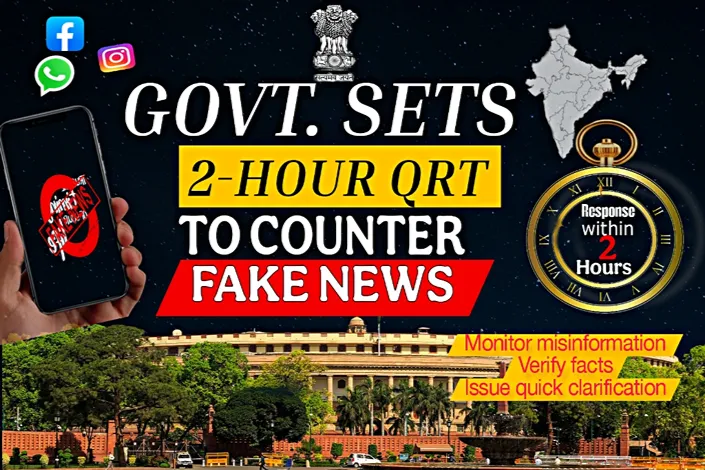

Fake news can travel across India in minutes. A government clarification, however, can take much longer to reach the same audience. That gap is now being targeted through India fake news QRTs, as government departments establish Quick Response Teams to counter misleading digital content. The teams are expected to identify, verify and respond to problematic social-media content rapidly.
Officials have indicated that responses should ideally be issued within two hours of the content being brought to attention. The move signals a shift in government communication. Instead of responding only after misinformation becomes widespread, ministries are being encouraged to build a faster institutional response.
Why India Is Building QRTs: How the New System Will Work
Social media has transformed the speed of information warfare. Misleading videos, recycled footage, edited images and AI-generated content can spread widely before authorities verify the facts. Against this backdrop, India fake news Quick Response Teams are being positioned as an early-response system to identify questionable content and establish the government’s factual position.
The move also reflects growing concerns over AI-generated misinformation. A parliamentary committee has called for stronger coordination among government bodies to tackle AI-generated fake news and related technological challenges. The government already has the PIB Fact Check Unit, which verifies claims using authoritative government sources and coordinates with concerned ministries.
The QRT process is expected to work through four key stages:
1. Detection
Potentially misleading posts can first be identified through social-media monitoring and digital conversations. The content may involve government schemes, policy decisions, official announcements or other public-interest matters.
2. Verification
Once a claim is flagged, the relevant ministry can be consulted. The information can then be compared with official documents, government websites, notifications and other authoritative sources. This stage is important because not every inaccurate-looking post is necessarily fake. Some claims may contain genuine information but present it without the proper context.
3. Response
After verification, the concerned department can prepare a factual clarification. The reported target is an ideal two-hour response window. However, the two-hour figure should not be treated as a guarantee for every case. Complex or sensitive claims may require additional verification before an official response is issued.
4. Coordination
More complicated or high-impact cases can involve ministry communication teams and the PIB Fact Check Unit. This could help coordinate responses when a claim involves multiple government departments. The broader objective is straightforward: shorten the gap between the spread of misinformation and the government’s factual response.
- Why Safed Sagar Still Matters 27 Years Later
- Banking for Youth: Sitharaman Calls for Month-Long PSB Campaign From October 2
- Declassified: Operation Sindoor- 34 Targets, 9 Strikes and the Secrets Revealed
- Ladli Behna Yojana: Who Benefits and What Comes Next?
- A Ramp Walk, a New Identity and Bastar’s Harder Battle
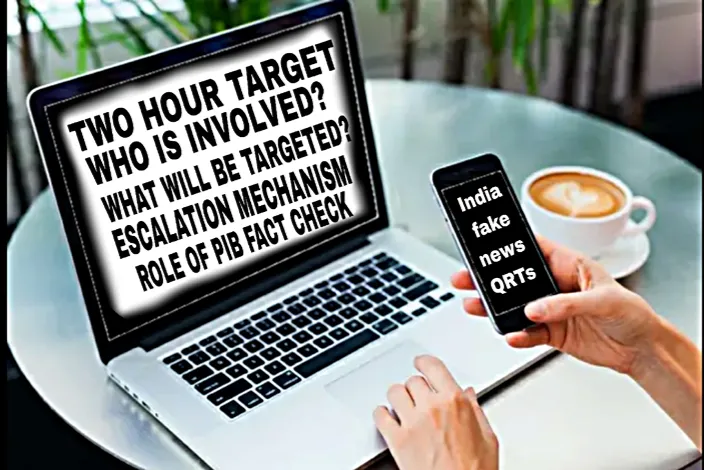
What the Two-Hour Target Means, Who Is Involved and What Will Be Targeted?
The two-hour target is designed to make government responses more timely when misleading content begins gaining attention. It is an ideal response window, rather than a guarantee that every claim will be resolved within two hours. The time required may vary depending on the complexity and sensitivity of the claim.
The system is being introduced across government departments. Reports indicate that Power, Agriculture and Commerce have already constituted QRTs, while other departments are expected to establish similar teams. A ministry-specific structure could also improve the quality of responses. Officials with subject expertise can assess claims related to their respective sectors instead of relying entirely on a centralised fact-checking process.
The QRTs are expected to focus on fake, misleading, manipulated, factually incorrect and distorted content, including material presented without proper context. This could cover recycled videos, miscaptioned photographs, altered visuals and AI-generated material. For example, an authentic photograph could be falsely linked to a recent event, while an old video could be presented as current. The PIB Fact Check Unit already classifies verified claims as Fake, Misleading or True. QRTs could therefore strengthen the ministry-level response by identifying and addressing problematic content within their respective areas.
How QRTs Will Escalate Cases and Work With PIB Fact Check
Not every misinformation case presents the same level of risk. A false claim about a government scheme differs significantly from content involving national security, communal tension, military operations or a national emergency. For that reason, serious or highly viral cases may require escalation beyond the concerned ministry. Claims involving multiple departments could also require wider coordination before an official response is issued. This could make India fake news QRTs part of a broader government information-response system rather than standalone communication teams.
The PIB Fact Check Unit can play a supporting role in this structure. Its established process involves researching claims through authoritative government sources and coordinating with the concerned ministry for verification. Under the QRT model, ministry teams could provide sector-specific expertise, while PIB Fact Check could assist with broader verification and public communication when required. This division could help responses remain both specialised and coordinated.
The model could also become important during geopolitical crises. Conflicts, military operations and diplomatic tensions often create an information vacuum that can quickly be filled by false claims, manipulated visuals or recycled footage. During Operation Sindoor, for example, PIB Fact Check issued warnings about false and manipulated content circulating online. A faster ministry-level response could help address similar claims before they gain wider traction.
However, the system’s credibility will depend on how it handles sensitive information. Fact-checking must focus on verifiable evidence rather than political disagreement. If that balance is maintained, QRTs could strengthen India’s crisis communication without turning every government-critical claim into a misinformation case.

Can India’s QRTs Beat Virality?
India’s QRT initiative reflects a growing gap between the speed of online information and traditional government communication. A misleading claim can gain traction within minutes, making a delayed response increasingly difficult to correct. The two-hour target is intended to narrow that gap. However, speed alone will not determine whether India fake news QRTs succeed. Their effectiveness will depend on three factors: accuracy, reach and response time.
A correction must first be properly verified. It must then reach the same audiences exposed to the original claim. Otherwise, even a fast response may have limited impact. This challenge could become greater with the rapid development of generative AI. Convincing fake videos, images and audio can make misinformation harder to identify and easier to circulate.
Therefore, ministries will need trained personnel, effective monitoring systems and clear coordination channels. The QRT model could strengthen India’s digital crisis communication, but its long-term success will depend on whether speed can be achieved without sacrificing credibility.In the information battle, responding quickly matters. Being trusted may matter even more.
FAQs
What are QRTs in the Indian government?
QRTs, or Quick Response Teams, are ministry-level teams designed to rapidly identify, verify and respond to misleading or fake social-media content.
What is the two-hour QRT target?
The reported target is for an appropriate response to be issued ideally within two hours after misleading content is brought to the department’s attention.
Which ministries have established QRTs?
Reports say departments including Power, Agriculture and Commerce have already constituted QRTs. Other departments are expected to follow.
What role will PIB Fact Check play?
PIB Fact Check can assist with verification and public fact-checking. Its established process relies on authoritative government sources and coordination with concerned ministries.
Will every critical social-media post be treated as fake news?
No. The stated focus is on content that is fake, misleading, factually incorrect, manipulated or distorted. Legitimate criticism is not automatically misinformation.