
India vs Pakistan: Rivalry Born in Partition
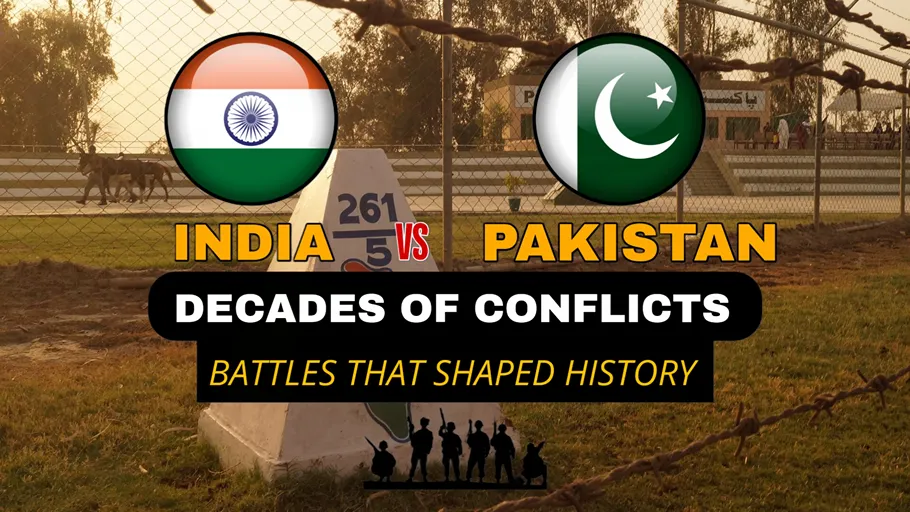
South Asia has lived with a military rivalry that began within months of Partition and never left the strategic map. India and Pakistan have fought wars in 1947–48, 1965, 1971 and 1999, while crises, cross-border firing and limited strikes have tested the nuclear threshold. The story is not only about victories, defeats or weapons; it is about how two states built identities, security doctrines and foreign policies around a dispute. That is why India Pakistan Military Power remains a subject watched far beyond the subcontinent.
Today, the conventional balance is considerably wider in India’s favour, but Pakistan retains advantages in selected land systems and a nuclear deterrent that blocks any simple reading. India Pakistan Military Power is best understood directly through the relationship between military capacity, geography, economics and political objectives. The lessons of past wars also matter because every conflict changed what the next confrontation looked like.
The 1947–48 war created a divided battlefield in Jammu and Kashmir; the 1965 war pushed both sides toward a diplomatic settlement; the 1971 war transformed South Asia through Bangladesh’s creation; and Kargil in 1999 showed how a limited conflict could become an international crisis even after both states acquired nuclear weapons. An important official reference is the Ministry of External Affairs’ text of the Simla Agreement, which set out a bilateral framework after the 1971 war. India Pakistan Military Power is thus not merely a ranking. It is the product of seven decades of conflict, state-building and strategic adaptation.
History of India-Pakistan Wars: Four Conflicts That Changed South Asia
The history of India Pakistan Military Power begins with the 1947–48 war after Partition, centred on the Kashmir crisis. The conflict ended with a UN-backed ceasefire on 1 January 1949, leaving Kashmir divided between the two countries and establishing a ceasefire line that later evolved into the Line of Control. UN military observers were deployed from 1949, marking the international dimension of the dispute. The 1965 war followed, with fighting spreading beyond Kashmir into areas along the international border. The conflict ended without a decisive territorial settlement, followed by the Tashkent Declaration in January 1966.
The 1971 war was a major turning point because its central issue was the political and military crisis in East Pakistan. India intervened alongside the Bangladesh liberation movement, and the conflict ended with the surrender of Pakistani forces in Dhaka and the creation of Bangladesh. Indian government records put the number of Pakistani personnel involved in the surrender at around 93,000. Unlike the earlier wars, Kargil in 1999 was a limited high-altitude conflict, after Pakistani forces and irregulars occupied positions on the Indian side of the Line of Control.
India launched Operation Vijay to recapture the occupied positions and largely kept the conflict confined to its side of the LoC. International diplomatic pressure also played an important role in ending the confrontation and securing Pakistan’s withdrawal. Together, the four major conflicts transformed India Pakistan Military Power, influencing military doctrines, defence planning and strategic thinking across South Asia. Each war introduced new lessons about geography, logistics, air power, intelligence and diplomacy, shaping the security relationship between the two nuclear-armed neighbours for decades.
How Wars Shaped India and Pakistan
Wars did more than redraw military maps; they transformed how India and Pakistan understood national security. For India, the 1947–48 war reinforced the need for a strong standing military, while the 1965 conflict exposed gaps in readiness, logistics and equipment. The 1971 war became the most significant turning point, as Bangladesh emerged as an independent nation and India demonstrated effective coordination between its Army, Navy and Air Force. The Simla Agreement later established a new framework for managing bilateral disputes. These developments played an important role in shaping India Pakistan Military Power and India’s long-term defence strategy.
Nuclear weapons did not end conventional conflict; instead, they made intelligence, precision strikes, air power and escalation control even more important. India Pakistan Military Power therefore evolved from a traditional contest over manpower and military platforms into a broader competition involving missiles, air defence, cyber capabilities, naval strength and economic resilience. India’s ability to combine military action with diplomatic restraint also strengthened its strategic image, particularly during crises that carried wider nuclear risks.
The 2025 armed clash again highlighted the dangers of conflict between two nuclear-armed neighbours, with both sides taking steps to avoid uncontrolled escalation. India Pakistan Military Power has therefore never depended on weapons alone. Institutions, geography, economic strength, technology, strategy and political decisions all shape the balance. Over decades, repeated conflicts also increased defence preparedness, encouraged modernisation and made national security a central priority for both countries. Ultimately, the evolution of India Pakistan Military Power reflects not only military competition but also the changing strategic realities of South Asia.
India Pakistan Military Power: Who Has the Edge in 2026?
On conventional measures, the India Pakistan Military Power balance is strongly tilted toward India, although important differences remain across individual capabilities. Global Firepower’s 2026 assessment ranks India fourth among 145 countries, while Pakistan ranks 14th. India is also listed with around 1.431 million active personnel compared with Pakistan’s 660,000, giving India a major advantage in manpower and overall force structure.
India also holds a significant advantage in air and naval strength. Global Firepower lists 2,183 Indian aircraft compared with 1,397 for Pakistan, including 476 Indian fighter aircraft against 331 Pakistani fighters. India has 343 naval vessels compared with Pakistan’s 120. India Pakistan Military Power therefore extends beyond land forces, with India possessing greater maritime reach and a broader ability to operate across the Indian Ocean region.
Pakistan, however, maintains important strengths in selected areas. Its 2026 inventory includes 662 self-propelled artillery systems and 652 mobile rocket launchers, both above India’s listed figures. Financial resources create another major gap: SIPRI estimates India spent $92.1 billion on defence in 2025, compared with Pakistan’s $11.9 billion. This gives India greater capacity for long-term procurement, research and modernisation, while Pakistan remains a significant military power due to its geography, artillery, missile capabilities, air force and nuclear deterrence.
| Military indicator | India | Pakistan |
|---|---|---|
| Global Firepower 2026 rank | 4 | 14 |
| Active personnel | 1,431,000 | 660,000 |
| Reserve personnel | 1,000,000 | 550,000 |
| Total aircraft | 2,183 | 1,397 |
| Fighter aircraft | 476 | 331 |
| Tanks | 3,913 | 2,677 |
| Naval fleet | 343 | 120 |
| Aircraft carriers | 2 | 0 |
| Submarines | 18 | 8 |
| Military spending, 2025 | $92.1 billion | $11.9 billion |
How India’s Wars Built Global Influence
India Pakistan Military Power helps explain India’s growing international profile, but military strength alone does not create global influence. Economic growth, diplomacy, technology and strategic partnerships are equally important. The 1971 war demonstrated India’s ability to coordinate its military forces effectively, while the Kargil conflict showed that India could apply military pressure while keeping the conflict limited. These experiences strengthened India’s strategic credibility and influenced how the world viewed its role in South Asia.
SIPRI’s 2026 assessment highlights that both India and Pakistan continue to modernise their nuclear capabilities. The 2025 clash again showed the risks of conflict between two nuclear-armed neighbours. India Pakistan Military Power therefore cannot be judged only through tanks, aircraft and warships. India has a larger conventional military, stronger economic resources and wider defence capabilities, while Pakistan’s nuclear deterrence remains a major factor in the regional strategic balance.
India’s growing global influence is also linked to defence partnerships, peacekeeping, technology cooperation and deeper ties with countries such as the United States, Russia, France, Japan and Australia. India Pakistan Military Power is therefore part of a much larger national strategy built around security and strategic autonomy. India’s experience shows that military capability can strengthen national power, but long-term stability ultimately depends on responsible decision-making, diplomacy and restraint.
Which India-Pakistan war was the most decisive?
The 1971 war produced the most consequential strategic outcome, leading to the creation of Bangladesh and a major shift in South Asian power relations.
Who has greater conventional military strength in 2026?
Based on Global Firepower’s 2026 assessment, India has the stronger overall conventional position, ranking fourth globally versus Pakistan at 14th.
Does Pakistan still have important military advantages?
Yes. Pakistan has strong artillery and rocket capabilities, a sizeable standing force, capable air systems and nuclear deterrence.
Why was the 1999 Kargil War important?
Kargil showed that even after nuclearisation, limited conventional conflict remained possible, while escalation control and diplomacy became central to the outcome.
By Sahil Koul | National Affairs Analyst covering Indian politics, governance, public policy, and major developments shaping the nation.