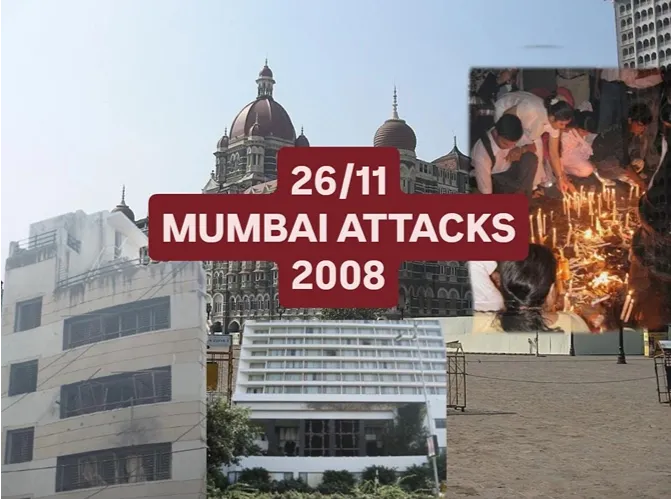

The 2008 Mumbai attacks, remembered as 26/11, began on the evening of November 26, 2008, and turned India’s financial capital into the centre of one of the country’s most traumatic terrorist attacks. Ten armed attackers struck several locations almost simultaneously, including a railway station, popular café, two luxury hotels and a Jewish community centre.
For nearly 60 hours, Mumbai faced gunfire, explosions, hostage situations and intense security operations. By the time the siege ended on November 29, 166 people had been killed and more than 300 injured. Nine attackers were dead, while one, Ajmal Amir Kasab, had been captured alive.
But the significance of the 2008 Mumbai attacks went far beyond the immediate tragedy. The assault exposed weaknesses in India’s coastal security, intelligence coordination and counterterrorism preparedness, while creating another major crisis in already tense India–Pakistan relations.
How the 26/11 Mumbai Attacks Were Planned and Carried Out
The investigation into the 2008 Mumbai attacks established that the assault was carried out by militants associated with Lashkar-e-Taiba (LeT), a Pakistan-based terrorist organisation. The attackers underwent training before being sent on the mission and were equipped with assault rifles, grenades, ammunition and other supplies. The route into Mumbai was particularly significant. The attackers travelled by sea from Pakistan. During the journey, they hijacked the Indian fishing vessel MV Kuber and used it to approach the Mumbai coastline. They subsequently transferred to smaller boats and landed in the Colaba area.
The maritime infiltration highlighted a major vulnerability. Mumbai was a coastal metropolis, yet India’s coastal surveillance and coordination mechanisms were not sufficiently prepared to detect and stop a small, determined team arriving by sea. After reaching Mumbai, the attackers split into smaller groups. Their targets were carefully selected to create casualties, international attention and a prolonged security crisis.
The first major locations hit included Chhatrapati Shivaji Terminus (CST), Leopold Café, Cama Hospital, the Taj Mahal Palace Hotel, the Oberoi-Trident Hotel and Nariman House, a Jewish community centre. The choice of targets was significant. CST was one of Mumbai’s busiest public spaces, while the hotels and Nariman House had strong international associations. The attackers were therefore able to combine mass-casualty violence with a prolonged hostage crisis.
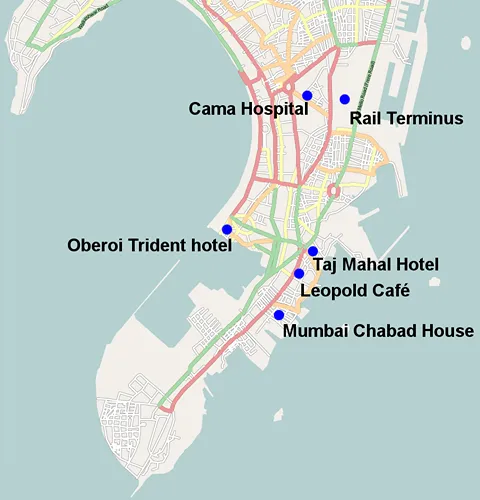
user:geni open street maps/Wikimedia Commons
- Indus Waters Treaty 1960: The High-Stakes Water Battle
- Air India AI2379: Alarming 300-Foot Drop Sparks Safety Questions
- India Independence Day: 79 Years of Freedom, Progress and Challenges
- BCI-NALSAR Crisis: What the Supreme Court Questioned
- Pahalgam Attack 2025: The Attack That Challenged Kashmir’s Security Narrative
Mumbai Attacks: The Night Terror Struck
The first phase of the 2008 Mumbai attacks unfolded rapidly. At Chhatrapati Shivaji Terminus, attackers opened fire on passengers in one of India’s busiest railway stations. The crowded environment made the assault particularly devastating. From there, attackers moved through the city, while other gunmen struck Leopold Café. The attack soon expanded into a much larger crisis.
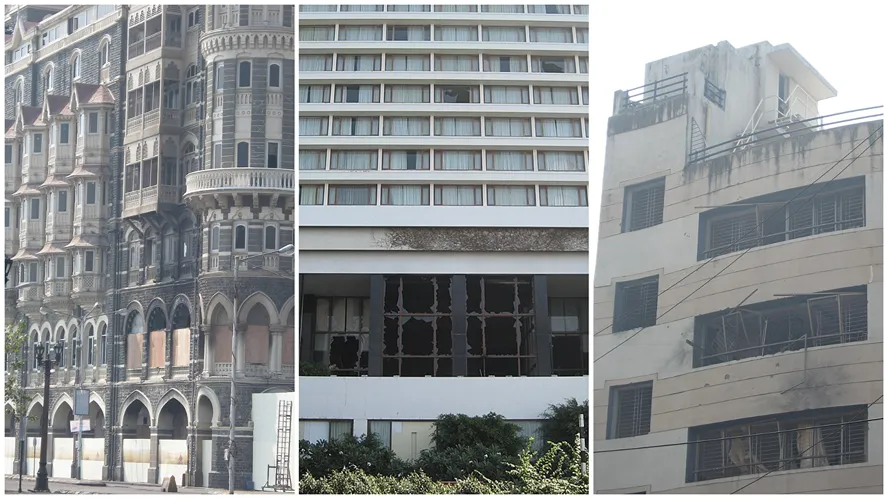
Photo: Nicholas/Wikimedia Commons
At the Taj Mahal Palace Hotel, heavily armed attackers entered the historic property and took hostages. Fires broke out inside the building, producing images that were broadcast around the world. The siege continued for almost three days.
The Oberoi-Trident Hotel was also attacked, with guests trapped inside while security forces attempted to locate the gunmen and rescue civilians. At Nariman House, attackers seized the Jewish community centre operated by the Chabad-Lubavitch movement. The location became another hostage scene and eventually required a specialised NSG operation. The attackers also moved through the area around Cama Hospital, where they encountered police officers.
The response came at enormous cost. Hemant Karkare, chief of the Mumbai Anti-Terrorism Squad; senior police officer Ashok Kamte; and encounter specialist Vijay Salaskar were among the security personnel killed during the fighting.
Police constable Tukaram Omble played a crucial role in the capture of Ajmal Kasab. Omble confronted Kasab and his associate despite being under fire. His actions helped police capture Kasab alive and obtain an unprecedented source of evidence about the attackers.

26/11 Timeline
| Date | Major development |
|---|---|
| 26 November | Attackers land in Mumbai and begin coordinated assaults |
| 26 November night | CST, Leopold Café, Taj, Oberoi-Trident and Nariman House attacked |
| 27 November | Security operations intensify; NSG commandos begin major counterterrorism operations |
| 28 November | Operations at Nariman House and Oberoi-Trident conclude; Taj siege continues |
| 29 November | Final attackers eliminated at the Taj; major operations end |
The final phase became known as Operation Black Tornado, the NSG’s counterterrorism operation to eliminate the remaining attackers and rescue hostages.
Ajmal Kasab, The Investigation and the Pakistan Connection
The capture of Ajmal Kasab became central to the investigation into the 2008 Mumbai attacks. Indian investigators recovered extensive evidence, including weapons, communications-related evidence and forensic material. Kasab’s statements provided further information about the attackers’ training, journey and handlers. Investigators also examined how the attackers communicated with individuals directing the operation from outside India.
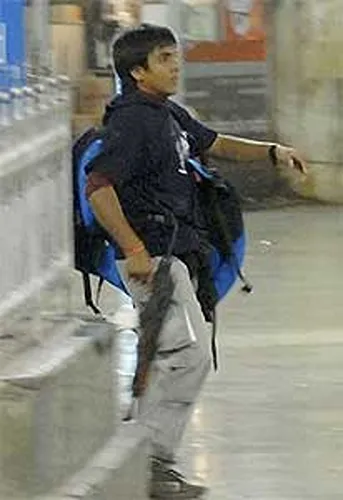
Photo: Sebastian D’Souza/Wikimedia Commons
Another major name to emerge was David Coleman Headley, a US-Pakistani national who conducted reconnaissance in Mumbai before the attacks. His activities became an important part of the international investigation into the planning of the assault. The evidence collected by Indian and international investigators linked the operation to Lashkar-e-Taiba and to Pakistan-based planning and training networks.
The Pakistan connection became one of the most politically sensitive aspects of the case. India repeatedly demanded action against those it identified as responsible for planning and supporting the attacks. Pakistan acknowledged that the attackers had originated from Pakistan but the issue of prosecution and accountability for the wider network remained contentious for years. The 2008 Mumbai attacks therefore became much more than a criminal investigation. They became a major diplomatic issue between two nuclear-armed neighbours.
Kasab was tried in India under multiple terrorism and murder-related charges. He was convicted and sentenced to death. After his conviction and the completion of legal proceedings, he was executed at Yerwada Central Jail in Pune on November 21, 2012. The legal case also demonstrated the importance of evidence gathered from the crime scenes, survivors, forensic examination, communications and Kasab’s own statements.
The Security Failures That 26/11 Exposed
Perhaps the most important lesson of the 2008 Mumbai attacks was that India’s security architecture had serious gaps. The attackers’ ability to enter Mumbai by sea raised questions about coastal surveillance. At the time, several agencies were responsible for different aspects of maritime security, creating challenges in coordination. The attack also exposed difficulties in responding to multiple simultaneous terrorist incidents.
Mumbai Police officers were among the first to confront the attackers, but many lacked the equipment and specialised resources necessary to deal with heavily armed militants. The delay in bringing specialised NSG forces from Delhi also became an important subject of scrutiny. The attack demonstrated a difficult reality: local police are often the first responders during terrorism, even when the incident eventually requires highly specialised forces. The Indian government subsequently introduced significant changes.
The National Investigation Agency (NIA) was established in the aftermath of the attacks to investigate major terrorism and national-security offences. India also expanded NSG capabilities and established regional hubs so that specialised commandos would not have to depend entirely on deployment from Delhi. Coastal security received greater attention through increased surveillance, coastal police infrastructure, coordination among maritime agencies and improved monitoring of vessels. Intelligence-sharing mechanisms were strengthened, while security agencies placed greater emphasis on preventing attacks against major public places and critical infrastructure.
In this sense, the 2008 Mumbai attacks became a turning point in India’s counterterrorism strategy.
The Geopolitical Impact and Legacy of 26/11
The consequences of the 2008 Mumbai attacks extended far beyond Mumbai. India–Pakistan relations deteriorated sharply. New Delhi demanded credible action against those responsible, while international governments also pressed Pakistan to address militant networks operating from its territory. The attacks became a reference point in subsequent discussions about terrorism in South Asia and repeatedly influenced the India–Pakistan diplomatic relationship.
Internationally, the attacks demonstrated how a relatively small group could use modern communications, maritime access and attacks on symbolic civilian targets to create a crisis with global consequences. For India, however, the most enduring legacy remains the victims. The 166 people killed came from different backgrounds and included Indian citizens, foreign nationals, police officers and other security personnel. Hundreds more survived with physical and psychological scars.
The 2008 Mumbai attacks also changed the way India viewed urban terrorism. Mumbai was not simply attacked because it was a large city. It was targeted because it represented India’s economic importance, international connectivity and global visibility. Sixteen years later, 26/11 remains a painful reminder that terrorism is not only about the immediate destruction it causes. It can expose institutional weaknesses, reshape national security policy, damage diplomatic relations and leave a lasting mark on public memory.
The central lesson of the 2008 Mumbai attacks is therefore not simply how the terrorists entered Mumbai or how the siege ended. It is how a coordinated assault exploited gaps between intelligence, policing, coastal security and emergency response—and how India subsequently attempted to close those gaps.
What were the 2008 Mumbai attacks?
The 2008 Mumbai attacks were a series of coordinated terrorist attacks carried out in Mumbai from November 26 to 29, 2008, by 10 attackers associated with Lashkar-e-Taiba.
How many people died in the Mumbai attacks?
A total of 166 victims were killed, while nine of the ten attackers were also killed. More than 300 people were injured
Who was Ajmal Kasab?
Ajmal Kasab was the only attacker captured alive. He was tried and convicted in India and executed on November 21, 2012.
Which places were attacked during 26/11?
Major targets included CST, Leopold Café, the Taj Mahal Palace Hotel, Oberoi-Trident Hotel, Nariman House and areas around Cama Hospital.
Which organisation was linked to the attacks?
Indian and international investigations linked the attacks to Lashkar-e-Taiba, a Pakistan-based terrorist organisation