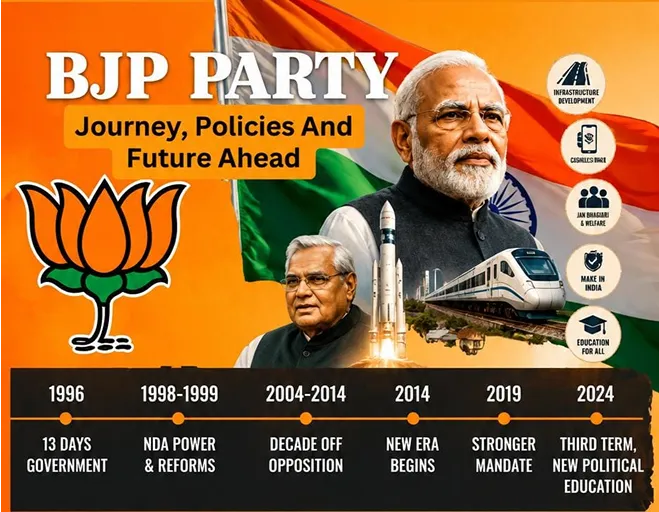

India’s political landscape has changed dramatically since the BJP Party emerged in 1980. Its roots trace back to the Bharatiya Jana Sangh, founded in 1951 by Syama Prasad Mukherjee, which later joined the Janata Party in 1977. After the Janata Party collapsed, the BJP was formally established on 6 April 1980. Atal Bihari Vajpayee became its first president, while L.K. Advani emerged as a key organisational leader in the party’s early years.
Initially, the BJP struggled to establish a nationwide electoral base. It won just two Lok Sabha seats in the 1984 general election, but the setback proved temporary. Over the following years, the party expanded its organisation, strengthened its voter base and emerged as a major national political force.
Its journey has since included electoral breakthroughs, coalition governments, periods in opposition, major reforms and ideological debates. Under Atal Bihari Vajpayee, the BJP established itself as a credible governing force, while Narendra Modi’s leadership later took the party to new electoral heights. Its rise has also reshaped debates around economic policy, welfare, national security, cultural identity and India’s role in global affairs.
BJP’s Rise to Power
The BJP’s electoral breakthrough accelerated in the late 1980s and early 1990s, as its focus on nationalism, cultural identity and the Ram Janmabhoomi movement expanded its national support. From just 2 Lok Sabha seats in 1984, the party rose to 85 in 1989, 120 in 1991 and 161 in 1996. It first formed a central government under Atal Bihari Vajpayee in 1996, although it lasted only 13 days. The BJP returned through the NDA in 1998 and formed a stable coalition government after the 1999 election. Vajpayee’s tenure emphasised infrastructure, economic reforms, telecommunications and national security, including the Golden Quadrilateral and Pokhran-II nuclear tests.
The BJP’s expansion was shaped by leaders such as L.K. Advani, Murli Manohar Joshi, Rajnath Singh, Amit Shah, Sushma Swaraj, Arun Jaitley and Smriti Irani. After a decade in opposition, Narendra Modi led the party to major victories in 2014 and 2019. In 2024, the BJP remained the largest party and formed the government with NDA allies.
BJP’s Reform and Policy Shift
Since 2014, BJP-led governments have introduced major reforms covering the economy, welfare, digital governance, infrastructure and education. The focus has been on economic formalisation, wider public services and technology-driven governance.
The government’s agenda has also included major constitutional and social changes. These policies have shaped debates around federalism, citizenship, gender representation and cultural identity.
Major Reforms Under BJP Governments
| Year | Major Reform / Initiative | Main Focus |
|---|---|---|
| 2014 | PM Jan Dhan Yojana | Financial inclusion |
| 2014 | Make in India | Manufacturing and investment |
| 2015 | Digital India | Digital infrastructure and services |
| 2016 | Insolvency and Bankruptcy Code | Corporate debt resolution |
| 2016 | Ujjwala Yojana | Clean cooking fuel access |
| 2017 | Goods and Services Tax | Unified indirect taxation |
| 2018 | Ayushman Bharat | Healthcare access |
| 2019 | Article 370 changes | Jammu and Kashmir’s constitutional status |
| 2019 | Citizenship Amendment Act | Citizenship framework |
| 2019 | Triple Talaq legislation | Reform of Muslim personal-law practice |
| 2020 | National Education Policy | Education reform |
| 2020 | Farm Laws | Agricultural market reform |
| 2021 | PM Gati Shakti | Integrated infrastructure planning |
| 2021 | Farm Laws Repeal | Withdrawal of the three farm laws |
| 2023 | Women’s Reservation Act | Legislative representation for women |
| 2024 | Ram Mandir inauguration | Major cultural and religious milestone |
These policies focus on economic growth, welfare access and stronger governance, supported by digital services and infrastructure development. However, reforms such as GST, farm laws and constitutional changes have also sparked major debates over economic policy, federalism, minority rights and secularism.
BJP Ideology and Challenges
The BJP Party is broadly associated with Hindutva, cultural nationalism, nationalism and Integral Humanism. Its political agenda also emphasises national security, economic development, welfare and India’s cultural identity. Supporters credit the party with expanding infrastructure, welfare delivery and India’s global profile. Critics, however, raise concerns over religious polarisation, minority rights, institutional independence and majoritarian politics.
The BJP has also faced criticism over several economic decisions. Demonetisation in 2016, the rollout of GST, unemployment concerns and the 2020 farm laws became major political flashpoints. After prolonged farmer protests, the three farm laws were repealed in 2021.
Overall, the BJP’s record combines major policy reforms and electoral successes with continuing debates over its economic, social and constitutional approach.
BJP’s New Political Phase
The 2024 Lok Sabha election changed the BJP’s parliamentary position. The party won 240 seats, down from 303 in 2019, but remained the largest party and formed the government with its NDA allies. Narendra Modi began his third consecutive term as Prime Minister on 9 June 2024, making coalition management more important than during the previous decade.
The BJP’s continued rule also carries wider geopolitical significance. India’s policies affect global supply chains, defence partnerships, technology, energy security and Indo-Pacific strategy. Stronger ties with major powers and greater focus on areas such as semiconductors, defence manufacturing and critical minerals could further strengthen India’s global position. At the same time, political stability and democratic institutions will remain important to India’s international partners and investors.
Conclusion
The BJP Party’s journey from winning just two Lok Sabha seats in 1984 to securing majorities in 2014 and 2019 marks a major transformation in Indian politics. Its rise has reshaped electoral competition and influenced India’s economic, welfare, infrastructure and constitutional policies.
The 2024 election, however, introduced a new political equation. While the BJP remained the largest party, its reliance on NDA allies made coalition management more important. Its future will depend on balancing economic growth, social concerns, regional interests and India’s expanding role in global geopolitics.
What is the BJP?
The BJP party is one of India’s two major national political parties. It was formally founded on 6 April 1980.
When did the BJP first come to power?
The BJP Party first formed a government at the Centre under Atal Bihari Vajpayee in 1996. It later led stable NDA governments from 1998 to 2004.
How many seats did the BJP win in 2024?
The BJP Party won 240 Lok Sabha seats in the 2024 general election. The NDA subsequently formed the government.
Who is the BJP’s current Prime Minister?
Narendra Modi is the Prime Minister and began his third consecutive term on 9 June 2024.
What are the BJP’s major policy areas?
Major areas include economic development, infrastructure, welfare, national security, digital governance, manufacturing, education and cultural issues.