

More than 42 kg of foreign-origin gold and around 10 kg of silver have been seized in a nationwide crackdown by the Directorate of Revenue Intelligence (DRI). The seizures were valued at more than ₹65 crore. Meanwhile, 25 people, including five foreign nationals, were arrested during multiple intelligence-led operations. However, the scale of the seizure is only one part of the story. The DRI gold smuggling investigation also exposed a striking variety of routes and concealment methods.
Gold was intercepted at airports, border areas and during domestic movement. Meanwhile, silver was recovered from a coastal route allegedly connected to Sri Lanka. The pattern suggests that precious-metal smuggling is being pursued through several channels at once. It also shows why intelligence-led enforcement has become increasingly important.
Background: DRI Intensifies Its Smuggling Crackdown
The latest action forms part of a sustained DRI campaign against organised precious-metal smuggling. According to the reports, the recent operations were conducted across Mumbai, Kolkata, Kerala, West Bengal, Assam and Tamil Nadu. The agency said different methods were being used by suspected smugglers. These included body concealment, specially created cavities and transit passengers.
Airport personnel were also allegedly involved in one Mumbai operation. Moreover, land and coastal routes were being used to move foreign-origin precious metals into India. Therefore, the crackdown provides a wider picture than a single airport seizure.
Mumbai: Transit Routes and Airport Assistance
The Mumbai operation offers one of the clearest examples of how international transit routes can be exploited. On August 28–29, DRI officers uncovered an alleged syndicate operating through Chhatrapati Shivaji Maharaj International Airport. Five foreign nationals were allegedly travelling through Mumbai from destinations including Dubai, Bangkok and Male. An airport staff member was also arrested for allegedly facilitating the removal of smuggled gold.
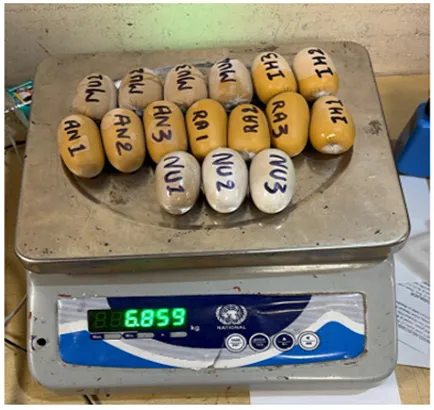
Credit:PIB
Six people were arrested in the operation. The recovered material consisted of 16 capsules containing 6.85 kg of 24-carat gold dust in wax form. This case is significant because it allegedly combined international transit with local assistance. Consequently, the airport was not simply being used as an entry point. It was allegedly being used as part of a broader logistical chain.
Kolkata and West Bengal: Airport and Border Routes
Kolkata produced several separate recoveries. At Netaji Subhas Chandra Bose International Airport, two passengers arriving from Dubai were intercepted. Around 4.87 kg of gold was recovered from semi-solid gold-containing paste concealed in their clothing. In another Kolkata case, 3.36 kg of foreign-origin gold was recovered as 11 raw chains. The DRI said the material had allegedly been handed over to one passenger for crossing the Green Channel.
The border route produced another major recovery. In Nadia district, 125 foreign-origin gold bars weighing 15.61 kg were recovered from a residential premises. The seizure was made with assistance from the Border Security Force (BSF). Two additional Indo-Bangladesh border operations resulted in seizures of 935 grams and 1.74 kg of foreign-origin gold. One person was arrested in each case. Thus, West Bengal appears repeatedly in the latest enforcement picture. However, the individual cases should not automatically be treated as one syndicate.
Kerala: Concealment Became the Key Tactic
Kerala also featured prominently in the crackdown. At Cochin International Airport, 1.78 kg of gold was extracted from two packets containing gold compound. The material had been concealed on a passenger arriving from Ras Al Khaimah. At Calicut International Airport, 549 grams of 24-carat foreign-origin gold was discovered inside specially created cavities in the heavy alloy section of an iron box.
The passenger had arrived from Jeddah. The gold was seized under the Customs Act, 1962. These cases demonstrate a recurring feature of DRI gold smuggling investigations: concealment is being adapted to the object being transported.
Assam and Tamil Nadu: Beyond the Airport Network
The crackdown also moved beyond major airports. In Guwahati, DRI seized 3.84 kg of foreign-origin gold bars allegedly smuggled through the Indo-Bangladesh border via the Tripura sector. Two people were arrested. Tamil Nadu revealed a different route altogether. At Ramanathapuram, DRI seized 1.36 kg of foreign-origin gold and 9.99 kg of foreign-origin silver. The precious metals were allegedly smuggled through a coastal route from Sri Lanka.
Three people were arrested in that operation. The Tamil Nadu seizure is especially important because it broadens the story beyond gold. It shows that gold and silver can move through different logistical channels. Consequently, enforcement cannot focus only on airports and land borders.
Gold, Silver and Multiple Routes: What the Pattern Shows
The seizures reveal a clear pattern: no single route or concealment method dominated the crackdown. Instead, suspected consignments were moved through international airports, land-border corridors and coastal routes. Meanwhile, concealment techniques were adapted to the method of transport. This variation is significant for enforcement agencies. It means that disrupting one route may not be enough to stop the wider flow of precious metals.
Moreover, the involvement of international transit points, border areas and coastal corridors highlights the cross-border nature of the challenge. Consequently, intelligence sharing and coordinated surveillance become increasingly important. The recovery of both gold and silver also broadens the picture. The crackdown was not focused solely on gold, but on foreign-origin precious metals moving through different channels. Rather than treating every seizure as part of one network, investigators will need to determine whether separate cases share common suppliers, handlers, financiers or destinations.
Geopolitical Implications: What the DRI Crackdown Reveals
The latest seizures extend beyond a conventional customs enforcement story. Links to the Gulf, Southeast Asia, Bangladesh and Sri Lanka place precious-metal trafficking within a broader regional context. India’s geography makes this challenge more complex. Its long land borders and extensive coastline provide multiple channels for cross-border movement. The India-Bangladesh border is particularly significant for eastern security, while the Sri Lanka-linked coastal route highlights vulnerabilities across India’s southern maritime space.
The Mumbai case adds another dimension. An airport staff member was arrested for allegedly facilitating the movement of smuggled gold. If established, such involvement could expose vulnerabilities within tightly controlled international entry points. The issue also carries economic-security implications. Foreign-origin gold and silver entering India outside legitimate channels can bypass customs controls. Such activity may also facilitate wider illicit financial networks. However, the separate seizures should not automatically be linked to a single nationwide or transnational syndicate. Further investigation will be needed to establish whether the cases share suppliers, financiers, handlers or recipients.
For India, the larger challenge is therefore cross-border network disruption. Tracking the financial and logistical links behind individual consignments could prove more significant than the seizures themselves. Greater information sharing with neighbouring countries and international enforcement agencies could also strengthen India’s response. This is particularly relevant when suspected routes cross multiple jurisdictions and transport networks.
Ultimately, the DRI gold smuggling crackdown highlights the intersection of economic security, border management and regional cooperation. The investigations will now determine whether these seizures represent separate operations or links within a wider cross-border trafficking ecosystem.
Beyond the Seizure: What Happens Next?
The immediate outcome is substantial: more than 42 kg of foreign-origin gold and around 10 kg of silver have been seized, with 25 arrests reported. Yet the bigger test will come during the investigation. Authorities will need to establish whether separate interceptions are connected. They will also need to identify suppliers, handlers, financiers and intended recipients. Most importantly, investigators will have to determine whether alleged airport assistance and cross-border routes represent isolated cases or recurring vulnerabilities.
For India, that distinction matters. The latest DRI gold smuggling crackdown shows that precious-metal trafficking is no longer defined by one route or one concealment method. Instead, the challenge is increasingly distributed across airports, borders, roads and coastal corridors. The seizures may have disrupted several operations. The investigations now need to determine how much of the wider supply chain was actually exposed.
FAQs
What did the DRI seize in the latest crackdown?
The DRI reported the seizure of more than 42 kg of foreign-origin gold and around 10 kg of silver, collectively valued at more than ₹65 crore.
How many people were arrested?
A total of 25 people were arrested, including five foreign nationals, across the multiple intelligence-led operations.
Where were the major gold seizures made?
Major recoveries were reported in Mumbai, Kolkata, Nadia in West Bengal, Kerala, Assam and along the India-Bangladesh border. A separate gold-and-silver seizure was reported in Ramanathapuram, Tamil Nadu.
How was the gold allegedly concealed?
The DRI reported several methods, including wax capsules, paste, body concealment, clothing and specially created cavities.
Was all the seized gold connected to one syndicate?
Not necessarily. The DRI described a series of operations involving different cases and locations. Individual links between the cases would need to be established through investigation.