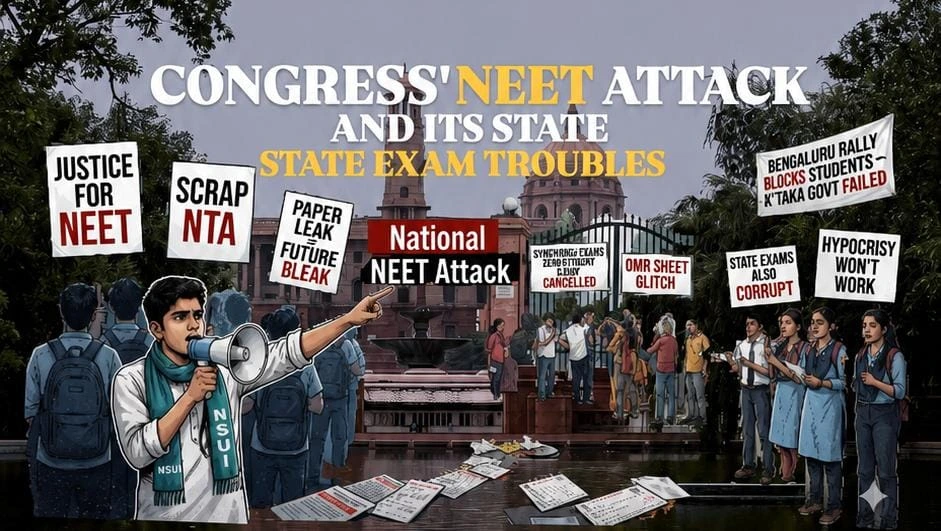

The Exam Scam Politics debate has intensified after the NEET UG 2026 controversy triggered nationwide protests and political clashes. While Congress leaders targeted the Union government over alleged failures in protecting students, the BJP responded by highlighting examination controversies in opposition-governed states.
The debate has now moved beyond a single examination. It has raised larger questions about transparency, accountability, and whether political parties apply the same standards when exam irregularities occur under their own governments.
NEET Paper Leak Controversy and Congress’ Opposition
The NEET UG 2026 controversy emerged as one of India’s biggest education-related political issues, triggering nationwide debates over examination security, student rights, and government accountability. Conducted by the National Testing Agency (NTA), NEET remains the country’s primary entrance examination for medical admissions, with lakhs of students appearing every year with the hope of securing seats in medical colleges.
The controversy intensified after allegations of a NEET UG 2026 paper leak emerged, raising serious concerns among students, parents, and education experts over examination security and the credibility of the testing process. Reports and claims surrounding the alleged leak created doubts about whether the examination system was able to ensure a fair opportunity for lakhs of medical aspirants. The issue soon became a major exam scam debate, with opposition parties accusing the government and the National Testing Agency (NTA) of failing to prevent paper leaks and protect the interests of students.
The growing anger among aspirants and citizens led to nationwide protests under the banner of the Cockroach Janta Party (CJP), a satirical protest movement that expanded the discussion beyond NEET and focused on broader concerns related to education reforms, accountability, and transparency in governance. The protests turned into a major political challenge for the government, with demonstrators demanding answers from the Ministry of Education and stronger action against those responsible for the alleged failures.
Congress and other opposition parties intensified their criticism of the Centre, questioning the handling of the NEET controversy and demanding greater responsibility from Union Education Minister Dharmendra Pradhan. The political pressure surrounding the issue eventually led to Dharmendra Pradhan’s resignation, marking a significant development in the ongoing debate over examination reforms and student concerns.
- Why India Rejected UK Migrant Returns Over Nirav Modi
- Sonam Wangchuk Reality: Facts Behind the Fame, Influence and Controversies
- India Develops First Indigenous 350kg Thrust Expendable Turbojet Engine: Why It Matters
- E20 Janta Party: Can Ethanol Politics Spark India’s Next Protest?
- Can India Restore Trust After NEET-UG Controversy?
Exam Controversies Mentioned in BJP Post
| State | Government | Exam Issue | Nature of Allegation | Education Minister |
|---|---|---|---|---|
| Jharkhand | JMM-Congress alliance | Recruitment selection controversy | Cutoff and OMR transparency concerns | Ramdas Soren |
| Karnataka | Congress | KPSC veterinary recruitment issue | Alleged irregularities, OMR manipulation claims | Madhu Bangarappa |
| Punjab | AAP | Recruitment exam cheating cases | Bluetooth-based cheating allegations | Harjot Singh Bains |
BJP’s Counter: Exam Issues in Opposition-Ruled States
The political battle over examination integrity expanded beyond the NEET controversy when the BJP questioned the opposition’s focus on national-level exams while highlighting recruitment-related controversies in states governed by non-BJP parties. According to the BJP’s argument, examination failures are not limited to central agencies or national-level tests. The party has pointed towards several state-level recruitment controversies, arguing that students and job aspirants face similar challenges when state examination systems fail.
A BJP social media post highlighted cases from Jharkhand, Karnataka, and Punjab, alleging irregularities ranging from recruitment transparency concerns to cheating incidents. However, these cases differ significantly in nature. While some involve allegations of manipulation in recruitment processes, others relate to cheating methods rather than direct question paper leaks. The distinction is important because a paper leak, recruitment irregularity, and exam cheating are separate issues with different legal and administrative implications.
Jharkhand: Questions Over Recruitment Transparency
In Jharkhand, where a JMM-led government with Congress alliance support is in power, the BJP highlighted a recruitment examination transparency controversy, alleging that 2,204 candidates were shortlisted without proper disclosure of cutoff details and OMR sheet transparency. Candidates reportedly raised concerns over the selection process and demanded greater clarity from authorities regarding the availability of OMR sheets, cut-off marks, and the overall credibility of the recruitment procedure.
The issue became part of a broader debate over transparency in government recruitment examinations in the state. The key political figures associated with the government are Chief Minister Hemant Soren and Education Minister Ramdas Soren. However, it is important to note that the controversy relates to allegations of selection process irregularities and lack of transparency rather than a confirmed question paper leak.
Karnataka KPSC Veterinary Recruitment Controversy
In Karnataka, where the Congress government is in power, the BJP highlighted allegations related to the Karnataka Public Service Commission (KPSC) Veterinary recruitment process. The allegations included claims of middlemen involvement, possible OMR manipulation, recruitment irregularities, and unfair selection practices. Political claims also alleged that middlemen demanded large sums of money in exchange for recruitment opportunities.
However, these allegations require proper investigation and official confirmation before they can be considered established facts. The controversy nevertheless raised broader concerns about the credibility and transparency of government recruitment systems. The key political figures associated with the state government are Chief Minister Siddaramaiah and Education Minister Madhu Bangarappa. The Karnataka case highlights a larger challenge facing competitive examinations — even allegations of manipulation can affect candidates’ trust and confidence in the fairness of the selection process.
Punjab: Bluetooth Cheating Allegations
In Punjab, governed by the Aam Aadmi Party (AAP), the BJP highlighted allegations related to recruitment examination cheating incidents, where some candidates were reportedly accused of using Bluetooth devices and other electronic methods to gain unfair advantages during exams. The controversy raised concerns about the effectiveness of examination security measures, including monitoring systems, candidate verification, and the misuse of technology in competitive examinations.
However, these incidents are different from a traditional paper leak, as Bluetooth cheating involves malpractice during the examination process rather than unauthorised access to question papers before the exam. Authorities treated such cases as isolated incidents rather than a complete failure of the examination system. The key political figures associated with the Punjab government are Chief Minister Bhagwant Mann and Education Minister Harjot Singh Bains. The issue highlights the growing challenge of preventing technology-enabled cheating and maintaining trust in recruitment examinations.
Exam Scam Politics: The Battle Over Accountability
The debate over examination irregularities has evolved into a larger political conflict over responsibility and governance. The NEET paper leak controversy became a major flashpoint, with Congress arguing that NEET is a national-level examination affecting millions of medical aspirants and that the Union government must take responsibility because the National Testing Agency (NTA) functions under the central administration. Congress maintained that any failure in a nationwide examination system requires answers from the Centre, especially when students and parents raise concerns about transparency and fairness. The party demanded accountability from the government and questioned how such an exam scam controversy could impact the future of lakhs of candidates.
The BJP, however, argued that examination credibility is not only a national issue but also a broader governance challenge. The party pointed towards recruitment controversies and alleged irregularities in opposition-governed states, claiming that questions of transparency and accountability should apply equally to state governments as well. The political debate around the exam scam issue highlights a larger reality: students ultimately suffer whenever examination systems fail, regardless of whether the exam is conducted by a central agency or a state recruitment body. For aspirants, the priority remains a fair selection process, secure examinations, and confidence that their hard work will not be affected by administrative failures.
Addressing repeated exam scam allegations requires stronger examination security, transparent evaluation procedures, timely investigations, and public disclosure of important processes such as answer keys, results, and selection criteria. Beyond political accusations, restoring trust in India’s examination system remains the biggest challenge for governments at every level.
Conclusion
The Exam Scam Politics debate highlights how examination controversies have become a major political issue in India, with allegations of exam scams increasingly influencing public discussions around education, governance, and accountability. While Congress’ protests over the NEET UG controversy focused on national-level examination security and questioned the government’s responsibility in preventing exam scams, the BJP responded by highlighting alleged recruitment irregularities and examination-related controversies in opposition-governed states.
Beyond political arguments and party accusations, the larger issue of exam scams directly affects millions of students whose careers depend on fair, transparent, and reliable examination systems. Every allegation of paper leaks, cheating networks, recruitment manipulation, or evaluation failures creates uncertainty among aspirants and damages public confidence in competitive exams. Addressing repeated cases of exam scams requires stronger security mechanisms, transparent evaluation procedures, independent investigations, and strict action against those responsible. Ultimately, preventing exam scams should remain a shared responsibility of both central and state governments to ensure that students’ hard work is protected and the credibility of India’s examination system is restored.
1. Why did Congress protest against NEET UG 2026?
Congress protested over allegations of paper leaks, irregularities, and concerns regarding the examination process managed by NTA.
2. Who is responsible for conducting NEET?
NEET UG is conducted by the National Testing Agency (NTA) under the Ministry of Education.
3. Are all exam controversies mentioned by BJP paper leaks?
No. The cases include different issues such as recruitment transparency concerns, alleged manipulation, and cheating incidents.
4. Which Karnataka exam controversy was highlighted?
The BJP referred to allegations involving the KPSC veterinary recruitment process, including claims of irregularities.
5. What is the bigger issue behind exam controversies?
The main concern is maintaining trust, fairness, and transparency in competitive examinations.