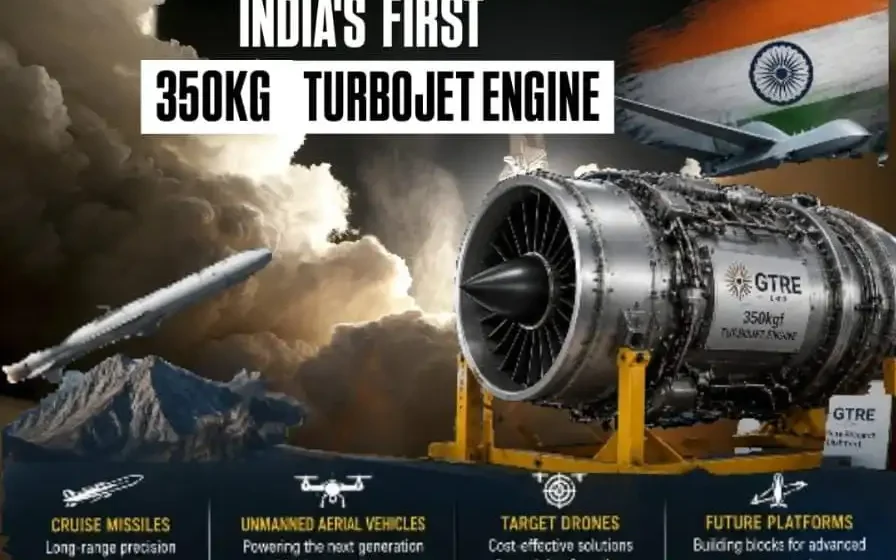

For decades, Indian aerospace’s biggest challenge has not been building platforms — it has been mastering the engines that power them. From fighter aircraft to unmanned systems, propulsion technology has remained one of the most complex areas dominated by a handful of advanced nations. The development of an indigenous 350kg thrust expendable turbojet engine represents a significant step in India’s attempt to build self-reliance in aerospace propulsion.
While smaller than fighter aircraft engines, this class of engine could have major implications for missiles, drones, target systems, and future unmanned platforms. The breakthrough is not just about creating another engine. It reflects India’s broader strategic goal of reducing dependence on foreign suppliers in critical defence technologies and strengthening its position in the global aerospace ecosystem.
Expendable Turbojet Engine Explained
An expendable turbojet engine is a compact jet propulsion system designed for short-duration missions rather than long-term use like commercial aircraft engines. The term “expendable” refers to its mission-specific design, not a lack of reliability.
These engines are mainly used in cruise missiles, unmanned aerial vehicles (UAVs), target drones, and experimental aerospace platforms. A turbojet works by compressing incoming air, mixing it with fuel, burning the mixture, and producing thrust through high-speed exhaust gases. Unlike rocket engines, turbojets use atmospheric oxygen, making them suitable for sustained atmospheric flight.
- Why India Rejected UK Migrant Returns Over Nirav Modi
- Sonam Wangchuk Reality: Facts Behind the Fame, Influence and Controversies
- From CJP Protest to Reservation Row: The Full Timeline
- E20 Janta Party: Can Ethanol Politics Spark India’s Next Protest?
- Can India Restore Trust After NEET-UG Controversy?
Who Built India’s Turbojet Engine?
The indigenous 350kg thrust expendable turbojet engine has been developed by India’s defence aerospace ecosystem, with the Gas Turbine Research Establishment (GTRE), a laboratory under the Defence Research and Development Organisation (DRDO), playing a key role in its design and development. GTRE has decades of experience in gas turbine and propulsion research, including work on indigenous aircraft engine technologies. The development of this compact turbojet engine reflects India’s broader effort to strengthen domestic capabilities in aerospace propulsion, one of the most challenging areas of defence engineering.
The manufacturing and precision engineering support for the engine has involved Azad Engineering, a Hyderabad-based company known for producing high-precision components for aerospace and defence applications. Such industry partnerships are becoming increasingly important as India moves from research and prototype development towards advanced manufacturing capabilities. While details regarding specific testing timelines, platforms, and operational deployment remain limited due to the strategic nature of defence propulsion projects, the collaboration between DRDO’s research expertise and private-sector manufacturing capability represents a significant step towards building an indigenous aerospace ecosystem.
Timeline of the Engine Development
| Year | Development Details |
|---|---|
| Before 2024 | GTRE had ongoing work on small indigenous gas turbines and expendable turbojet concepts. The exact start date of these efforts has not been publicly disclosed. |
| May 2024 | Azad Engineering was selected as the manufacturing and industrial partner for the programme. |
| 2024–2026 | GTRE and Azad Engineering jointly carried out manufacturing, precision machining, assembly, integration, and qualification activities for the engine. |
| July 2026 | The first indigenous 350kg thrust expendable turbojet engine was successfully realised and handed over. |
The importance of the engine goes beyond its thrust capability; it reflects the advanced engineering expertise required to develop compact propulsion systems. A small turbojet requires precision in areas such as compressor design, combustion technology, turbine manufacturing, heat-resistant materials, and fuel management systems.
Where It Will Be Used
A small indigenous turbojet engine could support multiple defence applications, including cruise missiles, unmanned aerial vehicles (UAVs), target drones, and future aerospace platforms. In cruise missile systems, turbojets provide continuous thrust, allowing long-distance and controlled atmospheric flight. For UAVs, indigenous propulsion can support the development of long-range drones, surveillance platforms, combat UAVs, and autonomous aerial systems while reducing dependence on imported engines.
The engine could also be used in target drones that help armed forces test weapons and train defence systems. A domestic propulsion system can lower costs and improve availability for repeated military testing. Beyond immediate applications, small propulsion systems can become building blocks for future aerospace programmes, helping India develop more advanced indigenous platforms.
Why This Engine Matters
1. Reducing Foreign Dependence
Aircraft engines are among the most sensitive defence technologies, and even advanced aerospace nations rely on specialised partnerships for certain propulsion systems. Developing indigenous engines gives India greater control over production timelines, supply chains, upgrades, and strategic decisions.
2. Strengthening Defence Manufacturing
India’s push for Atmanirbhar Bharat in defence has increased focus on domestic aerospace capabilities. Engine development requires advanced metallurgy, precision engineering, heat-resistant materials, and extensive testing. Success in smaller engines can help build expertise for future, more powerful propulsion systems.
3. Supporting Drone and Missile Development
Engine Development Challenges
Modern warfare is increasingly shaped by autonomous weapons, drones, precision strike systems, and AI-based platforms. Reliable indigenous propulsion technology will play a crucial role in strengthening India’s future drone and missile capabilities. Despite their smaller size, compact turbojet engines are highly complex to design and manufacture. They require advanced materials, specialised alloys, and heat-resistant coatings to handle extreme temperatures and pressure.
Other challenges include improving fuel efficiency, reducing weight, maintaining performance stability, and ensuring reliability. Before deployment, engines must undergo extensive ground, environmental, and flight testing. The biggest long-term challenge is scaling production while maintaining consistent quality, moving from a successful prototype to a reliable industrial capability.
India’s Aerospace Race
Small turbo jet engine technology is not new globally. Countries including the United States, France, Russia, Israel, and China have invested heavily in compact propulsion systems. The United States has decades of experience in cruise missile propulsion, while countries such as Israel have developed strong capabilities in drone technologies.
China has also invested significantly in indigenous aerospace manufacturing capabilities. India’s progress places it among countries attempting to build complete defence technology ecosystems rather than relying only on imported platforms. However, becoming globally competitive will require continued investment in engine reliability, production capacity, advanced materials, and research and development.
Future Prospects
The 350kg thrust turbojet engine could become a foundation for future aerospace programmes, including advanced indigenous drones, improved cruise missile systems, autonomous aerial platforms, defence exports, and more powerful propulsion technologies.
India has made progress in areas such as space systems, missiles, and aircraft development, but indigenous propulsion remains one of the biggest technological challenges. The engine’s real success will depend not only on its development but also on reliable production, integration, and operational deployment.
Geopolitical Impact
Defence technology has become a major factor in global power competition. Countries that control critical technologies such as engines, semiconductors, and advanced manufacturing enjoy greater strategic independence.
For India, developing domestic propulsion technology has implications beyond defence. It strengthens its position as an emerging aerospace power and reduces vulnerabilities created by international supply chain disruptions. As military competition increasingly moves toward drones, autonomous systems, and precision weapons, propulsion technology will remain a key strategic advantage.
What is India’s 350kg turbojet engine?
India’s 350kg turbojet engine is an indigenous small propulsion system designed for applications such as unmanned platforms, target drones, and strategic aerospace systems.
Why are small turbojet engines important?
Small turbojet engines are important because they power systems such as cruise missiles and drones, which are becoming increasingly significant in modern warfare.
Is India developing larger aircraft engines?
Yes, India has been pursuing various aerospace engine development efforts, including initiatives related to aircraft propulsion technology.
How does this engine help India’s defence sector?
The engine can reduce dependence on foreign propulsion systems and strengthen India’s domestic defence manufacturing capability.
Which countries lead in turbojet engine technology?
Countries such as the United States, France, Russia, China, and Israel have advanced capabilities in different areas of aerospace propulsion technology.