
India China Border Dispute: Decades of Tension Along the Himalayas
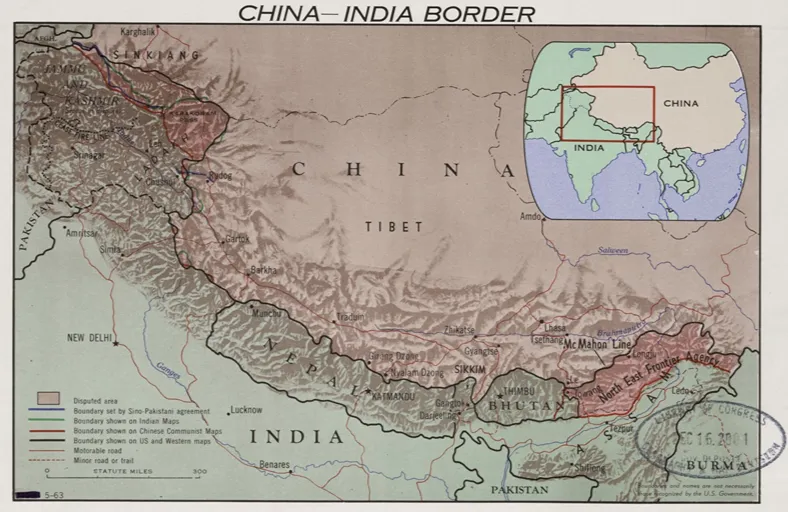
The Himalayas are more than a natural barrier between India and China. They are a strategic frontier shaped by territorial claims, military deployments and decades of diplomatic tension. The India China Border Dispute covers several sensitive regions, including Ladakh, Himachal Pradesh, Uttarakhand, Sikkim and Arunachal Pradesh. Because the Line of Actual Control (LAC) is not mutually delineated across all sectors, both sides have different perceptions of their respective positions. This has repeatedly created friction between Indian and Chinese troops. The dispute is therefore not only about territory but also about infrastructure, military preparedness, logistics and maintaining a strong presence along the Himalayan frontier.
The India China Border Dispute entered a particularly dangerous phase after the 2020 eastern Ladakh crisis, which led to a prolonged military standoff and significant troop deployments on both sides. India maintains that approximately 38,000 square kilometres of its territory in Ladakh remains under Chinese control, while China claims large areas of Arunachal Pradesh. In October 2024, India and China reached an agreement on patrolling arrangements in Depsang and Demchok, helping facilitate disengagement from several friction points. However, the agreement did not resolve the wider territorial dispute. The India China Border Dispute therefore remains a major strategic challenge for New Delhi.
Today, the India China Border Dispute is increasingly influenced by more than troop deployments. Roads, bridges, tunnels, airfields, surveillance systems, communications networks and forward logistics have become critical elements of India’s Himalayan security strategy. India has accelerated infrastructure development along sensitive border areas while strengthening military preparedness and diplomatic engagement. The objective is to prevent unilateral changes to the status quo while maintaining channels for dialogue. Disengagement can reduce immediate tensions, but it does not represent a final boundary settlement. For India, the long-term challenge is to combine credible deterrence with diplomacy and development, ensuring that national security and border infrastructure advance together.
India China Border Dispute: The Main Events That Shaped the Conflict
The India China Border Dispute has been shaped by several major conflicts and military standoffs. The 1962 war was the biggest early turning point, exposing India’s weaknesses in military preparedness, logistics and border infrastructure. Chinese forces advanced in both the western and eastern sectors, leaving a lasting impact on India’s defence strategy. India later strengthened its military capabilities and Himalayan infrastructure. The clashes at Nathu La and Cho La in 1967 showed a stronger Indian response, while the 1975 Tulung La incident and the 1986–87 Sumdorong Chu crisis highlighted the continuing dangers along the disputed frontier.
The India China Border Dispute entered a more diplomatic phase after Prime Minister Rajiv Gandhi’s 1988 visit to China. Both countries sought to manage the boundary disagreement while expanding broader bilateral relations. This approach produced important agreements, including the 1993 Agreement on Maintenance of Peace and Tranquility and the 1996 confidence-building measures. However, these agreements did not permanently settle the boundary. The 2017 Doklam standoff demonstrated that strategic competition remained intense, while the 2020 Galwan Valley clash once again brought Indian and Chinese forces into direct confrontation along the Line of Actual Control.
Today, the India China Border Dispute has developed into a wider strategic competition involving military deployments, roads, tunnels, surveillance systems, diplomacy and economic resilience. After the 2020 crisis, India accelerated infrastructure development and strengthened its military presence across sensitive Himalayan sectors. The India China Border Dispute therefore cannot be viewed only through the lens of past wars. It is now a continuing contest over maintaining the status quo and protecting territorial claims. The key lesson from decades of confrontation is that temporary peace does not necessarily mean a permanent solution. Strong preparedness, effective diplomacy and sustained border development remain crucial for India’s long-term security.
Key Numerical Differences in the India-China Border Dispute
| Comparison | Figure 1 | Figure 2 | Difference |
|---|---|---|---|
| Indian territory under Chinese control vs. territory ceded by Pakistan to China | 38,000 sq km | 5,180 sq km | 32,820 sq km |
| Chinese claim in Arunachal Pradesh vs. Indian territory under Chinese control | 90,000 sq km | 38,000 sq km | 52,000 sq km |
| Chinese claim in Arunachal Pradesh vs. territory ceded by Pakistan | 90,000 sq km | 5,180 sq km | 84,820 sq km |
| 2025 BRO infrastructure projects vs. 2026 VVP-I blocks | 125 projects | 46 blocks | 79 |
| 2025 BRO project cost vs. 2026 VVP-I blocks | ₹5,000 crore | 46 blocks | Not directly comparable |
The Indian government has stated that approximately 38,000 sq km of Indian territory in Ladakh is under Chinese control. It has also stated that Pakistan ceded approximately 5,180 sq km of Indian territory to China in 1963, while China claims approximately 90,000 sq km in Arunachal Pradesh.
India China Border Dispute: The Biggest Turning Points for India
India’s Changing Security Strategy
The India China Border Dispute has transformed India’s approach to national security. The 1962 war highlighted serious weaknesses in military preparedness, logistics and border infrastructure. By 1967, Indian forces were better prepared and demonstrated stronger tactical capabilities during clashes at Nathu La and Cho La. The 1986–87 Sumdorong Chu crisis further underlined the importance of rapid mobilisation and maintaining strategic positions in difficult Himalayan terrain. After 1988, India increasingly combined military preparedness with diplomatic engagement. Agreements signed during the 1990s helped create mechanisms to manage tensions and reduce the risk of localised incidents escalating into a larger conflict.
Infrastructure Becomes a Strategic Weapon
The 2020 Galwan crisis became another major turning point in the India China Border Dispute, accelerating India’s focus on roads, bridges, tunnels, air connectivity and forward logistics. The Border Roads Organisation has expanded infrastructure development across Ladakh and the northeastern frontier. In December 2025, the government announced 125 border infrastructure projects, including 28 roads and 93 bridges, costing approximately ₹5,000 crore. These projects are designed to improve troop mobility and strengthen India’s ability to respond quickly to developments along the Line of Actual Control. Better infrastructure also reduces the logistical disadvantages that affected India’s border preparedness during earlier conflicts.
From Reactive Defence to Sustained Deterrence
India’s response to the India China Border Dispute now extends beyond military deployments. The government is also developing frontier villages, telecommunications, electricity, roads and civilian connectivity. In March 2026, the Ministry of Home Affairs reported 2,662 projects worth ₹1,161.81 crore under the Vibrant Villages Programme-I, while 112 roads and 35 bridges were sanctioned to connect previously unconnected villages. These measures indicate a shift from reactive defence toward sustained deterrence. The objective is not necessarily to pursue another war, but to ensure India can protect its territorial interests and respond rapidly if the status quo is challenged. This broader strategy is reshaping India’s Himalayan security posture.
India China Border Dispute: Can India Recover Areas Under Chinese Control?
India’s approach to the India China Border Dispute is unlikely to depend on a sudden military operation to reclaim large areas under Chinese control. Any major conflict would carry serious escalation risks between two nuclear-armed countries. Instead, India can strengthen its position through military deterrence, better roads, tunnels, bridges, airfields and surveillance systems. Improved infrastructure would allow faster troop movement and stronger logistical support in difficult Himalayan terrain. Maintaining a credible military presence can also discourage further attempts to change the status quo. For India, the priority is to make every disputed area difficult and costly to alter through sustained preparedness and strategic planning.
Diplomacy remains equally important in managing the India China Border Dispute. India and China have shown that military and diplomatic negotiations can produce limited disengagement arrangements, including the October 2024 agreement concerning Depsang and Demchok. However, disengagement does not represent a final boundary settlement. India must continue presenting its territorial claims consistently while opposing unilateral changes along the Line of Actual Control. At the same time, stronger surveillance and intelligence capabilities can help detect unusual military activity at an early stage. A combination of diplomatic engagement, military preparedness and economic resilience can improve India’s bargaining position without unnecessarily pushing both countries toward another major confrontation.
The future of the India China Border Dispute will ultimately depend on India’s ability to combine national power with patience and diplomacy. Frontier villages, roads, telecommunications and civilian infrastructure are strategically important because they strengthen India’s ability to administer and defend remote border regions. Programmes such as Vibrant Villages and Border Roads Organisation projects therefore have significance beyond development. They contribute to long-term border security and national presence. A durable solution will most likely require negotiations and a mutually acceptable boundary settlement rather than relying entirely on military force. India can preserve its territorial claims, strengthen deterrence and improve its negotiating position while keeping diplomatic channels open.
What is the India China Border Dispute?
The India China Border Dispute is the unresolved territorial disagreement between India and China involving multiple sectors of the Himalayan frontier, particularly Ladakh and Arunachal Pradesh. The Line of Actual Control is not mutually delineated in its entirety.
How much Indian territory does India say China controls?
The Government of India has repeatedly stated that approximately 38,000 square kilometres of Indian territory in Ladakh is under Chinese control. It also cites 5,180 square kilometres of Indian territory in Pakistan-occupied Kashmir that Pakistan ceded to China in 1963.
What was the biggest military turning point after 1962?
The 1967 Nathu La and Cho La clashes were important because Indian forces demonstrated significantly stronger preparedness than during the 1962 war. The 1986–87 Sumdorong Chu crisis was another major test of India’s ability to rapidly reinforce the Himalayan frontier.
Did India and China resolve the border dispute in 2024?
No. The October 2024 agreement addressed patrolling arrangements in Depsang and Demchok and enabled disengagement from the 2020 friction points, but it did not constitute a final settlement of the boundary dispute.
How can India strengthen its position without starting another war?
India can strengthen deterrence through border infrastructure, surveillance, logistics, military preparedness, economic resilience, diplomatic engagement and development of frontier villages. These measures improve India’s ability to protect its territorial claims while keeping diplomatic channels open.
By Sahil Koul | National Affairs Analyst covering Indian politics, governance, public policy, and major developments shaping the nation.