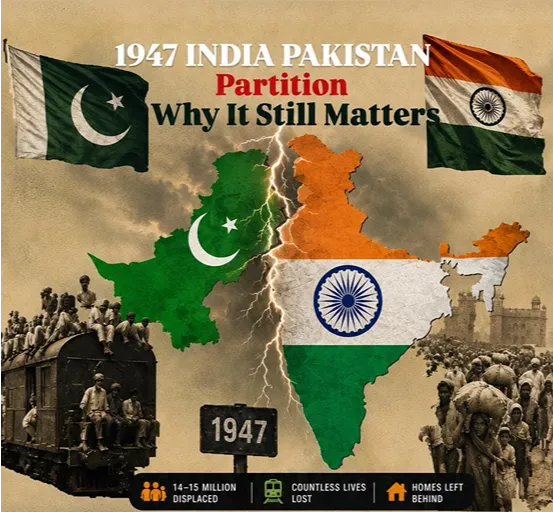

The 1947 India-Pakistan Partition was one of the most consequential political events of the 20th century. It ended British colonial rule and created two independent states, India and Pakistan, but independence came at a devastating human cost. The Indian Independence Act 1947 provided the legal framework for creating the two dominions and dividing the provinces of Punjab and Bengal, while also establishing arrangements for the division of government institutions, military forces and other assets.
The Partition largely followed religious demographics, with Muslim-majority regions forming Pakistan and predominantly Hindu and Sikh areas becoming part of India. Yet communities were deeply interwoven, especially in Punjab and Bengal, where Hindus, Muslims and Sikhs had lived together for generations. The sudden creation of an international border therefore triggered widespread fear, communal violence and one of the largest forced migrations in modern history.
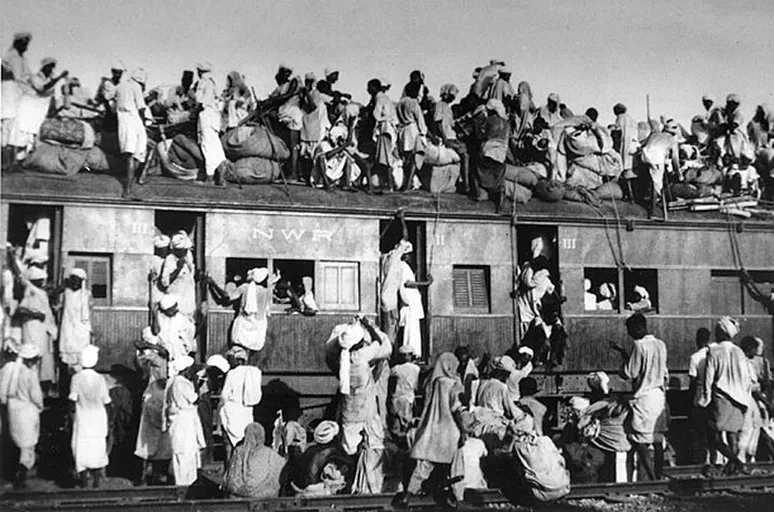
Around 14–15 million people crossed the new borders, with Muslims moving largely towards Pakistan and Hindus and Sikhs towards India. Killings, looting, abductions, sexual violence and the destruction of homes and property accompanied the migration. While the exact death toll remains disputed, estimates range from hundreds of thousands to around one million or more. Partition thus created a defining paradox: political independence ended colonial rule, but the process left a lasting humanitarian, political and geopolitical legacy across South Asia.
Background History Behind Partition
The roots of the 1947 India-Pakistan Partition developed over several decades. British India was deeply diverse, with major religious, linguistic and regional communities. Colonial constitutional reforms increasingly organised political representation around communal identities. The Muslim League, founded in 1906, emerged as an important voice for Muslim political interests, while the Indian National Congress became the principal force in the independence movement. Political differences grew after the 1937 provincial elections, while the Second World War further transformed India’s political landscape. In 1940, the Lahore Resolution marked a major turning point by strengthening the Muslim League’s demand for separate Muslim-majority political units.
After the Second World War, attempts to agree on India’s constitutional future repeatedly failed. The Cabinet Mission Plan of 1946 proposed a federal arrangement that could have preserved a united India, but Congress and the Muslim League disagreed over the distribution of political power. Communal violence then intensified across several regions, particularly Bengal and Punjab. By 1947, Britain’s decision to transfer power rapidly, combined with political deadlock and growing insecurity between communities, made Partition increasingly likely. The result was a hurried division that created India and Pakistan while setting the stage for mass migration, violence and decades of geopolitical rivalry.
Why India Was Partitioned
The 1947 India-Pakistan Partition resulted from years of political disagreements, failed negotiations and rising communal tensions. Muhammad Ali Jinnah and the Muslim League feared Muslim political marginalisation in a Hindu-majority India, while Congress leaders generally opposed dividing the country along religious lines.
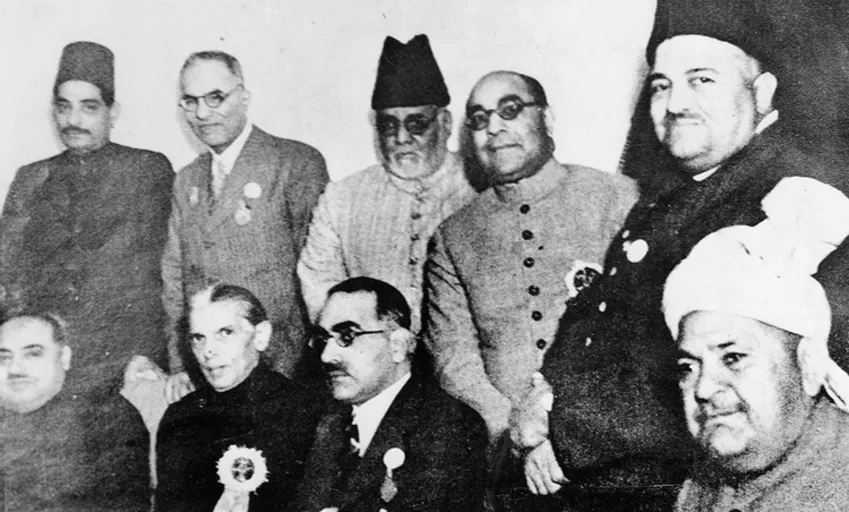
Credit: Wikipedia
Attempts to reach a compromise, including the Cabinet Mission Plan of 1946, failed as mistrust deepened. Meanwhile, violence in Calcutta, Noakhali, Bihar and Punjab made the political crisis increasingly difficult to contain.
Britain also played a decisive role in the final stage. After World War II, economic and political pressures pushed Britain towards withdrawal, while Lord Louis Mountbatten, the last Viceroy, accelerated the transfer of power from the original 1948 deadline to August 1947. The Indian Independence Act 1947 provided the legal framework for creating India and Pakistan, but the rushed transition left little time to divide government institutions, military forces and resources as millions began moving across the new borders.
Leaders Behind Partition and the Radcliffe Line
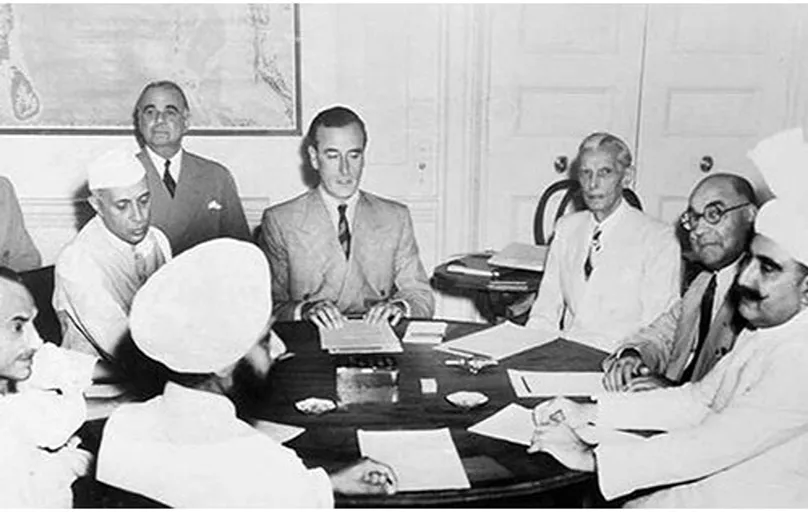
The 1947 India-Pakistan Partition was shaped by leaders with competing visions for India’s future. Muhammad Ali Jinnah led the demand for Pakistan, while Jawaharlal Nehru eventually accepted Partition to end political deadlock.
Credit: Wikipedia
Mahatma Gandhi and Maulana Abul Kalam Azad opposed the division, while Sardar Patel accepted it as a practical settlement. Lord Mountbatten oversaw the final transfer of power and accelerated independence.
The division was then physically marked by the Radcliffe Line, drawn by British lawyer Sir Cyril Radcliffe, who chaired the boundary commissions for Punjab and Bengal. Working under severe time constraints, the commissions divided territories largely according to religious demographics, but the new borders also cut through villages, farmland, railway routes and established communities. The final boundary awards were announced after independence, leaving millions uncertain about which country they now belonged to. This uncertainty intensified the refugee crisis and contributed to the violence and displacement that followed Partition.
Partition’s Human Cost and Legacy
The 1947 India-Pakistan Partition triggered one of the largest forced migrations in modern history, displacing around 14–15 million people. Communal violence, abductions, sexual violence and property loss devastated communities, while refugee movements transformed cities such as Delhi, Lahore, Karachi and Amritsar. The trauma of separation and lost homes continues across generations.
Its geopolitical legacy remains visible in 2026, especially through the Kashmir dispute. The 22 April 2025 Pahalgam terrorist attack, which killed 26 people, triggered a major India-Pakistan crisis. India launched Operation Sindoor on 7 May 2025, followed by missile, drone, and artillery exchanges, culminating in a ceasefire on 10 May. Continuing tensions in Kashmir show how unresolved issues linked to Partition still influence South Asian security and diplomacy.
| Year | Key development and significance |
|---|---|
| 1947 | Partition created India and Pakistan, followed by the first war over Jammu and Kashmir. |
| 1965 | Second major India-Pakistan war took place, largely centred on Kashmir. |
| 1971 | War between India and Pakistan resulted in the creation of Bangladesh. |
| 1998 | India and Pakistan conducted nuclear tests, transforming their rivalry into a nuclear security issue. |
| 1999 | Kargil conflict brought the two nuclear-armed countries into direct military confrontation. |
| 2001–02 | Parliament attack triggered a major India-Pakistan military mobilisation. |
| 2008 | Mumbai terrorist attacks severely damaged bilateral relations and stalled dialogue. |
| 2016 | Uri terrorist attack was followed by India’s announced surgical strikes across the Line of Control. |
| 2019 | Pulwama attack was followed by India’s Balakot air strike and another major India-Pakistan crisis. |
| 2021 | India and Pakistan reaffirmed the ceasefire along the Line of Control. |
| 22 Apr 2025 | Pahalgam terrorist attack killed 26 civilians and sharply worsened bilateral relations. |
| 7 May 2025 | Operation Sindoor targeted terrorist infrastructure in Pakistan and Pakistan-occupied Jammu and Kashmir, according to the Indian government. |
| 7–10 May 2025 | Drone, missile, artillery and other military exchanges marked the most serious escalation in years. |
| 10 May 2025 | India and Pakistan agreed to stop military action following the escalation. |
| 2026 | Political unrest and election-related violence in Pakistan-administered Kashmir highlighted continuing regional instability. |
Why Partition Still Matters
The 1947 India-Pakistan Partition created a lasting strategic rivalry. The accession of Jammu and Kashmir triggered the first India-Pakistan war and made the region a permanent flashpoint. Nuclear weapons later raised the stakes, while the creation of Bangladesh in 1971 reshaped South Asia. China’s strategic ties with Pakistan and tensions with India added another layer to the region’s geopolitics. Today, India-Pakistan tensions can affect regional security, trade, energy and nuclear stability, while water disputes add further pressure amid climate change and population growth.
Partition’s legacy also extends beyond geopolitics. It left unresolved questions over national identity, minority rights, displacement and historical memory. Yet the division could not erase South Asia’s shared heritage. Families, languages, food, literature and cultural traditions continue to connect communities across the border. Nearly eight decades later, the events of 1947 remain relevant because their political consequences continue to shape the region, while their human and cultural legacy lives on across generations.
Conclusion
The 1947 India-Pakistan Partition was both a defining moment of decolonisation and a devastating humanitarian tragedy. It ended British rule, created India and Pakistan, and redrew South Asia’s political map. Yet rushed negotiations, failed compromises and widespread communal violence left consequences that continue to shape the region.
Nearly eight decades later, Kashmir remains disputed, India and Pakistan remain strategic rivals, and South Asia remains a critical nuclear security region. The lasting lesson of Partition is not simply about borders. It shows how political decisions can reshape societies, identities and international relations for generations. Its legacy remains visible today in the region’s politics, security, diplomacy and collective memory.
What was the 1947 India-Pakistan Partition?
The 1947 India-Pakistan Partition divided British India into two independent dominions, India and Pakistan, during the transfer of British power.
Why was India partitioned in 1947?
Partition resulted from prolonged political disagreements, Muslim League demands for Pakistan, Congress-League differences, communal violence, and Britain’s decision to transfer power rapidly.
How many people were displaced by Partition?
An estimated 14–15 million people crossed the new borders during the Partition crisis.
How many people died during Partition?
There is no universally accepted figure. Historical estimates range from hundreds of thousands to around one million or more.
Why does Partition still matter today?
Partition remains relevant because it shaped the Kashmir dispute, India-Pakistan rivalry, South Asian security, refugee identities and debates over nationalism and religious identity.