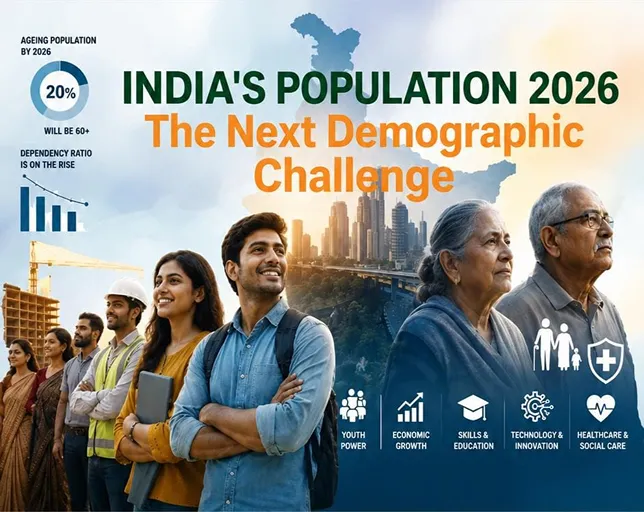

The India population 2026 story is no longer simply about being the world’s most populous country. India’s demographic structure is changing rapidly, with population growth slowing, fertility rates declining and life expectancy increasing. At the same time, the share of older citizens is steadily rising, signalling a gradual shift from a young population toward an ageing society.
This transition presents both a major opportunity and a growing population challenge. India still has a vast working-age population that can support manufacturing, services, technology and domestic consumption. However, this demographic advantage depends on creating quality jobs, improving skills, expanding education and raising productivity. The coming years could therefore determine whether India successfully captures its demographic dividend while preparing for the population challenges ahead.
The shift also carries wider economic and geopolitical implications. A large, skilled and productive population can strengthen India’s economic power, global workforce and strategic influence. However, rising ageing could eventually increase pressure on healthcare, pensions and public finances. India’s challenge is therefore not simply managing population growth, but converting its demographic strength into sustainable economic and national power.
India Population 2026: Current Size and Global Position
The India population 2026 is projected at around 1.477 billion, or nearly 148 crore people, making India the world’s most populous country. However, the headline figure tells only part of the story. Behind this massive population is a significant demographic transition, with population growth slowing, fertility rates declining and life expectancy increasing. These changes are gradually reshaping India’s age structure and could have major consequences for its workforce, economy and society in the decades ahead.
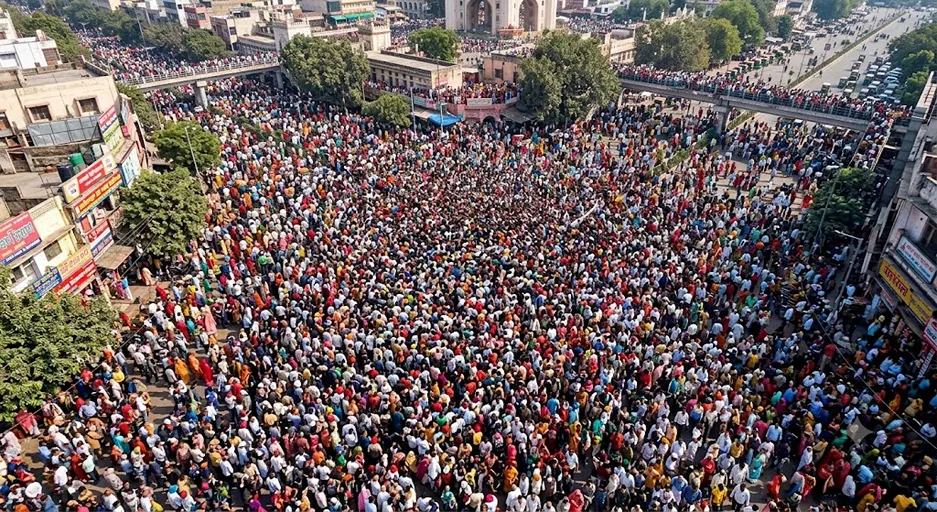
India’s Population Growth
| Year | Estimated Population | Annual Growth |
|---|---|---|
| 2000 | 1.058 billion | 1.90% |
| 2010 | 1.243 billion | 1.47% |
| 2020 | 1.403 billion | 0.98% |
| 2024 | 1.451 billion | 0.89% |
| 2025 | 1.464 billion | 0.89% |
| 2026 | 1.477 billion | 0.87% |
The figures show a clear demographic transition. India’s population is still growing, but the annual growth rate has fallen sharply. Therefore, population decline is not the immediate concern in 2026. The more important issue is how falling fertility and rising longevity will reshape India’s population in the coming decades.
India remains the world’s most populous country, ahead of China. China is already experiencing population decline, while India continues to record modest growth. The United States ranks third globally, followed by Indonesia and Pakistan. Nigeria, Brazil, Bangladesh, Russia and Ethiopia also remain among the world’s most populous countries. This ranking highlights an important geopolitical shift: India retains a major demographic advantage, while China is confronting a shrinking and ageing population. At the same time, India’s fertility rate has moved close to the replacement level, suggesting that its population growth will continue slowing over time.
Why India’s Population Growth Is Slowing
India’s population growth is slowing due to falling fertility, higher education levels, urbanisation and rising life expectancy. The India population 2026 trend reflects a major demographic shift that has developed over several decades. The average number of children per woman has declined significantly, with NFHS-5 recording a Total Fertility Rate of 2.0, below the replacement-level benchmark of 2.1.
Education, employment and changing lifestyles are also influencing family choices. As more women pursue higher education and careers, marriage and childbirth are increasingly delayed. At the same time, rising living costs and greater spending on education, housing and healthcare are encouraging many families to choose smaller households. These factors are reshaping the Indian population outlook for 2026 and reducing the pace of population growth.
However, this transition is not uniform across India. States such as Bihar and Uttar Pradesh continue to record relatively higher fertility, while several southern states have lower fertility and are ageing faster. This regional divide makes a single demographic policy difficult to implement. The India population 2026 challenge will therefore require state-specific strategies that support younger populations while preparing faster-ageing states for rising healthcare, pension and social-care needs.
India’s Demographic Dividend and Ageing Challenge
India’s large working-age population remains one of its strongest economic advantages. Falling fertility has increased the share of people in working ages, creating the potential for a significant demographic dividend. However, the India Population 2026 advantage is not automatic. India must provide young people with quality education, skills, healthcare and productive employment. If job creation fails to keep pace, the large workforce could instead fuel unemployment and social pressure. Greater female participation in the workforce will also be essential to strengthening India’s economic potential.
At the same time, the India Population 2026 outlook highlights the growing challenge of population ageing. UNFPA projects that people aged 60 and above could account for around 20% of India’s population by 2050. This will increase demand for geriatric healthcare, pensions, long-term care, elderly-friendly housing and skilled caregivers. The impact will vary across states. Kerala, Tamil Nadu and other southern states are ageing faster, while states such as Bihar remain comparatively young. India will therefore need state-specific ageing policies rather than a uniform national approach.
When population decline eventually begins, it will not automatically weaken India’s economy. However, a shrinking workforce could create labour shortages and increase pressure on pensions, healthcare and families caring for older relatives. India can address these challenges through automation, artificial intelligence, higher productivity and greater workforce participation. Ultimately, the India Population 2026 challenge is not simply about population size. The country’s future will depend on how effectively it turns its demographic strength into a skilled, productive and economically active population.
India Population 2026: Economic Impact
India’s large workforce and vast domestic market have been major drivers of economic growth. However, the India population 2026 outlook points to slower population growth and gradual ageing, which could eventually create labour shortages and increase pressure on pensions, healthcare and social protection. These changes could affect labour-intensive sectors such as manufacturing, construction and services.
At the same time, India’s population transition in 2026 could open new economic opportunities. Rising demand for healthcare, insurance, pharmaceuticals, senior living and elderly care could support new industries and employment. Businesses may also increase investment in automation, artificial intelligence and advanced technologies to manage future workforce constraints.
Ultimately, the India population 2026 challenge is not simply about population size. India’s long-term economic strength will depend on higher productivity, better skills, quality education, technological innovation and greater female workforce participation.
India’s Demographic Future and Global Impact
India’s population is becoming an important geopolitical asset, but its value will depend on how effectively the country converts its demographic strength into economic and strategic power. A large, young and skilled population can strengthen India’s workforce, consumer market, military capacity and global influence. However, ageing could eventually reduce the size of the workforce and increase pressure on public finances. China provides a clear comparison, as its population is already declining and ageing faster than India’s.
India’s demographic shift could also reshape global markets. Its workforce may become increasingly important as developed economies face labour shortages, while its large consumer base can continue attracting global investment. At the same time, rising demand for healthcare, pharmaceuticals and elderly care could create new economic opportunities. The India population transition is therefore more than a domestic issue. India must use its demographic dividend today while preparing for an ageing society tomorrow. Its future global influence will ultimately depend on productivity, skills, employment and effective demographic policies.
What is the India population in 2026?
India’s estimated mid-year 2026 population is around 1.477 billion, according to estimates based on the United Nations World Population Prospects 2024.
Is the India population declining in 2026?
No. India’s population is still increasing in 2026. However, the annual growth rate has slowed significantly, and population decline is expected later in the demographic transition.
When will India’s population peak?
The UN’s 2024 medium projection places India’s population at about 1.692 billion in 2054. It then falls to roughly 1.505 billion by 2100.
How will population ageing affect India?
Ageing will increase demand for healthcare, pensions, long-term care and social protection. It could also reduce the relative size of India’s working-age population.
Will a smaller population hurt India’s economy?
Not necessarily. A smaller population can be manageable if India raises productivity. Automation, technology, skills and greater female employment could offset a shrinking workforce.