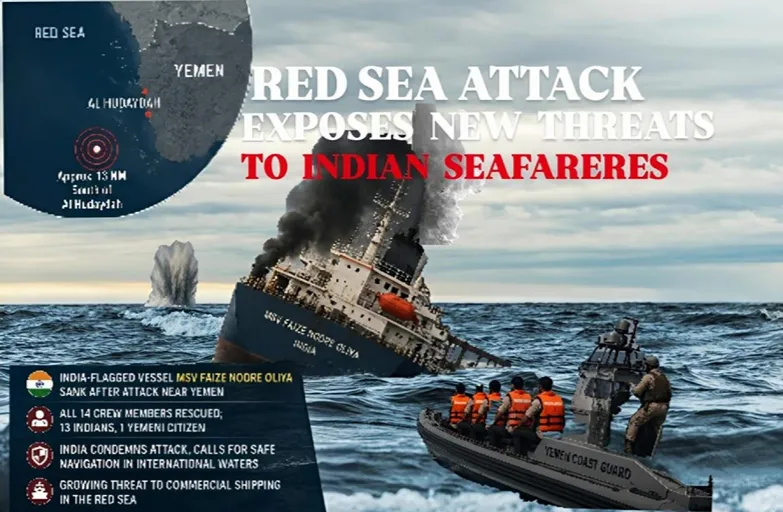

The sinking of an India-flagged vessel in the Red Sea is not just another maritime incident. It is a stark reminder that escalating geopolitical tensions in West Asia are increasingly threatening civilian shipping, global trade, and the lives of thousands of merchant seafarers. Although every crew member was rescued safely, the attack has renewed international concerns about the security of one of the world’s most critical shipping corridors.
The mechanised sailing vessel MSV Faize Noore Oliya sank off Yemen’s western coast on 4 August 2026 after it came under attack while transiting the Red Sea. India strongly condemned the assault, describing it as an unprovoked attack on a civilian commercial vessel, and renewed its call for the restoration of safe and unhindered navigation through international waters. Beyond the immediate humanitarian impact, the incident underscores how the conflict in West Asia is spilling into vital maritime trade routes, posing fresh challenges for international commerce and maritime security.
What Happened?
The India-flagged vessel MSV Faize Noore Oliya sank in the Red Sea on 4 August 2026 after coming under attack off Yemen’s western coast, highlighting the growing threat to commercial shipping in the region. According to Union Ports, Shipping and Waterways Minister Sarbananda Sonowal, the mechanised sailing vessel was struck by a projectile, causing it to capsize and sink. He condemned the incident as an unprovoked attack on a civilian vessel. All 14 crew members, including 13 Indian nationals and one Yemeni citizen, were rescued by the Yemeni Navy and Coast Guard and taken safely to the port of Mokha.
However, conflicting accounts emerged over the nature of the attack. While India said the vessel was hit by a projectile, Yemen’s government-aligned National Resistance Forces (NRF) claimed it was struck by an explosives-laden boat near Al Hudaydah. No group had claimed responsibility at the time of publication.
Key Developments
India responded quickly after the attack, treating the incident as both a humanitarian and maritime security concern. The Ministry of External Affairs (MEA) condemned the strike on the India-flagged vessel, describing it as an unprovoked attack on a civilian commercial ship. The ministry also reiterated India’s longstanding position that commercial shipping must be protected and that freedom of navigation in international waters should be restored.
Meanwhile, the Indian Embassy in Riyadh has been coordinating with Yemeni authorities to assist the rescued crew and monitor their welfare. At the same time, Union Ports, Shipping and Waterways Minister Sarbananda Sonowal directed the Director General of Maritime Administration (DGMA) to review safety measures for Indian seafarers operating in high-risk regions. The attack has also renewed concerns about maritime security in the Red Sea, where commercial vessels continue to face increasing threats amid regional instability.
Red Sea Attack: Key Facts and Statistics
| Category | Details |
|---|---|
| Vessel | MSV Faize Noore Oliya |
| Flag State | India |
| Date of Attack | 4 August 2026 |
| Location | Red Sea, near Al Hudaydah, Yemen |
| Strategic Waterway | Bab el-Mandeb Strait |
| Crew on Board | 14 (13 Indians, 1 Yemeni) |
| Indian Crew Rescued | 13 |
| Total Crew Rescued | 14 |
| Vessel Status | Sank after the attack |
| Rescue Operation | Yemeni Navy and Coast Guard |
| Indian Government Response | MEA condemned the attack and called for safe navigation |
| Responsibility | No group claimed responsibility |
| Share of Global Trade via Red Sea | Approximately 12–15% |
| Indian Seafarers Killed in West Asia Conflict | 10 |
| Indian Seafarers Killed in Black Sea Attacks | 5 |
Human Cost for Indian Seafarers
Although all 13 Indian crew members were rescued safely, the attack highlights the growing dangers faced by Indian seafarers working in conflict-prone waters. India is one of the world’s largest suppliers of merchant sailors, many of whom serve on international cargo vessels. According to government figures, 10 Indian seafarers have died in the West Asia conflict, while five others were killed in attacks on merchant ships in the Black Sea during the Russia-Ukraine war. The incident underscores the urgent need to strengthen maritime security and better protect civilian crews operating along global trade routes.
Impact on Global Trade
The attack on the India-flagged vessel highlights the growing economic risks posed by instability in the Red Sea. The incident occurred near the Bab el-Mandeb Strait, one of the world’s most strategic maritime chokepoints, and highlights the growing economic risks of instability in the Red Sea. This vital corridor carries around 12–15% of global seaborne trade, connecting Europe and Asia through the Suez Canal, while also transporting a significant share of the world’s oil and liquefied natural gas (LNG).
If attacks on commercial vessels continue, shipping companies may increasingly reroute vessels around the Cape of Good Hope in South Africa, leading to longer transit times and higher transportation costs. Consequently, shipping and insurance costs are likely to rise, global supply chains could face further delays, and oil prices as well as the cost of imported goods may increase. For India, which relies heavily on this route for crude oil imports and exports to Europe, ensuring the security of the Red Sea shipping corridor remains a critical strategic priority.
Conclusion
The sinking of the MSV Faize Noore Oliya highlights the growing security risks facing civilian shipping in the Red Sea. Although all crew members were rescued, the attack underscores how regional conflicts are increasingly threatening global trade and maritime safety. For India, protecting its merchant fleet and seafarers has become a strategic priority alongside safeguarding critical trade routes. As instability persists in West Asia, stronger international cooperation will be essential to ensure safe navigation and maintain the uninterrupted flow of global commerce.
Why did the India-flagged vessel sink?
The MSV Faize Noore Oliya sank after being attacked near Yemen in the Red Sea. India said it was struck by a projectile, while Yemeni forces reported an explosives-laden boat.
Were the Indian crew members rescued?
Yes. All 13 Indian nationals and one Yemeni crew member were rescued safely by the Yemeni Navy and Coast Guard.
Why is the Red Sea strategically important?
The Red Sea connects the Suez Canal with the Bab el-Mandeb Strait, making it one of the world’s busiest maritime trade corridors.
How does the attack affect global trade?
Continued attacks can increase shipping costs, delay deliveries, raise insurance premiums, and disrupt international supply chains.
Why are Indian seafarers increasingly at risk?
Indian merchant sailors frequently work on international vessels operating through conflict-prone regions such as the Red Sea and Black Sea, exposing them to growing security threats.