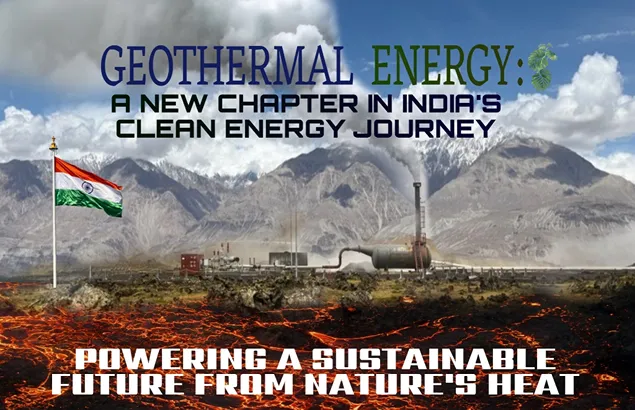

India’s renewable-energy story has largely been written in sunlight and wind. Now, another resource is drawing attention from beneath the country’s surface: geothermal heat. Unlike solar and wind, geothermal energy can provide power continuously. Therefore, it could offer India another way to diversify its renewable-energy portfolio. However, turning geological potential into commercially viable energy will require technology, investment and sustained exploration.
The timing is significant. India notified its National Policy on Geothermal Energy in September 2025. Then, in July 2026, the country reached another milestone in Ladakh. The ONGC Energy Centre commissioned India’s first two geothermal wells in Puga Valley. Together, these developments suggest that geothermal energy is moving from geological surveys towards practical demonstration.
Geothermal Energy: The Resource Beneath India
Geothermal energy is produced from heat stored within the Earth’s crust. That heat can appear naturally through hot springs and other geothermal manifestations. Where geological conditions permit, underground heat can be extracted for electricity generation. It can also be used directly for heating, agriculture, aquaculture and cooling applications.
The Ministry of New and Renewable Energy’s geothermal overview describes geothermal energy as a renewable resource available around the clock. It is also largely independent of weather conditions. This reliability gives geothermal energy a different strategic value. Solar generation falls when sunlight disappears. Wind generation varies with weather patterns. Geothermal resources, however, can potentially provide a more consistent supply.
At the same time, India’s resource base remains largely underdeveloped. Geological Survey of India assessments have identified hundreds of hot springs across the country. According to government data, India has about 381 documented hot springs. Furthermore, 42 geothermal manifestations have been identified as promising areas for power generation or direct heat applications.
The estimated theoretical geothermal potential is around 10,600 MW. However, theoretical potential should not be confused with commercially exploitable capacity. That distinction will be crucial as India moves towards actual projects.
Why Ladakh Could Become the First Major Test
Credits: Wikimedia commons
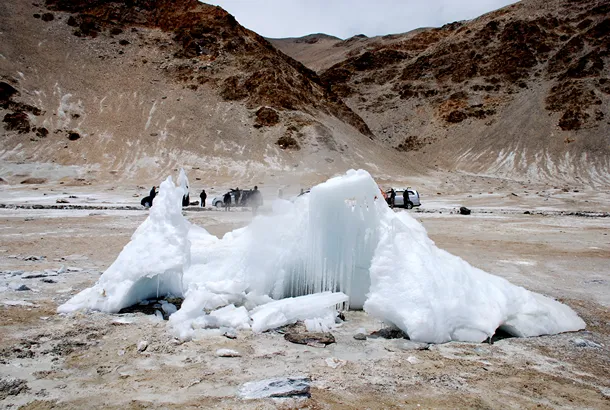
The most closely watched development is taking place in Puga Valley, Ladakh. Puga is already known for its hot springs and strong geothermal characteristics. More importantly, it has now become the site of India’s first two geothermal wells. The wells were drilled to around 1,000 metres. They are being used to evaluate the underground reservoir and understand its energy potential. The project is also expected to support India’s first 1-megawatt demonstration geothermal power project. Consequently, Puga could become an important testing ground for Indian geothermal technology and project economics. Yet, Ladakh presents both opportunity and difficulty.
The region sits at an altitude of more than 14,000 feet in parts of the Puga Valley area. Construction and maintenance therefore face difficult terrain and harsh weather. Infrastructure is another concern. Power projects require roads, equipment, transmission links and reliable logistical support. Nevertheless, these challenges make Ladakh strategically important. If geothermal systems can be developed successfully there, valuable lessons could be generated for other difficult locations. The experience could also help Indian institutions develop domestic expertise in drilling, reservoir assessment and geothermal power systems.
India’s Other Geothermal Projects
| Project / Location | State | Main Focus | Current Status / Significance |
| Gandhinagar | Gujarat | Solar–geothermal hybrid energy | Three geothermal wells have been drilled. Geothermal fluid of 70–80°C has been produced, with 50–90 kW electricity generation demonstrated. |
| Ankleshwar | Gujarat | Geothermal power from existing oil and gas wells | A pilot is assessing whether unproductive oil and gas wells can be retrofitted for geothermal power generation. Field investigations and baseline data have been completed. |
| Manuguru | Telangana | Small-scale geothermal power | A 20-kW pilot plant was commissioned using a closed-loop Binary Organic Rankine Cycle system. It provides early operational experience with geothermal electricity. |
| Tawang | Arunachal Pradesh | Resource assessment | Studies are underway at five geothermal sites, using field investigations and geochemical analysis to assess the region’s resources. |
| Hyderabad | Telangana | Geothermal cooling | Research is focused on developing a geothermal cooling system for air-conditioning applications through modelling and performance analysis. |
| Shallow Geothermal Pilot | India-wide / research | Heating and cooling | A pilot is developing analytical models for shallow geothermal systems using borehole heat exchangers. |
Geothermal Energy’s Wider Role in India’s Energy Security
The value of geothermal energy extends well beyond electricity generation. Its broader applications could also give India another tool for strengthening energy security. Geothermal heat can be used directly for agriculture, aquaculture, heating and cooling. It can also support district heating systems and ground-source heat pumps. Therefore, some geothermal resources could remain useful even where electricity generation is not commercially viable.
This creates a more flexible development model for India. Instead of asking whether every geothermal site can generate power, policymakers could assess which energy service suits each location best. For example, underground heat could support local heating without being converted into electricity. Similarly, agricultural and aquaculture projects could use geothermal heat directly. Consequently, smaller projects could become more practical in suitable regions.
The strategic value becomes clearer when viewed through the lens of energy security. India’s energy challenge is not only about producing more electricity. It is also about reducing exposure to external energy shocks and diversifying domestic energy sources. Geothermal energy could contribute to that diversification because its heat is locally available. Once a suitable reservoir is developed, its operation does not depend on imported fuel. Moreover, geothermal power can potentially provide steady generation alongside variable sources such as solar and wind.
This could make geothermal energy a useful complement to India’s wider renewable-energy system. At the same time, its direct-heating applications could help reduce fossil-fuel use in selected sectors. However, geothermal energy should not be viewed as a replacement for solar, wind or nuclear power. Its resources are geographically concentrated, while exploration and drilling can be expensive and technically uncertain. Therefore, its greatest strategic value may lie in complementing India’s existing energy mix rather than competing with its dominant renewable sources.
What Stands Between Potential and Reality?
India now has a policy framework and early demonstration activity. However, several obstacles remain.
Exploration Risk
A promising hot spring does not automatically guarantee a commercially viable power reservoir. More drilling and geological assessment will be required.
High Upfront Costs
Deep drilling and specialised equipment can make geothermal projects capital-intensive. Financing will therefore remain a major factor.
Technology and Expertise
India will need stronger domestic capabilities in geothermal drilling, reservoir modelling and power conversion technologies. The government is already encouraging international cooperation. India has cooperation mechanisms with countries including Australia, Iceland, Saudi Arabia and the United States.
Infrastructure
Many promising geothermal areas are located far from major industrial centres. Transmission infrastructure and difficult terrain could therefore affect project economics.
Commercial Viability
Ultimately, geological potential must translate into competitive energy costs. Demonstration projects will be important because they can establish actual performance under Indian conditions.
From Geological Potential to Strategic Asset
India’s geothermal journey is still at an early stage. The National Policy has created a framework for exploration and development. Meanwhile, Puga Valley has provided the country with a practical testing ground. The next phase will be more demanding. India will need better resource mapping, stronger research partnerships and private-sector participation. Pilot projects will also need to demonstrate whether geothermal systems can operate reliably and economically.
If those tests succeed, geothermal energy could occupy a useful niche within India’s broader energy transition. More importantly, its strategic value could extend beyond megawatts. Indigenous heat resources could support remote communities, reduce fossil-fuel dependence and provide reliable energy services in selected regions.
The question, therefore, is not whether geothermal energy can replace India’s major renewable sources. Instead, the bigger question is whether India can turn its underground heat into one more layer of energy security. Puga Valley may provide the first answer.
FAQs
What is geothermal energy?
Geothermal energy is renewable energy derived from heat stored inside the Earth. It can be used to generate electricity or provide direct heating and cooling.
How much geothermal potential does India have?
Government sources cite an estimated theoretical potential of about 10,600 MW. However, this figure does not represent commercially exploitable capacity.
Why is Puga Valley important?
Puga Valley in Ladakh hosts India’s first two geothermal wells. The wells are being evaluated for reservoir potential and could support a 1-MW demonstration power project.
Can geothermal energy generate electricity continuously?
Potentially, yes. One of geothermal energy’s major advantages is its ability to operate independently of sunlight and daily weather conditions, subject to the characteristics of the geothermal resource.
Is geothermal energy only useful for electricity?
No. It can also support direct heating, agriculture, aquaculture, district heating and cooling, and ground-source heat-pump applications.