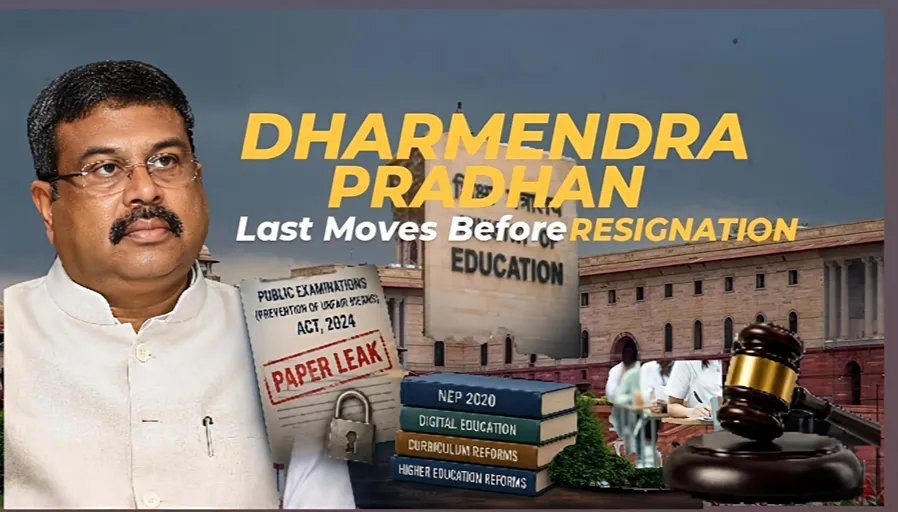

Few Union Education Ministers have left office under the level of public scrutiny that surrounded Dharmendra Pradhan. His final months in charge of the ministry were defined by intense debate over national entrance examinations, particularly following allegations of paper leaks. At the same time, his tenure concluded after a series of significant legislative and administrative measures aimed at strengthening India’s examination system and advancing broader education reforms. The Dharmendra Pradhan Resignation therefore signifies more than a political transition, it marks the conclusion of a consequential chapter in India’s education policy.
As concerns over examination integrity grew, Pradhan responded with a combination of legislative action, administrative reforms, and institutional reviews. His ministry introduced stricter legal provisions against examination malpractice, initiated changes to strengthen the National Testing Agency (NTA), and continued implementing key reforms under the National Education Policy (NEP) 2020. While critics questioned whether these measures were sufficient to restore public trust, supporters argued they laid the foundation for a more accountable and secure examination system. Regardless of differing views, the developments during his final months reshaped the national conversation on education governance, transparency, and the future of high-stakes examinations in India.
Early Life and Political Journey
Dharmendra Pradhan took charge as India’s Union Education Minister in July 2021 after serving in several key ministries of the central government. Born on 26 June 1969 in Talcher, Odisha, he comes from a political family. His father, Debendra Pradhan, was a senior Bharatiya Janata Party (BJP) leader and served as a Union Minister in the Atal Bihari Vajpayee government.
Pradhan began his political career through the Akhil Bharatiya Vidyarthi Parishad (ABVP) during his college years and gradually rose through the ranks of the BJP. He served as a Member of the Odisha Legislative Assembly, represented Deogarh in the Lok Sabha, and later represented Bihar and Madhya Pradesh in the Rajya Sabha before winning the Sambalpur Lok Sabha seat.
Before leading the Education Ministry, Pradhan held important portfolios, including Petroleum and Natural Gas, Steel, and Skill Development and Entrepreneurship. During these assignments, he gained a reputation for implementing large-scale government programmes such as the Pradhan Mantri Ujjwala Yojana, expanding skill development initiatives, and promoting industrial growth. This administrative experience shaped his approach to education, where he focused on implementing the National Education Policy (NEP) 2020, strengthening higher education, expanding digital learning, improving vocational training, and enhancing the credibility of national entrance examinations.
Key Education Reforms
While examination controversies largely dominated public discourse during his final months in office, Dharmendra Pradhan’s tenure also witnessed several landmark institutional reforms aimed at strengthening India’s education system. One of his most significant legislative achievements was the enactment of the Public Examinations (Prevention of Unfair Means) Act, 2024, the country’s first dedicated law to combat organized malpractice in public examinations. The legislation was introduced to curb paper leaks, impersonation, and other unfair means that had repeatedly undermined the credibility of recruitment and entrance examinations.
The Act established a stringent legal framework by prescribing imprisonment and substantial financial penalties for individuals and organized groups involved in examination fraud. It also empowered investigating agencies to take stronger action against those facilitating paper leaks and other examination-related offences. By criminalizing organized cheating networks and strengthening accountability, the law marked a major shift in India’s approach to protecting the integrity of public examinations. Supporters viewed it as a long-overdue reform that addressed a critical gap in the legal system, while also sending a strong message that large-scale examination malpractice would no longer be treated as a minor administrative issue.
Major Reforms Before Resignation
While examination controversies dominated the headlines, Dharmendra Pradhan’s tenure also brought major reforms to India’s education sector. His ministry advanced the National Education Policy (NEP) 2020, strengthened examination governance, expanded digital learning, modernised higher education, and enacted the Public Examinations (Prevention of Unfair Means) Act, 2024 to combat paper leaks and organised examination fraud. The timeline below highlights the key initiatives introduced during his tenure.
| Year | Reform / Initiative | Objective | Significance |
|---|---|---|---|
| 2021 | Assumed charge as Union Education Minister | Lead implementation of NEP 2020 | Began one of India’s largest education reform programmes. |
| 2021–2022 | Implementation of NEP 2020 | Reform school and higher education | Accelerated structural changes across the education system. |
| 2022 | Expansion of Digital Education (DIKSHA, SWAYAM, PM eVIDYA) | Improve access to quality learning | Strengthened digital education nationwide. |
| 2022 | Academic Bank of Credits (ABC) | Enable credit transfer across institutions | Increased flexibility in higher education. |
| 2022–2023 | Higher Education Reforms | Promote multidisciplinary learning | Encouraged innovation and institutional autonomy. |
| 2023 | NCERT Curriculum Review | Update textbooks under the National Curriculum Framework | Revised school curriculum and learning material. |
| 2023–2024 | NTA Reforms | Improve examination governance | Enhanced security, transparency, and accountability. |
| 2024 | Public Examinations (Prevention of Unfair Means) Act, 2024 | Prevent paper leaks and organised cheating | India’s first dedicated anti-paper leak law. |
| 2024 | Committee to Review NTA | Recommend improvements to examination systems | Focused on institutional reforms and efficiency. |
| 2024–2026 | Strengthening Examination Security | Introduce stricter security protocols | Restored confidence in national examinations. |
| 2024–2026 | Skill-Integrated Education | Align education with industry needs | Improved employability through vocational learning. |
| 2026 | Administrative Measures During Examination Crisis | Review and implement corrective actions | Marked the final phase of his tenure. |
Final Statement
Before the Dharmendra Pradhan Resignation, the Ministry of Education implemented several corrective measures in response to the NEET controversy, including administrative reforms and a review of examination governance. In his resignation letter, Pradhan said he had accepted responsibility from the outset of the crisis and stressed that the interests of students must remain the government’s highest priority. He also maintained that misinformation had influenced parts of the public narrative surrounding the issue. While outlining the reforms and corrective actions taken by his ministry, Pradhan said stepping down was in the larger public interest and would allow the government to focus on restoring trust in India’s examination system and broader education framework.
Conclusion
The Dharmendra Pradhan Resignation marks the end of a tenure that combined ambitious education reforms with unprecedented challenges. During his time as Union Education Minister, he advanced the implementation of the National Education Policy (NEP) 2020, introduced India’s first dedicated anti-paper leak law through the Public Examinations (Prevention of Unfair Means) Act, 2024, strengthened examination governance, and promoted digital and higher education reforms.
Although controversies surrounding national entrance examinations overshadowed his final months in office, his policy decisions have left a lasting impact on India’s education system. Whether these reforms ultimately restore public trust and strengthen examination integrity will determine how his tenure is remembered in the years ahead.
What is the Public Examinations (Prevention of Unfair Means) Act, 2024?
It is a central law designed to prevent organized cheating, paper leaks, and other unfair practices in public examinations by prescribing criminal penalties and fines.
What were Dharmendra Pradhan’s major education reforms?
His tenure included implementation of NEP 2020, expansion of digital learning, higher education reforms, curriculum reviews, and legislation against examination malpractice.
3. Why is examination security important?
A credible examination system protects merit, ensures fairness for students, and strengthens confidence in educational institutions.
4. How did the NEP 2020 progress during Pradhan’s tenure?
The ministry expanded multidisciplinary education, the Academic Bank of Credits, vocational education, and digital learning initiatives across schools and universities.