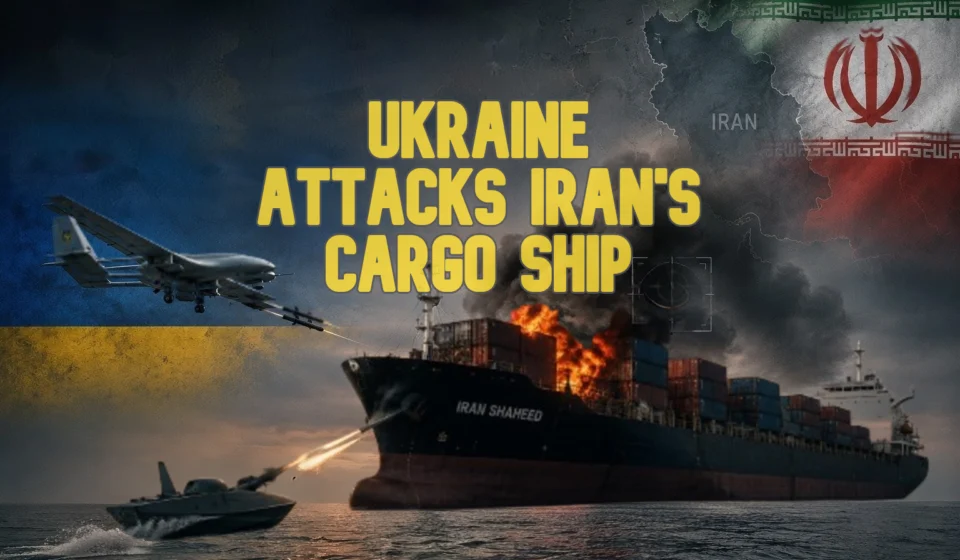

The Ukraine Caspian Sea strike has opened an unexpected chapter in the Russia-Ukraine war. Instead of targeting assets near the front lines, Ukraine reportedly struck an Iranian cargo vessel operating in the Caspian Sea. The move has raised difficult questions about how far the conflict could spread.
Although Kyiv says the operation targeted military logistics rather than civilian shipping, the incident carries consequences beyond the battlefield. It directly touches Iran, one of Russia’s most important strategic partners. As a result, analysts are now debating whether this strike represents a one-off operation or the beginning of a broader campaign against Russia’s overseas supply network.
Why Caspian Sea Strike Happened
Western governments have repeatedly accused Iran of supplying drones, ammunition, and military technology to Russia. Consequently, disrupting these routes could reduce Moscow’s ability to replenish military equipment. Ukraine appears to have calculated that weakening Russia’s logistics network may be as important as targeting forces on the battlefield.
Ukraine argues that military supply chains are legitimate wartime targets. Kyiv believes any vessel transporting equipment for Russia’s military becomes part of its war effort. By striking the Iranian cargo ship, Ukraine aimed to disrupt Russian logistics, increase the risks for countries supporting Moscow, and demonstrate its ability to hit strategic targets far beyond the front lines.
- Why India Rejected UK Migrant Returns Over Nirav Modi
- Sonam Wangchuk Reality: Facts Behind the Fame, Influence and Controversies
- India Develops First Indigenous 350kg Thrust Expendable Turbojet Engine: Why It Matters
- E20 Janta Party: Can Ethanol Politics Spark India’s Next Protest?
- Can India Restore Trust After NEET-UG Controversy?
Why the Caspian Sea Matters
The Caspian Sea is often viewed as an energy hub. However, since the Ukraine war began, it has gained greater strategic importance as a key transport and logistics corridor. Russia and Iran have increasingly relied on this route to move goods and maintain connectivity while facing restrictions elsewhere. The corridor links Iranian ports with southern Russia through waters controlled by regional states, making it valuable for trade and military logistics.
Iran has condemned the reported strike, warning against actions that threaten regional security. Tehran has repeatedly denied supplying weapons specifically for use in Ukraine, although Western intelligence agencies have accused Iran of providing drones and military technology that support Russia’s military operations. The incident could further strain relations between Kyiv and Tehran, but Iran will likely weigh any response carefully, as direct retaliation could internationalize the conflict and increase pressure from Western governments.
For Moscow, the Caspian corridor has become increasingly important due to the impact of Western sanctions on traditional trade routes. Russia has expanded its reliance on alternative logistics networks through friendly partners. If these routes become vulnerable to future attacks, Moscow could face higher transportation costs, longer delivery times, increased military logistics risks, and greater dependence on protected shipping. While a single strike may not significantly alter the course of the war, repeated disruptions could create serious challenges for Russia’s strategic planning.
Could This Escalate the War?
The conflict has already expanded beyond the battlefield through cyberattacks, sanctions, energy disputes, and maritime security concerns. The reported Caspian Sea strike has raised questions about whether the war could involve more countries and create a wider regional crisis. If tensions escalate further, Russia is likely to increase political and military support for Iran due to their growing strategic partnership. This could include intelligence sharing, logistics assistance, weapons cooperation, and diplomatic backing. However, direct Russian military intervention against Ukraine over a single incident would depend on the scale of escalation and Moscow’s broader strategic calculations.
China is less likely to support Iran militarily. Although Beijing maintains close economic and strategic ties with both Russia and Iran, it has avoided direct involvement in the Ukraine war. China would likely call for restraint while protecting its trade routes, energy interests, and regional stability rather than joining a military confrontation.
Other Caspian countries, including Azerbaijan, Kazakhstan, and Turkmenistan, are unlikely to become direct participants but may strengthen maritime security measures or adjust shipping policies if tensions rise. NATO members are also unlikely to enter the conflict directly unless their forces or territories are attacked. While a wider regional war remains unlikely, repeated strikes on strategic shipping routes, military assets, or foreign personnel could increase the risk of miscalculation and trigger a broader diplomatic crisis.
The impact of the strike could extend far beyond Ukraine and Iran. It may push Russia and Iran toward deeper military coordination as Moscow attempts to secure alternative supply routes. Meanwhile, countries around the Caspian Sea may reassess maritime security, and commercial operators could demand stronger protections. Although energy infrastructure was not directly targeted, instability in major transport corridors could increase shipping costs and insurance premiums. Western governments are also expected to closely monitor developments, as weaknesses in Russia’s supply networks could make sanctions and strategic pressure more effective.
Ukraine’s New Strategy?
Ukraine has increasingly focused on disrupting logistics instead of only targeting frontline positions. Recent operations have reportedly focused on oil infrastructure, ammunition depots, military airfields, railway networks, naval facilities, and long-range supply routes. If the Caspian operation proves effective, similar strategies could become more common. However, each strike also carries diplomatic risks, forcing Kyiv to balance military gains with the possibility of wider escalation.
What Happens Next?
Much depends on how Russia and Iran respond. If isolated, the strike may highlight Ukraine’s expanding reach. However, repeated attacks on key supply routes could increase regional tensions and force governments, shipping companies, and insurers to reassess risks in the Caspian Sea. The Ukraine Caspian Sea strike reflects how modern warfare is shifting beyond front lines toward logistics and strategic networks. If similar operations continue, the Caspian Sea could become a new geopolitical flashpoint.
The reported Ukraine Caspian Sea strike demonstrates how the conflict is evolving beyond traditional front lines. Rather than focusing solely on territorial battles, Ukraine appears increasingly willing to target the broader supply networks that sustain Russia’s military campaign.
Whether this marks the beginning of a sustained strategy remains uncertain. Nevertheless, the operation underscores the growing interconnectedness of modern warfare, where logistics, diplomacy, and regional partnerships are as important as military strength. If similar incidents continue, the Caspian Sea could emerge as another strategic flashpoint in an already complex geopolitical conflict.
Why did Ukraine reportedly attack an Iranian cargo ship?
Ukraine believes vessels transporting military-related cargo supporting Russia are legitimate military targets because they contribute to Moscow’s war effort.
Why is the Caspian Sea strategically important?
The Caspian Sea serves as a crucial transport corridor connecting Iran and Russia for trade, energy, and military logistics.
Has Iran admitted supplying weapons to Russia?
Iran has denied supplying weapons specifically for use in Ukraine, although Western governments continue to accuse Tehran of providing drones and military equipment.
Could this lead to a wider regional conflict?
It could increase tensions, but a broader conflict would depend on future military and diplomatic responses from Russia, Iran, and other regional actors.
How does this affect the Russia-Ukraine war?
If supply routes become less secure, Russia could face greater logistical challenges, potentially affecting its military operations over time.