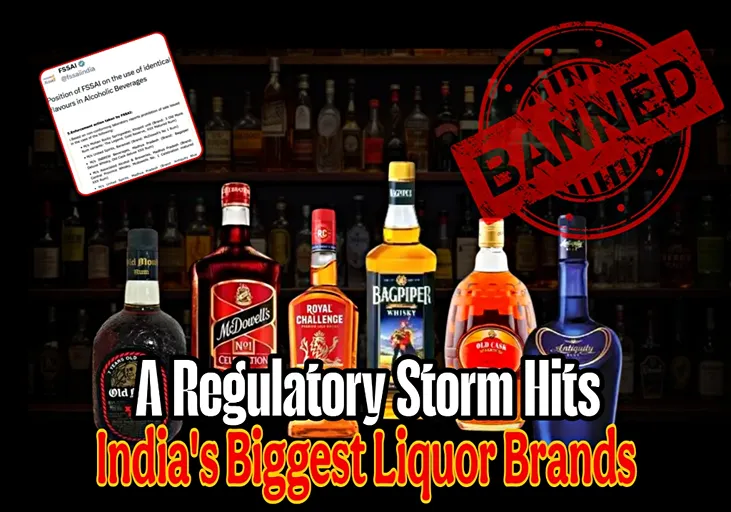

A regulatory order has placed some of India’s most recognizable liquor brands under intense public scrutiny. The FSSAI Liquor Crackdown is not just about a few product variants. Instead, it has raised wider questions about food safety compliance, manufacturing practices, and consumer transparency in India’s alcoholic beverage industry.
Moreover, the action signals that regulators are becoming more willing to enforce quality standards across established brands. As a result, both manufacturers and consumers are watching closely to understand what comes next.
What Is the FSSAI Liquor Crackdown?
The Food Safety and Standards Authority of India (FSSAI) recently directed authorities to stop the sale of selected liquor variants manufactured by some of India’s best-known alcohol companies. The action followed regulatory inspections that reportedly found violations involving flavouring practices and labelling requirements.
Importantly, the order does not cover every product sold under these brands. Instead, it applies only to specific variants manufactured at identified facilities.Therefore, consumers should understand that the regulatory action is targeted rather than a blanket ban on entire brands.
Why Did FSSAI Take Action?
According to regulatory findings, the issue was not simply about brand names. Instead, it concerned whether the products complied with standards prescribed under India’s food safety regulations.
Officials found concerns in several areas.
Use of Artificial Flavouring
One of the main concerns involved the use of artificial or nature-identical flavouring substances in certain whisky and rum variants. Traditionally, the aroma and taste of these spirits develop through fermentation, distillation, ageing, and blending. However, regulators believe some products relied on flavouring agents that altered the natural characteristics expected from these beverages.
Consequently, questions were raised about whether such products complied with prescribed standards.
Labelling Concerns
Another important issue related to product labels.
FSSAI reportedly observed that certain claims could create confusion regarding the production or ageing process of the liquor. Although the products were not declared unsafe for immediate consumption, regulators argued that consumers deserve accurate and transparent information before making purchasing decisions.
Food Standards Compliance
The regulator also concluded that some affected variants failed to meet prescribed quality requirements under existing food safety rules. Therefore, enforcement action was initiated until compliance issues are addressed.
Which Liquor Brands Were Affected?
The regulatory action attracted widespread attention because it involved several household names.
Among the affected variants were:
- Old Monk XXX Matured Rum
- Old Monk Gold Reserve
- Old Monk The Legend
- McDowell’s No.1 Celebration Rum
- Bagpiper Deluxe Whisky
- Royal Challenge Whisky
- Antiquity Blue Whisky
- Old Cask Deluxe XXX Rum
However, it is important to understand that only specified variants produced at particular manufacturing units were covered by the order. Therefore, the action should not be interpreted as a complete nationwide ban on every product sold under these brands.
Why This Action Is Significant
At first glance, the order appears to concern only a handful of liquor products. However, its broader implications extend far beyond individual bottles. India has one of the world’s largest alcohol markets. Millions of consumers purchase these brands every year. Consequently, any regulatory intervention involving such well-known products immediately attracts national attention.
More importantly, the action demonstrates that regulators are willing to scrutinize even market-leading brands. This sends a strong message across the alcoholic beverage industry.
Manufacturers may now review:
- Production methods: Companies may reassess how their spirits are produced, blended, flavoured, and processed. This could help ensure that every stage meets prescribed standards.
- Ingredient declarations: Manufacturers may provide clearer information about additives and flavouring substances used in their products. Greater transparency could also help consumers understand what they are purchasing.
- Quality assurance systems: Internal testing and monitoring procedures may be strengthened. Problems could then be detected before products are distributed to retailers.
- Labelling practices: Brands may review claims about ageing, ingredients, and manufacturing processes. Labels must accurately represent the product and should not create a misleading impression.
- Regulatory documentation: Companies may maintain more detailed records to demonstrate compliance during inspections. Proper documentation could also make regulatory reviews easier and more transparent.
As a result, industry-wide compliance standards could become stricter.
Impact on Consumers
For consumers, the immediate impact is not about product safety but about regulatory compliance and transparency. FSSAI has not stated that the affected liquor variants pose an immediate health risk. Instead, the regulator’s action is based on alleged violations of prescribed standards related to flavouring and labelling.
The crackdown has, however, drawn attention to the importance of clear and accurate product information. Consumers increasingly expect labels to reflect how a product is made and what ingredients or flavouring substances are used. By enforcing these standards, FSSAI aims to ensure that buyers receive accurate information and are not misled by product claims. If manufacturers strengthen compliance and improve transparency, the action could enhance consumer trust in both the regulatory system and the alcoholic beverage industry.actices.
Impact on the Liquor Industry
The Indian liquor industry operates in a highly regulated environment. Apart from excise laws administered by states, manufacturers must also comply with food safety standards established by FSSAI. Consequently, this action could encourage companies to undertake internal compliance reviews. Several developments may follow.
Greater Regulatory Audits
Manufacturing facilities could face more frequent inspections.
Better Quality Control
Companies may strengthen testing procedures before products reach the market.
Review of Product Labels
Marketing teams could revise product descriptions to ensure they accurately reflect manufacturing practices.
Increased Compliance Costs
Although compliance improvements require investment, they also reduce long-term regulatory risks.
Company Responses
The companies linked to the affected brands have defended their manufacturing practices. United Spirits, the Indian arm of Diageo, said its products comply with applicable laws and described the issue as an industry-wide matter. However, FSSAI’s ban on the identified liquor variants remains in force, while United Spirits has challenged the order in court. Meanwhile, Inbrew Beverages and Mohan Rocky Springwater, associated with the affected Old Monk variants, had not issued a public response when the ban was announced. The final outcome will depend on the ongoing legal proceedings.
Regulatory Framework Behind the Action
The Food Safety and Standards Authority of India functions under the Food Safety and Standards Act, 2006.
Its responsibilities include:
- Establishing food standards
- Monitoring food quality
- Regulating food businesses
- Protecting consumer interests
- Enforcing labelling requirements
Although alcohol is primarily regulated through state excise departments, FSSAI also oversees food safety aspects relating to alcoholic beverages.
Therefore, manufacturers must satisfy both food safety and excise requirements.
Could This Lead to Wider Industry Reforms?
The current The FSSAI Liquor Crackdown could mark a turning point for India’s alcoholic beverage industry. By taking action against well-known brands, the regulator has signalled that compliance with food safety and labelling standards will be closely monitored, regardless of a company’s market position.
As a result, liquor manufacturers may strengthen their quality control systems, review the use of flavouring substances, and ensure that product labels accurately reflect their ingredients and manufacturing processes. Companies could also increase internal audits and regulatory compliance checks to reduce the risk of similar enforcement actions.
If FSSAI continues conducting inspections across the sector, more manufacturers could come under scrutiny. This may encourage the industry to adopt higher compliance standards, improve transparency, and align production practices more closely with India’s food safety regulations. While the long-term impact remains uncertain, the crackdown has already reinforced the importance of regulatory compliance in one of the country’s largest consumer markets.
Held Under Controversies
The latest regulatory action has sparked significant debate across the alcohol industry. Some experts believe the crackdown reflects stronger consumer protection measures. They argue that flavouring practices and product claims should strictly comply with prescribed standards.
However, industry representatives maintain that some flavouring methods have long been used in spirit production. According to them, the interpretation of regulations remains open to discussion. Therefore, several companies are expected to seek legal or technical clarification from the authorities.
Another point of controversy concerns consumer perception. Since popular brands were named in the order, many buyers initially believed that all products under those labels had been banned. Later, it became clear that only specific variants manufactured at certain facilities were covered. This misunderstanding has highlighted the importance of clear public communication during regulatory actions. It has also renewed discussions on balancing consumer awareness with the reputation of established brands.
What Happens Next?
With the ban already in effect, the focus now shifts to how both regulators and manufacturers respond. The affected companies are likely to review their production methods, flavouring practices, and product labels to address the compliance issues identified by FSSAI. Some manufacturers, including United Spirits, have already challenged the regulator’s order in court, while others may seek regulatory clarification or take corrective measures to meet the required standards.
At the same time, FSSAI is expected to continue inspections and enforcement across the alcoholic beverage sector to ensure compliance with food safety and labelling regulations. The outcome of the ongoing legal proceedings, along with any future regulatory decisions, could shape how liquor manufacturers approach quality control, product formulation, and regulatory compliance in the years ahead. For consumers, the crackdown reinforces that established brands are also subject to the same food safety standards and regulatory oversight as any other manufacturer.
Conclusion
The FSSAI Liquor Crackdown is about far more than a few popular liquor brands. It reflects India’s growing focus on regulatory compliance, transparent labelling, and consumer protection. Although the affected products were not declared unsafe, regulators have made it clear that established brands are expected to meet the same standards as every other manufacturer.
The coming months will determine whether this remains an isolated enforcement action or marks the beginning of broader reforms across India’s alcoholic beverage industry. Either way, the crackdown has already become one of the most closely watched regulatory developments in the country’s liquor sector.
FAQ
What is the FSSAI Liquor Crackdown?
It refers to FSSAI’s regulatory action against specific liquor variants that allegedly violated food safety and labelling standards.
Has FSSAI banned all Old Monk and McDowell’s products?
No. The order applies only to selected variants manufactured at identified facilities, not every product sold under those brands.
Are the affected liquor products unsafe to drink?
FSSAI has not stated that the products pose an immediate health risk. The action focuses on compliance with flavouring and labelling regulations.
Why were flavouring substances questioned?
Regulators believe certain variants used artificial or nature-identical flavouring that may not comply with prescribed standards for those spirits.
What could happen next?
Manufacturers may update production practices, revise labels, submit compliance documents, or challenge the regulatory findings through legal and administrative channels.