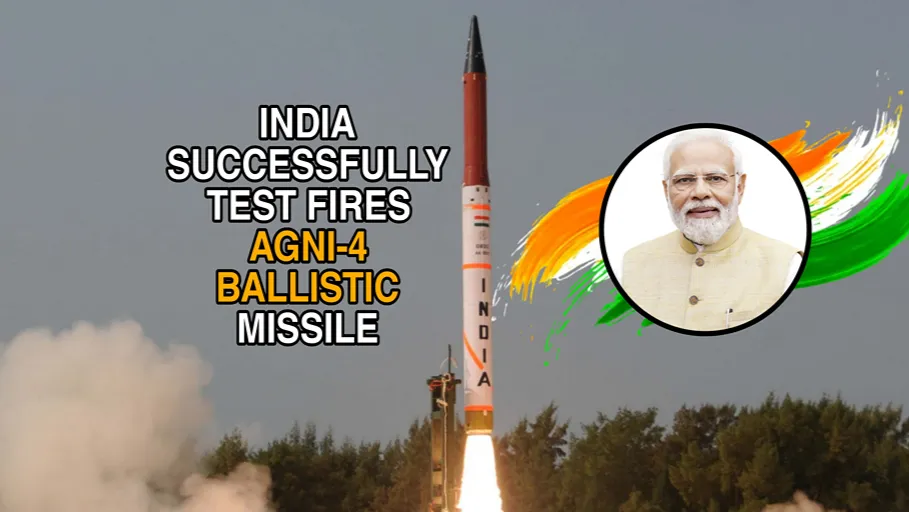
Agni-4 Ballistic Missile Test Fired Successfully: Powerful Facts That Boost India’s Defence Strength

Latest Update and Strategic Importance for India
India has achieved another significant milestone in defence technology with the successful test firing of the Agni-4 ballistic missile, strengthening its strategic deterrence capability. The latest trial showcases India’s growing expertise in developing advanced missile systems through indigenous technology. The Agni-4 ballistic missile was successfully launched from the Integrated Test Range (ITR), Chandipur, Odisha, under the supervision of the Strategic Forces Command (SFC). The test validated key systems, including navigation, guidance, propulsion, and re-entry technology, confirming the missile’s operational reliability.
The successful trial comes at a time when major global powers are rapidly upgrading their strategic missile capabilities. For India, the Agni-4 ballistic missile represents technological advancement, defence self-reliance, and stronger national security preparedness. As part of India’s Agni missile series, the system fills the gap between shorter-range missiles and advanced long-range platforms. The successful test further strengthens India’s ability to maintain credible deterrence and respond effectively to evolving security challenges.
What Is Agni-4 Ballistic Missile?
The Agni-4 ballistic missile is an intermediate-range ballistic missile (IRBM) developed by India to strengthen its strategic defence capabilities and provide a reliable long-distance strike option. Designed by the Defence Research and Development Organisation (DRDO), the missile plays an important role in India’s credible minimum deterrence strategy by ensuring that the country maintains the ability to respond effectively to potential security threats. Unlike conventional battlefield weapons, strategic missiles are primarily developed to act as deterrence systems. Their purpose is not only to strike targets but also to prevent conflicts by ensuring that adversaries understand the consequences of any aggressive action.
The Agni-4 ballistic missile represents a major advancement in India’s indigenous missile technology and reflects the country’s growing capability in designing and operating advanced strategic weapon systems. The missile has an approximate range of 4,000 kilometres, allowing it to cover significant distances and strengthen India’s strategic reach. It is equipped with a two-stage solid fuel propulsion system, which provides better operational readiness and reduces preparation time compared with liquid-fuel missile systems. The Agni-4 ballistic missile is launched from a road-mobile platform, giving Indian defence forces greater flexibility and survivability during critical situations. Its mobile launcher system makes it difficult for adversaries to detect and target the missile before deployment.
The missile was developed by the Defence Research and Development Organisation (DRDO) and tested at the Integrated Test Range (ITR), Chandipur, Odisha, one of India’s primary missile testing facilities. The testing process involves evaluating the missile’s propulsion, navigation, guidance, accuracy, and overall flight performance. The Agni-4 ballistic missile carries a payload capacity of around 1,000 kilograms and uses advanced navigation and control technologies to improve precision during long-range missions. These systems help the missile maintain accuracy even while travelling thousands of kilometres at extremely high speeds.
Overall, the Agni-4 ballistic missile is a key component of India’s strategic defence framework. With its long-range capability, advanced guidance system, mobility, and indigenous development, the missile strengthens India’s position among nations possessing sophisticated ballistic missile technology.
What Are the Key Features of Agni-4 Ballistic Missile?
The strength of the Agni-4 ballistic missile comes from several advanced technologies that improve accuracy, mobility, and survivability.
Long-Range Strike Capability
The missile can travel approximately 4,000 kilometres, allowing India to maintain strategic reach across a wide geographical area. This capability provides India with greater flexibility in planning defence strategies.
Advanced Navigation System
The missile uses sophisticated navigation technology that improves accuracy during long-distance flight. Modern ballistic missiles depend heavily on precision guidance because even small errors during launch can affect final accuracy.
Solid Fuel Propulsion
The use of solid fuel technology provides faster launch preparation compared to liquid-fuel systems. This improves operational readiness and reduces the time required before deployment.
Road-Mobile Capability
The Agni-4 ballistic missile can be launched from mobile platforms, making it harder for adversaries to detect and target. Mobility increases survivability during possible conflicts.
High Temperature Re-entry Technology
During its return journey through the atmosphere, the missile faces extreme heat and pressure. Advanced heat-resistant materials allow the warhead section to survive these conditions.
How Agni-4 Ballistic Missile Can Transform India’s Military Power and Global Strategic Position
The successful testing of the Agni-4 ballistic missile marks a significant advancement in India’s strategic defence capabilities. The missile strengthens India’s military position by improving its long-range strike capability, enhancing deterrence, and supporting the country’s vision of becoming more self-reliant in advanced defence technology. One of the most important contributions of the Agni-4 ballistic missile is the strengthening of India’s nuclear deterrence strategy. A reliable strategic missile system ensures that India maintains a credible second-strike capability, which plays a crucial role in maintaining regional stability. The objective of such weapons is not offensive expansion but preventing conflicts by ensuring that any potential threat is met with a strong and effective response capability.
The Agni-4 ballistic missile also enhances India’s defence preparedness by allowing armed forces to regularly evaluate missile performance, improve operational procedures, and maintain confidence in strategic systems. Continuous testing and technological upgrades are essential for advanced weapons because accuracy, reliability, and quick response capability determine their effectiveness during critical situations.= Another major advantage of the Agni-4 ballistic missile is its contribution to India’s strategic autonomy. The missile demonstrates India’s ability to design, develop, and operate complex defence systems using indigenous expertise. By reducing dependence on foreign defence technology, India strengthens its domestic defence industry and builds greater control over critical military capabilities.
The development of the Agni-4 ballistic missile also places India among a select group of nations that possess advanced ballistic missile technology. Countries such as the United States, Russia, China, France, and the United Kingdom have developed sophisticated missile systems as part of their strategic security frameworks. The United States operates advanced missile systems such as Minuteman III and Trident, which provide long-range strategic capabilities. Russia has developed powerful systems including Topol-M and Yars, designed for intercontinental missions. China’s DF-series missiles provide medium and long-range strike capabilities, while France’s M51 missile and the United Kingdom’s Trident missile system support their respective nuclear deterrence strategies.
India’s Agni series of missiles, including the Agni-4 ballistic missile, focuses on maintaining credible regional strategic deterrence. With an approximate range of 4,000 kilometres, the missile enhances India’s ability to safeguard national interests and maintain a strategic balance in the region. The capability of the Agni-4 ballistic missile gives India the ability to reach several strategically important areas within its operational range, including neighbouring regions and parts of Asia. However, such missiles primarily serve as deterrence tools designed to prevent conflicts rather than encourage military aggression.
Overall, the Agni-4 ballistic missile represents a major milestone in India’s defence modernisation journey. It strengthens nuclear deterrence, improves military readiness, supports indigenous defence development, and reinforces India’s position as a growing strategic power in the global security landscape.
Which Countries Can Agni-4 Reach?
The Agni-4 ballistic missile has a range of approximately 4,000 km. Its operational reach places several important regions within strategic consideration. Potential areas within this range include:
- Pakistan
- China’s western and southern regions
- Parts of Central Asia
- Indian Ocean strategic zones
However, missile capability does not automatically mean military targeting. Such systems primarily serve as deterrence tools designed to prevent conflict.
Role of DRDO and Other Institutions in Developing Agni-4 and India’s Future Defence Roadmap
The successful development of the Agni-4 ballistic missile is the result of decades of research, innovation, and collaboration between Indian scientists, engineers, defence organisations, and manufacturing partners. At the centre of this achievement is the Defence Research and Development Organisation (DRDO), which has played the primary role in designing, developing, testing, and improving the missile system. DRDO scientists have worked extensively on critical technologies such as advanced propulsion systems, guidance and navigation technology, composite materials, precision control systems, and flight testing mechanisms to ensure that the missile delivers high performance and reliability.
The development of the Agni-4 ballistic missile reflects the capabilities of India’s indigenous defence research ecosystem. Multiple DRDO laboratories have contributed to different aspects of missile development, including propulsion, electronics, structural design, and advanced communication systems. Continuous testing and evaluation have helped improve the missile’s accuracy, operational readiness, and overall effectiveness. The Strategic Forces Command (SFC) also plays an important role in the operational evaluation and management of India’s strategic missile systems. The involvement of SFC ensures that advanced missile platforms meet the requirements of the armed forces and remain prepared for strategic missions. Coordination between DRDO scientists and military personnel helps bridge the gap between technological development and operational deployment.
India’s growing defence manufacturing sector has also contributed significantly to the success of the Agni-4 ballistic missile programme. Public-sector organisations, private defence companies, and technology partners provide essential components, manufacturing support, and advanced materials required for missile production. This increasing participation of domestic industries supports India’s goal of achieving greater self-reliance under the defence indigenisation initiative. Looking ahead, the Agni-4 ballistic missile represents only one part of India’s larger defence modernisation roadmap. Future missile development efforts are expected to focus on improving accuracy, reducing deployment time, enhancing guidance systems, integrating advanced missile defence technologies, and exploring next-generation capabilities such as hypersonic systems.
As global security challenges continue to evolve, India’s missile programme will continue adapting through advanced research and technological innovation. The continued advancement of the Agni-4 ballistic missile and other strategic systems highlights India’s commitment to strengthening national security while building a powerful indigenous defence technology base. Through the combined efforts of DRDO, the armed forces, and the Indian defence industry, the country is moving towards a more advanced and self-reliant military capability.
What is Agni-4 ballistic missile?
The Agni-4 ballistic missile is an intermediate-range ballistic missile developed by DRDO to strengthen India’s strategic defence capabilities.
What is the range of Agni-4 missile?
The missile has an approximate range of around 4,000 kilometres.
Who developed Agni-4 missile?
The missile was developed by the Defence Research and Development Organisation (DRDO) with support from Indian defence institutions and industries.
Why is Agni-4 important for India?
The missile improves India’s strategic deterrence capability and strengthens national security preparedness.
Which countries have similar ballistic missile technology?
Countries including the United States, Russia, China, France, and the United Kingdom possess advanced ballistic missile systems.
By Sahil Koul | National Affairs Analyst covering Indian politics, governance, public policy, and major developments shaping the nation.