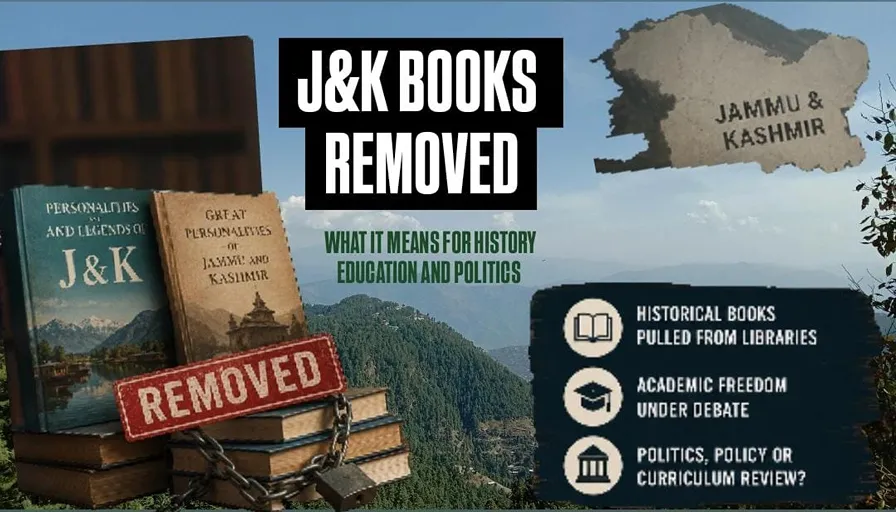

The decision that led to J&K books removed from several libraries and universities has sparked widespread debate. The withdrawal of “Personalities and Legends of J&K” and “Great Personalities of Jammu and Kashmir” has raised questions about academic freedom and historical narratives. According to the Jammu and Kashmir administration, the books were removed because they allegedly glorified separatist leaders and promoted anti-India content.
While governments regularly review educational material, the removal of books from a politically sensitive region has drawn greater scrutiny. Supporters see it as a step to safeguard educational content, while critics argue it could limit access to diverse historical perspectives and academic debate.
What Are the Two Books About?
“Personalities and Legends of J&K” and “Great Personalities of Jammu and Kashmir” are books that profile influential figures from Jammu and Kashmir’s history, culture, religion, and politics. They include biographies of rulers, saints, scholars, poets, social reformers, and political leaders, aiming to present the region’s historical and cultural evolution.
However, the Jammu and Kashmir administration alleged that parts of the books went beyond historical documentation by portraying separatist leaders and individuals convicted in terrorism-related cases in a positive light. Officials said the books referred to figures such as Maqbool Bhat, Syed Ali Shah Geelani, and Masarat Alam Bhat as “martyrs” or “legends” and used terms like “Indian-occupied Kashmir.” These allegations formed the basis for their removal from libraries and educational institutions.
Why Were the J&K Books Removed?
The Jammu and Kashmir administration said it removed “Personalities and Legends of J&K” and “Great Personalities of Jammu and Kashmir” because they allegedly contained content glorifying separatist leaders and convicted terrorists while describing India as an occupying state. According to officials, the books referred to figures such as Maqbool Bhat, Syed Ali Shah Geelani, and Masarat Alam Bhat in positive terms and used expressions like “Indian-occupied Kashmir.”
The administration also cited serious lapses in the review process under the Samagra Shiksha scheme, saying the books were approved without adequate scrutiny. Following the decision, authorities withdrew the books from schools and libraries, blacklisted the authors and publishers, suspended several education officials, and launched a police investigation into their distribution.
Current Developments
The Jammu and Kashmir administration has launched a wide-ranging crackdown following the discovery of the two books in government schools and libraries. Authorities ordered the immediate withdrawal of “Personalities and Legends of J&K” and “Great Personalities of Jammu and Kashmir”, alleging that the publications contained content promoting separatist narratives and glorifying individuals linked to militancy.
The government has also blacklisted the authors and publishers, suspended eight School Education Department officials, and disengaged one contractual employee over alleged lapses in the review process. Meanwhile, the Counter-Intelligence Kashmir (CIK) wing of the J&K Police has registered an FIR and initiated an investigation into how the books were approved and distributed under the Samagra Shiksha scheme.
Key Facts About the J&K Books Removal
The controversy centres on “Personalities and Legends of J&K” and “Great Personalities of Jammu and Kashmir”, two books that were reportedly distributed to government schools and libraries under the Samagra Shiksha scheme. The Jammu and Kashmir administration ordered their withdrawal after alleging that the books glorified separatist leaders and contained anti-India narratives.
Following the decision, authorities recalled all copies, blacklisted the authors and publishers, suspended eight School Education Department officials, and launched a high-level inquiry. The Counter-Intelligence Kashmir (CIK) wing also registered an FIR and began investigating the procurement and distribution of the books, making the issue one of the most significant education-related controversies in the region in recent years.
Politics Behind the Book Removal?
The removal of the two J&K books has fueled political debate because Jammu and Kashmir remains one of India’s most sensitive regions. The administration argued that the books contained separatist and anti-India narratives, making their withdrawal necessary to prevent the promotion of content that could influence students. Officials described the move as an effort to protect educational institutions from material considered contrary to national interests.
However, the decision has also sparked concerns about academic freedom and the role of governments in shaping historical narratives. While supporters view the action as a legitimate step to remove allegedly biased content, critics argue that historical debates should be addressed through scholarly discussion rather than restricting access to books. As a result, the controversy has become part of a broader conversation about education, politics, and how history is presented in conflict-sensitive regions.
Books That Have Faced Restrictions in India
| Year | Book | Author | Nature of Restriction | Primary Reason |
|---|---|---|---|---|
| 1988 | The Satanic Verses | Salman Rushdie | Import banned by the Government of India | Religious controversy and concerns over public order |
| 1993 | Understanding Islam through Hadis | Ram Swarup | Banned in parts of India under legal provisions | Alleged offensive religious content |
| 2004 | Shivaji: Hindu King in Islamic India | James W. Laine | Banned in Maharashtra (later lifted by courts) | Public protests over historical references |
| 2009 | Jinnah: India–Partition–Independence | Jaswant Singh | Temporarily banned in Gujarat (later overturned) | Political controversy regarding Muhammad Ali Jinnah |
| 2014 | The Hindus: An Alternative History | Wendy Doniger | Withdrawn from publication in India by publisher following legal action | Religious objections and legal dispute |
| 2014 | Madhorubhagan (One Part Woman) | Perumal Murugan | Faced withdrawal after protests (later restored following court support) | Religious and cultural objections |
Key Takeaways
Book restrictions in India have occurred for different religious, political, and historical reasons. While some books were banned or withdrawn, others later returned after legal challenges.
Similarly, the reported removal of the two J&K books has sparked debate over academic freedom and historical interpretation. However, each case has unique circumstances and should be assessed on its own merits.
Was the Removal Justified?
Whether the removal was justified depends on one’s perspective. The Jammu and Kashmir administration argued that the books contained content glorifying separatist leaders, promoting anti-India narratives, and referring to Jammu and Kashmir as “Indian-occupied Kashmir.” Officials said withdrawing the books was necessary to ensure educational materials align with national interests and do not promote extremist or separatist ideologies.
Critics, however, argue that removing books from libraries may limit academic freedom and access to diverse historical perspectives. They contend that controversial works should be critically examined rather than removed entirely. Ultimately, the debate reflects the broader challenge of balancing national security concerns with the principles of open academic inquiry and historical scholarship.
Conclusion
The removal of “Personalities and Legends of J&K” and “Great Personalities of Jammu and Kashmir” has become more than an education-related decision. It has reignited debate over how history should be taught, who shapes historical narratives, and where the balance lies between national security and academic freedom. While the Jammu and Kashmir administration maintains that the books promoted separatist and anti-India narratives, critics argue that restricting access to historical works could limit scholarly discussion.
As investigations continue, the controversy is likely to remain a significant issue in both education and politics. The outcome may influence how educational content is reviewed in the future, particularly in politically sensitive regions. Ultimately, the debate highlights the challenge of preserving historical inquiry while ensuring that educational materials meet established legal and policy standards.
Why were the J&K books removed?
The Jammu and Kashmir administration said the books were removed because they allegedly glorified separatist leaders and convicted terrorists, promoted anti-India narratives, and described Jammu and Kashmir as “Indian-occupied Kashmir.”
Which books were removed?
The books are “Personalities and Legends of J&K” and “Great Personalities of Jammu and Kashmir.” They were reportedly distributed to government schools and libraries under the Samagra Shiksha scheme.
What action did the government take?
Authorities withdrew the books from educational institutions, blacklisted the authors and publishers, suspended eight School Education Department officials, and launched a police investigation into their procurement and distribution.
Was the removal legally justified?
The administration maintains that the action was necessary to prevent educational materials from promoting separatist or extremist narratives. However, critics argue that the decision raises concerns about academic freedom and access to historical literature.
Why has this issue become politically significant?
The controversy goes beyond two books because it involves Jammu and Kashmir, a region with a complex political history. It has sparked wider debates over education, historical narratives, national security, and academic freedom.