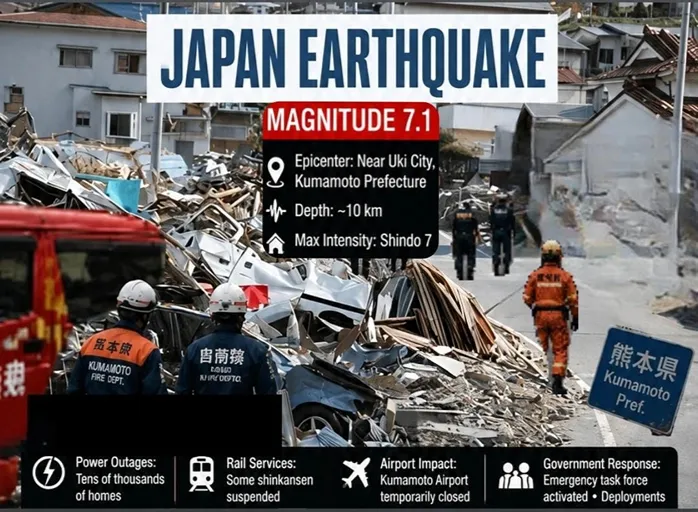

Japan’s latest earthquake has once again reminded the world that even the most prepared nation cannot eliminate the threat of powerful natural disasters. A strong 7.1-magnitude earthquake struck southwestern Japan on July 28, shaking cities across Kyushu, disrupting transport, damaging infrastructure, and triggering emergency operations.
Authorities moved quickly to assess the damage while issuing tsunami advisories and warnings about aftershocks. Although Japan’s advanced disaster management system helped reduce the immediate impact, the event has renewed questions about infrastructure resilience, economic disruption, and long-term seismic risks.
Magnitude and Epicenter
The Japan Earthquake measured magnitude 7.1, according to the Japan Meteorological Agency. Its epicenter was located near Uki City in Kumamoto Prefecture on the island of Kyushu, at a shallow depth of about 10 kilometres, resulting in intense ground shaking across the region.
The quake reached Shindo 7, the highest level on Japan’s seismic intensity scale, with residents reporting violent tremors. Authorities briefly issued a tsunami advisory for the Ariake and Yatsushiro seas before lifting it after further assessments confirmed there was no major tsunami threat.
Current Damage Assessment
Initial reports indicate widespread disruption across Kumamoto Prefecture and nearby areas. The Japan Earthquake caused multiple injuries, damaged roads, bridges, and older buildings, and led to the partial collapse of a shopping mall. Authorities also suspended Kyushu Shinkansen services, temporarily closed Kumamoto Airport, and reported power outages affecting tens of thousands of households.
Emergency response teams, firefighters, police, and the Self-Defense Forces were quickly deployed to support rescue efforts. Meanwhile, ongoing aftershocks have complicated recovery operations, prompting officials to warn residents about the risks of landslides, structural damage, and possible fires.
Japan’s Earthquake Preparedness
Japan is one of the world’s most earthquake-prepared countries. After major disasters such as the 1995 Kobe Earthquake, the 2011 Great East Japan Earthquake, and the 2016 Kumamoto Earthquake, the government strengthened building standards, expanded earthquake early warning systems, and improved nationwide disaster preparedness through regular drills and public awareness programmes.
These measures cannot stop earthquakes, but they significantly reduce casualties and damage. Following the latest Japan Earthquake, authorities quickly activated emergency response teams, deployed the Self-Defense Forces, coordinated rescue operations, and warned residents to remain alert for aftershocks and possible landslides.
Japan’s Long History of Earthquakes
Japan experiences some of the world’s highest levels of seismic activity because it sits along the Pacific Ring of Fire, where several major tectonic plates meet. The country records more than 1,500 felt earthquakes every year, although most are minor and cause little or no damage.
Several historic earthquakes have reshaped Japan’s disaster management policies.
| Year | Earthquake | Magnitude | Major Impact |
|---|---|---|---|
| 1923 | Great Kanto Earthquake | 7.9 | Over 100,000 deaths |
| 1995 | Great Hanshin (Kobe) | 6.9 | More than 6,400 deaths |
| 2011 | Great East Japan (Tohoku) | 9.0 | Tsunami and Fukushima nuclear disaster |
| 2016 | Kumamoto Earthquake | 7.0 | Infrastructure destruction across Kyushu |
| 2024 | Noto Peninsula Earthquake | 7.6 | Major damage across central Japan |
| 2026 | Kumamoto Earthquake | 7.1 | Significant infrastructure damage and rescue operations underway |
Japan Earthquake Statistics
The latest Japan Earthquake measured magnitude 7.1 and struck near Uki City in Kumamoto Prefecture at a depth of about 10 km. The quake reached Shindo 7, Japan’s highest seismic intensity, causing severe ground shaking across Kyushu.
A tsunami advisory was issued but later lifted. The earthquake caused power outages affecting tens of thousands of homes, suspended Kyushu Shinkansen services, and temporarily closed Kumamoto Airport. In response, the Japanese government activated an emergency task force, deploying rescue teams and the Self-Defense Forces while warning residents about possible aftershocks.
How Many Earthquakes Occur in Asia?
Asia experiences the highest number of earthquakes of any continent, recording an estimated 100,000 to 150,000 or more earthquakes each year. Most of these are too small to be felt by people and are detected only by sensitive seismic instruments. However, around 20,000 to 30,000 earthquakes are strong enough to be felt, while approximately 100 to 150 earthquakes reach magnitude 6.0 or higher annually. On average, 10 to 20 major earthquakes (magnitude 7.0+) occur in Asia each year, with an occasional magnitude 8.0 or greater earthquake.
The continent’s high seismic activity is primarily due to its location along the Pacific Ring of Fire, where several major tectonic plates, including the Pacific, Eurasian, Philippine Sea, and Indo-Australian plates, interact. In addition, the ongoing collision between the Indian Plate and the Eurasian Plate continues to create intense seismic activity across the Himalayan region. As a result, countries such as Japan, Indonesia, China, Nepal, Taiwan, India, Iran, and Turkey experience frequent earthquakes, making Asia the world’s most earthquake-prone continent.
What was the magnitude of the latest Japan Earthquake?
The earthquake measured magnitude 7.1, according to the Japan Meteorological Agency.
Where was the earthquake’s epicenter?
The epicenter was near Uki City in Kumamoto Prefecture on Japan’s Kyushu island.
Why does Japan experience so many earthquakes?
Japan lies on the Pacific Ring of Fire, where multiple tectonic plates converge, making it one of the world’s most earthquake-prone countries.
How many earthquakes occur in Japan each year?
Japan experiences more than 1,500 felt earthquakes annually, although the vast majority are minor.
How prepared is Japan for earthquakes?
Japan operates one of the world’s most advanced earthquake preparedness systems, including early warning technology, strict building standards and regular public emergency drills.