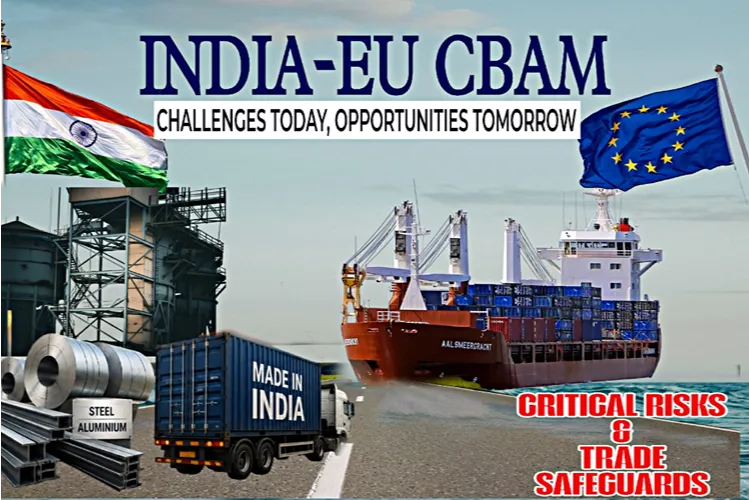

Europe’s climate policy is rapidly becoming a trade issue for India. The European Union’s Carbon Border Adjustment Mechanism (CBAM) has entered its definitive phase, creating new compliance and cost considerations for Indian exporters of carbon-intensive goods.
But there is a significant new development. In January 2026, India and the EU announced the conclusion of their long-awaited Free Trade Agreement, with New Delhi securing specific provisions on carbon pricing, verification, technical cooperation and financial support.
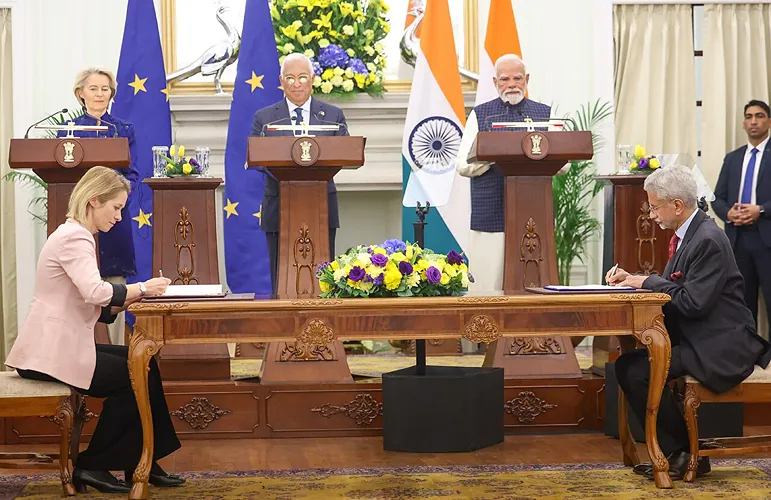
Photo: Prime Minister’s Office
The result is a more complicated picture than simply an EU carbon measure hurting Indian exports. CBAM remains a challenge, but India has also negotiated mechanisms intended to help its industries adapt.
What Is CBAM and Why Does It Matter to India?
The Carbon Border Adjustment Mechanism (CBAM) is the European Union’s system for addressing the carbon emissions embedded in certain goods imported into its market. The basic idea is straightforward: European manufacturers already face carbon costs under the EU’s climate framework. Without a corresponding mechanism for imports, the EU argues that foreign producers could gain a price advantage by operating under less stringent carbon constraints. This could encourage carbon leakage, where production shifts to countries with weaker climate regulations. CBAM is designed to address that gap.
Its transitional phase began on 1 October 2023, when importers started reporting the greenhouse-gas emissions embedded in covered products without yet facing the full financial mechanism. The transitional period ended on 31 December 2025, and the definitive regime began on 1 January 2026. This makes 2026 the first year of the definitive system. The first annual CBAM declarations and corresponding certificate surrender for 2026 imports will take place in 2027.
Initially, CBAM covers six sectors: cement, iron and steel, aluminium, fertilisers, electricity and hydrogen. For India, steel and aluminium are particularly significant because of their importance to the country’s industrial and export sectors. If an Indian producer manufactures a carbon-intensive product, the European importer can face a higher carbon-related cost, which may eventually affect the Indian exporter through pricing, profit margins and competitiveness.
It is also important to clarify that CBAM is not a conventional tax charged directly to the Indian government or Indian exporter. The immediate compliance and financial obligation falls on the EU importer. However, the additional cost can travel through the supply chain, potentially making carbon-intensive Indian products more expensive in the European market.
The five major risks for Indian exporters
1. Higher costs: Carbon-intensive products can become more expensive in the European market.
2. Competitiveness pressure: Indian producers could face stronger competition from manufacturers with lower emissions intensity.
3. Decarbonisation costs: Companies need to invest in cleaner technologies, renewable energy and more efficient production.
4. Reporting and verification burden: Exporters increasingly need accurate product-level emissions data and credible verification.
5. Pressure on smaller businesses: Smaller manufacturers may find carbon accounting and technological upgrades more difficult and expensive than large corporations.
The challenge is therefore not simply paying a carbon-related cost. It is adapting India’s manufacturing system to a trading environment in which carbon intensity increasingly influences market access and price.
India’s Response and the New FTA Safeguards
India has not responded to the European mechanism through diplomacy alone. It is simultaneously developing domestic carbon-market mechanisms and encouraging industries to reduce their emissions. A central part of this response is the Carbon Credit Trading Scheme (CCTS) and the broader Indian Carbon Market (ICM).
The framework is intended to give emissions reductions an economic value and encourage industries to improve their emissions intensity. Better measurement and verification can also help Indian exporters produce the information increasingly required by international markets.
Steel has received particular attention because of its importance to Indian industry and its exposure to carbon-related trade requirements. Government initiatives around green steel and the Green Steel Taxonomy are intended to support the shift towards lower-emission production.
However, India’s domestic carbon market does not automatically cancel CBAM obligations. The EU has its own rules governing embedded emissions and recognition of carbon prices paid outside Europe. India’s domestic mechanisms therefore need to work alongside international negotiations and export-sector decarbonisation.
The January 2026 breakthrough
This is where the India–EU Free Trade Agreement changes the story. On 27 January 2026, Prime Minister Narendra Modi and European Commission President Ursula von der Leyen announced the conclusion of the India–EU FTA at the 16th India–EU Summit.
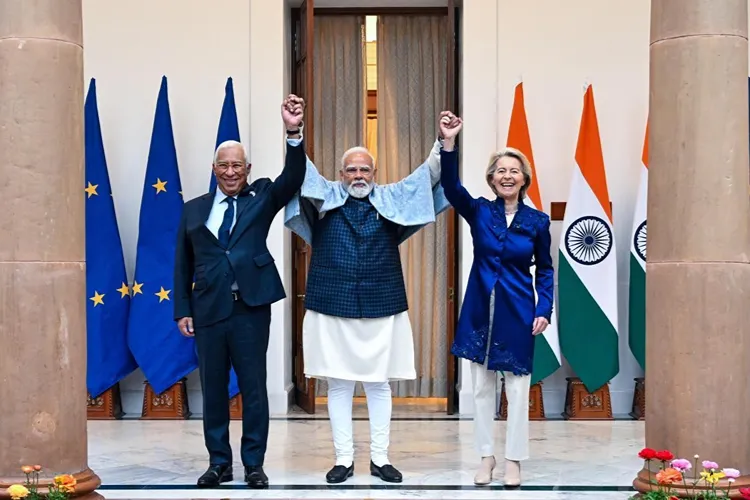
© European Union, 2026, licensed under CC BY 4.0
India secured forward-looking CBAM provisions covering five important areas:
- Most-Favoured-Nation assurance, providing flexibility if the EU grants relevant treatment to third countries under its carbon-border rules.
- Technical cooperation on recognition of carbon prices, potentially helping India and the EU address how domestic carbon pricing interacts with European requirements.
- Recognition of verifiers, an important issue because credible emissions verification is central to compliance.
- Financial assistance to support emissions reduction.
- Targeted support to help Indian industries reduce greenhouse-gas emissions and comply with emerging carbon requirements.
These provisions do not mean that Indian exporters are exempt from the European mechanism. Instead, they create a framework for cooperation, negotiation and assistance as Indian industry adjusts. The FTA announcement is therefore significant because India has moved from simply responding to an external environmental trade measure to securing a formal framework for engagement around it.
The scale of the India–EU relationship
The significance of these negotiations becomes clearer when the size of bilateral trade is considered.
| India–EU trade indicator | Figure |
| Bilateral goods trade, 2024–25 | US$136.54 billion |
| India’s goods exports to EU, 2024–25 | US$75.85 billion |
| India’s goods imports from EU, 2024–25 | US$60.68 billion |
| India–EU services trade, 2024 | US$83.10 billion |
| Indian exports receiving preferential access under FTA | Over 99% by trade value |
| Labour-intensive exports targeted for major tariff reductions | US$33 billion |
| EU subsectors accessible to Indian service providers | 144 |
| EU sectors/sub-sectors offered for Contractual Service Suppliers | 37 |
| EU sectors/sub-sectors offered for Independent Professionals | 17 |
The FTA is broader than carbon policy. It covers goods, services, rules of origin, customs, trade facilitation, digital trade, intellectual property, mobility and other areas.
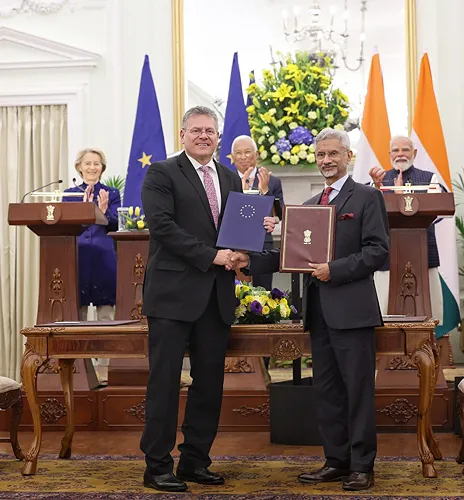
Photo: Prime Minister’s Office
For Indian exporters, more than 99% of exports by trade value are set to receive preferential access under the agreement. Around US$33 billions of exports in labour-intensive sectors such as textiles, leather, marine products, gems and jewellery and related industries are highlighted as major beneficiaries. Agriculture also receives greater access, while India has protected sensitive areas including dairy and several agricultural products. This makes the carbon question even more important: greater market access is valuable only if Indian businesses can remain competitive under Europe’s evolving regulatory requirements.
Can India Turn the CBAM Challenge Into an Advantage?
The biggest question now is whether Indian industry can turn carbon compliance into a competitive advantage rather than simply treating it as an additional cost. The risks are real. Steel, aluminium and other energy-intensive industries may require substantial investment to reduce emissions, while smaller exporters could struggle with emissions measurement, verification and reporting. If Indian products remain more carbon-intensive than competing goods, European buyers may face higher costs, potentially affecting demand and the competitiveness of Indian exports.
At the same time, there is an opportunity. Companies that invest in cleaner manufacturing, renewable energy and more efficient technologies can potentially reduce their exposure to future carbon costs while positioning themselves for markets where low-carbon production is increasingly valued. India’s domestic carbon-market framework, green-steel initiatives and the CBAM provisions secured through the India–EU FTA can work together to support this transition.
The FTA also creates a wider platform for cooperation in clean technologies, artificial intelligence and semiconductors, opening possibilities for technology partnerships and investment that could help modernise Indian industry. For New Delhi, the strategy is therefore becoming clearer: protect market access, negotiate fair treatment, improve emissions measurement and accelerate industrial decarbonisation.
There is, however, an important caveat. The conclusion of the India–EU FTA does not mean every provision becomes operational immediately. The agreement must go through the relevant legal and ratification processes before it enters into force. For exporters, however, the direction of travel is already clear: carbon emissions are becoming a commercial factor alongside price, quality, logistics and productivity.
CBAM may have begun as an EU climate measure, but its implications now extend far beyond environmental policy. It is pushing India to rethink how its industries compete in global markets while encouraging a deeper economic relationship with Europe. The real test will be whether India can use this transition to build cleaner industries without sacrificing its cost advantage. If it succeeds, what initially appears to be a threat could become an opportunity—combining greater access to the European market, greener manufacturing and a stronger position in the next generation of global trade.
What is CBAM?
CBAM stands for Carbon Border Adjustment Mechanism. It is an EU system designed to address the carbon emissions embedded in certain imported goods and reduce the risk of carbon leakage.
When did CBAM become effective?
Its transitional reporting phase began on 1 October 2023. The definitive regime began on 1 January 2026. The first annual declaration and certificate surrender relating to 2026 imports take place in 2027.
Which Indian industries are most affected?
Steel and aluminium are among the most significant Indian sectors exposed to the mechanism. Cement, fertilisers, electricity and hydrogen are also among the sectors initially covered.
Does the India–EU FTA remove CBAM for Indian exporters?
No. The FTA does not provide a blanket exemption. Instead, India secured provisions covering carbon-price recognition, verifier recognition, technical cooperation, financial assistance, targeted support and an MFN assurance relating to the EU’s carbon-border framework.
Can India’s Carbon Credit Trading Scheme reduce CBAM costs?
India’s Carbon Credit Trading Scheme can help industries measure and reduce their emissions, but participation does not automatically eliminate European obligations. The EU determines how foreign carbon prices and emissions reductions are recognised under its own rules.