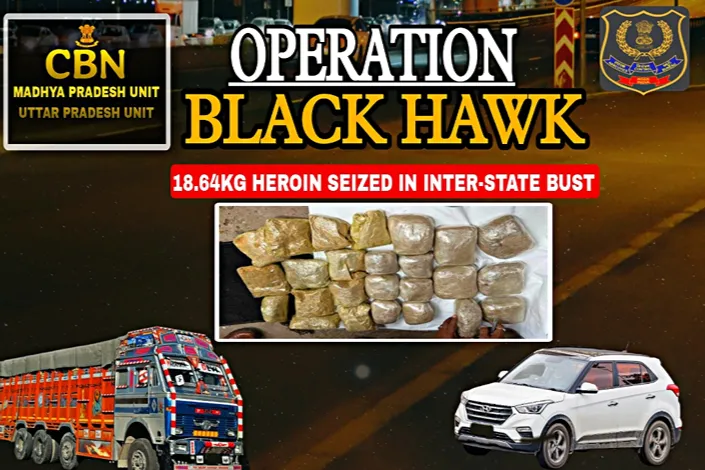

A major CBN heroin bust near Lucknow has exposed an inter-state trafficking network moving narcotics from the Northeast toward Uttar Pradesh. The operation resulted in 18.64 kg of crude heroin being seized and three suspected members of the network being arrested.
What makes the case more significant is how the heroin was transported. In one vehicle, the consignment was hidden inside a specially fabricated fuel-tank compartment. In another, it was concealed inside a secret chamber in a truck’s body frame. The seizures therefore point to a trafficking model that relies on long-distance road movement, vehicle modification and careful concealment.
How Operation Black Hawk Exposed Hidden Heroin Compartments
The operation began with intelligence developed by the CBN Madhya Pradesh Unit about suspected drug movement from the Northeast toward Lucknow. Based on those inputs, joint teams from the CBN Madhya Pradesh and Uttar Pradesh units established surveillance along the Sultanpur–Lucknow Highway during the intervening night of August 20 and 21, 2026.
The first breakthrough came on August 21, when an Assam-registered Hyundai Creta was tracked through multiple toll plazas and intercepted near Lucknow. The vehicle initially appeared empty, while its occupants denied involvement in drug trafficking. However, officers became suspicious after learning that the vehicle had been refuelled four times over roughly 500 kilometres.
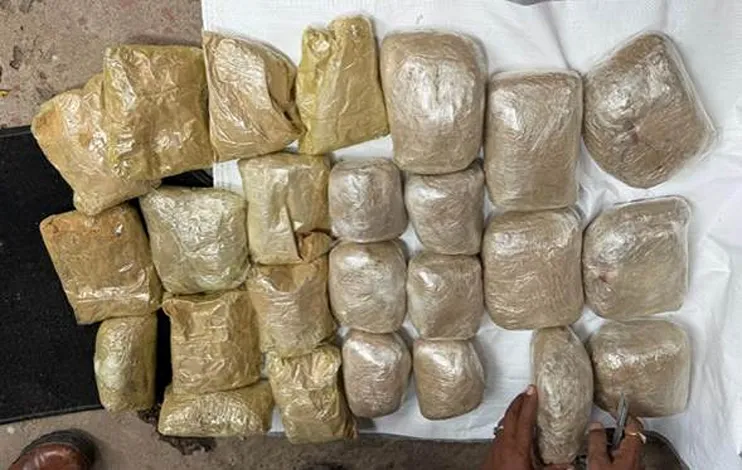
A physical tapping test of the fuel tank produced a hollow acoustic response. The vehicle was then taken to the CBN office in Lucknow, where technical assistance was used to dismantle the tank. Officers discovered a specially fabricated compartment containing 25 waterproof packages with 16.46 kg of crude heroin. Two suspects were arrested.
The operation then uncovered a second concealment method. Acting on separate intelligence, the CBN Uttar Pradesh Unit tracked a heavy truck travelling along the Siliguri–Lucknow corridor. After following it through multiple toll plazas, officers intercepted the vehicle near Barabanki. A detailed search revealed 2.16 kg of crude heroin hidden inside a specially constructed chamber within the truck’s body frame. One suspect was arrested. Together, the two recoveries resulted in 18.64 kg of crude heroin being seized. Both vehicles were also confiscated as investigators continued probing the wider inter-state trafficking network.
The Northeast–UP Route Behind the Case
The geographical dimension makes this CBN heroin bust significant. According to the CBN, the contraband originated from a North-Eastern state and was being transported toward Uttar Pradesh. However, the agency has not publicly identified the specific state. The second seizure specifically involved the Siliguri–Lucknow corridor, where a heavy truck was tracked before being intercepted near Barabanki. This route connects important commercial centres across eastern and northern India, making it relevant to the investigation.
Siliguri is also strategically important because it serves as the gateway to India’s Northeast through the narrow Siliguri Corridor, commonly known as the “Chicken’s Neck.” This makes the region an important transit point for legitimate trade and transportation. However, the current case does not establish that the entire Siliguri–Lucknow corridor is routinely used for heroin trafficking. Instead, it shows that an existing long-distance transport network was allegedly used to move one consignment of narcotics.
The larger question is whether investigators can establish a connection between the reported Northeastern source, the transit route and the intended market in Uttar Pradesh. If such links are found, they could reveal how the suspected network organised its supply chain across multiple states. For now, the route is best understood as one part of the investigation, rather than evidence of a wider trafficking pattern across the entire corridor.
What Earlier CBN Recoveries Tell Us
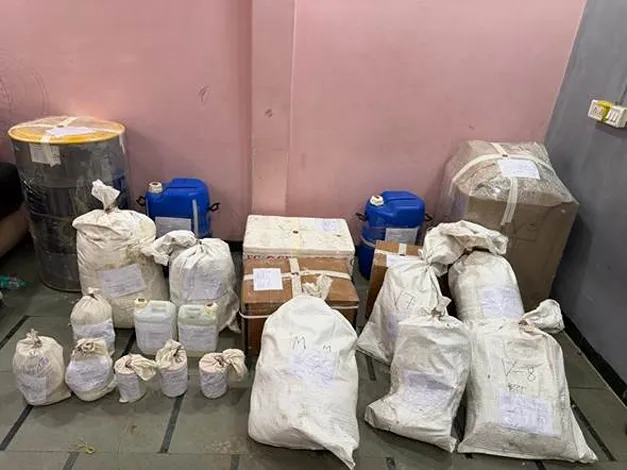
The CBN heroin bust under Operation Black Hawk did not occur in isolation. In recent months, the Central Bureau of Narcotics has carried out several major operations involving heroin, poppy husk, psychotropic tablets, methamphetamine and tramadol. These cases reveal how varied India’s narcotics trafficking landscape has become. Different consignments have been moved through railways, road corridors, commercial vehicles and warehouses. At the same time, traffickers have reportedly used handbags, modified vehicle compartments, tanker cavities and other concealment methods.
Recent Major CBN Recoveries in 2026
Credit: PIB
| Date | Operation/Location | Substance | Quantity Recovered | Key Details |
|---|---|---|---|---|
| Feb. 2026 | Mhow, Indore, Madhya Pradesh | MD/Methamphetamine | 51.992 kg | CBN uncovered an illicit manufacturing facility and also seized more than 260 kg of chemicals and sophisticated equipment. Three people were arrested. |
| June 3, 2026 | Ujjain Railway Station, Madhya Pradesh | Heroin | 1.067 kg | A passenger was intercepted on the Shipra Express. The heroin was reportedly carried in a handbag. One person was arrested. |
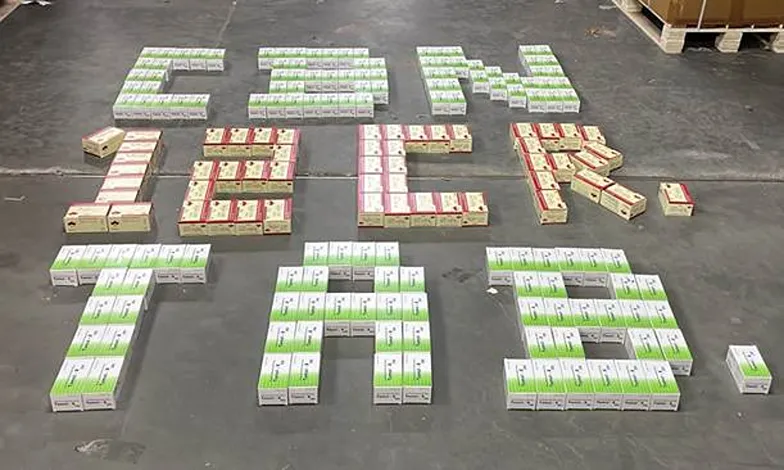
| July 10–20, 2026 | Delhi, Bengaluru and Kochi | Tramadol Hydrochloride | 12 crore tablets | Under Operation Vajra, CBN stopped the suspected illegal diversion of an export consignment weighing around 30 tonnes. Three key suspects were arrested. |
| Aug. 18–19, 2026 | Madhya Pradesh and Rajasthan | Poppy husk | 1,522 kg+ | Three operations resulted in the seizure of more than 1,522 kg of poppy husk. One tanker contained 1,432.680 kg hidden beneath iron sheets and mesh. |
| Aug. 18–19, 2026 | Madhya Pradesh and Rajasthan | Psychotropic tablets | 24,895 tablets | Alprazolam and Tramadol tablets were recovered during the same three-operation crackdown. Four vehicles were seized and three people were arrested. |
| Aug. 21, 2026 | Near Lucknow, Uttar Pradesh | Crude heroin | 16.46 kg | The first Operation Black Hawk seizure. Heroin was concealed in a specially fabricated fuel-tank compartment containing 25 waterproof packages. Two suspects were arrested. |
| Aug. 21, 2026 | Near Barabanki, Uttar Pradesh | Crude heroin | 2.16 kg | A second Black Hawk seizure involved heroin hidden inside a specially constructed chamber in a heavy truck. One suspect was arrested. |
| Aug. 21, 2026 | Lucknow operations combined | Crude heroin | 18.64 kg | The two Black Hawk recoveries together produced 18.64 kg of crude heroin. The CBN said the drugs originated from a northeastern state and were being trafficked toward Uttar Pradesh. |
Credit: PIB
Why Intelligence-Sharing Matters for the Next Stage
The operation also highlights why coordination between enforcement units can be critical when suspected trafficking networks cross state boundaries. The CBN Madhya Pradesh Unit developed intelligence about suspected drug movement from the Northeast toward Uttar Pradesh, while the Uttar Pradesh Unit helped monitor the movement near Lucknow and developed separate intelligence concerning the truck travelling along the Siliguri–Lucknow corridor.
The resulting action was therefore not based on a single checkpoint or isolated search. Instead, information was converted into surveillance, surveillance led to interception, and detailed searches then exposed the concealed compartments. This approach becomes particularly important when a trafficking chain involves a source region, transit corridors and a final distribution market.
The investigation now moves beyond the 18.64 kg heroin recovery. The CBN has said that financial and logistical investigations are underway to identify upstream suppliers in the Northeast and dismantle downstream distribution channels. Investigators will need to establish who supplied the heroin, who arranged the modified vehicles and whether the three arrested suspects were merely transporters or had deeper links to the network. They will also need to determine whether the two seizures were connected to the same supply chain. If those links are established, Operation Black Hawk could prove to be more than a successful interception; it could become a breakthrough into a wider inter-state trafficking network.
What Operation Black Hawk Reveals About India’s Drug Network
The CBN heroin bust is significant because it shows how suspected narcotics networks can operate across state boundaries. The contraband reportedly originated in the Northeast before being moved toward Uttar Pradesh through long-distance road routes and sophisticated concealment methods. The two seizures also reveal how trafficking methods are being adapted. A fabricated fuel-tank compartment concealed 16.46 kg of crude heroin, while a secret chamber in a heavy truck contained another 2.16 kg. Together, the recoveries totalled 18.64 kg of crude heroin.
Three suspects were arrested and booked under the Narcotic Drugs and Psychotropic Substances Act, 1985. The two vehicles used for transporting the consignments were also confiscated, along with the entire seized consignment.However, the recovery may represent only one part of the investigation. The CBN has said that financial and logistical investigations are underway to identify upstream suppliers and downstream distribution channels.
Investigators will now need to determine who supplied the heroin, who arranged the modified vehicles and whether the three arrested suspects were transporters or had deeper links to the network. They will also need to establish whether both seizures were connected to the same supply chain. If those links are confirmed, Operation Black Hawk could move beyond a major drug seizure and help expose a wider inter-state trafficking network. The case also shows why India’s narcotics enforcement increasingly depends on intelligence-sharing, route tracking, technical searches and financial investigations.
FAQs
What is Operation Black Hawk?
Operation Black Hawk is a CBN-led narcotics operation that resulted in the seizure of 18.64 kg of crude heroin in two separate recoveries near Lucknow and Barabanki.
How was the heroin transported?
The consignments were moved using two different vehicles. One shipment was concealed inside a fabricated fuel-tank compartment, while another was hidden inside a secret chamber in a heavy truck.
Where did the seized heroin reportedly originate?
The CBN said the contraband originated from a North-Eastern state and was being transported toward Uttar Pradesh. The specific state has not been publicly identified.
What is the significance of the Siliguri–Lucknow corridor?
The corridor became relevant after a heavy truck carrying 2.16 kg of crude heroin was tracked along the route and intercepted near Barabanki. However, the case does not establish that the entire corridor is routinely used for drug trafficking.
What happens after the 18.64 kg heroin seizure?
The CBN is conducting financial and logistical investigations to identify upstream suppliers and downstream distributors. Investigators are also examining whether the two seizures were connected to the same trafficking network.