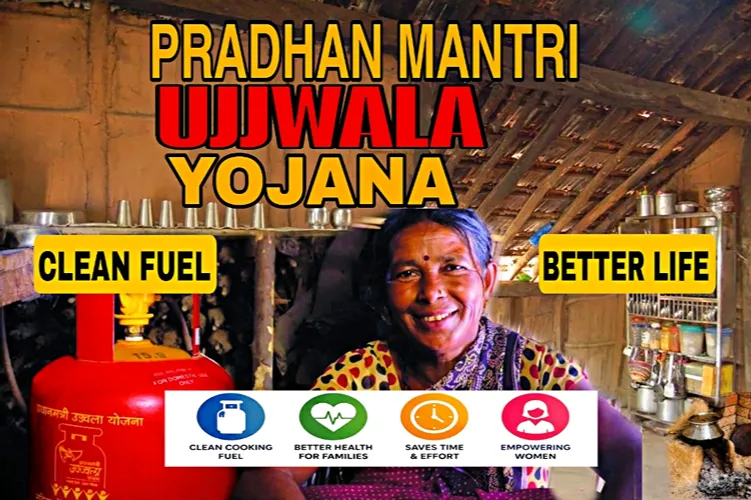

India’s clean-cooking story did not begin with LPG. For decades, millions of households, particularly in rural areas, depended on firewood, crop residue, cow dung and other traditional fuels to prepare everyday meals. For families living on limited incomes, changing that routine was not simply a matter of convenience. The upfront cost of an LPG connection could itself become a barrier. That was the gap the Pradhan Mantri Ujjwala Yojana (PMUY) was designed to address.
Launched on 1 May 2016 at Ballia, Uttar Pradesh, the scheme put women at the centre of India’s push for cleaner household cooking. Instead of treating LPG access only as an energy issue, the government connected it with health, women’s welfare and household dignity. Nearly a decade later, PMUY has become one of India’s most recognisable welfare schemes. Its impact is visible not only in the number of LPG connections issued, but also in the changing expectations of millions of families about what a modern kitchen should look like.
Yet the story is not entirely straightforward. A connection is the beginning of the transition, not its end. The price of refills, household incomes and the availability of alternative fuels continue to influence how families actually use LPG.
- Jharkhand Student Protest 2026 Update: Exam Row Deepens After Fresh Government Move
- 26/11 Mumbai Attacks: The Night Terror Struck India
- Indus Waters Treaty 1960: The High-Stakes Water Battle
- Air India AI2379: Alarming 300-Foot Drop Sparks Safety Questions
- India Independence Day: 79 Years of Freedom, Progress and Challenges
How PMUY Changed India’s Cooking Story
Before the scheme was launched, LPG access remained uneven across India. Urban and middle-class households had considerably easier access to cooking gas, while poorer rural families often relied on traditional fuels. PMUY attempted to change that equation by providing eligible women with LPG connections and financial assistance for the connection. The programme was built around a straightforward principle: a poor household should not be denied cleaner cooking simply because the initial cost is beyond its reach.
The choice to issue the connection in the name of an adult woman was also significant. It gave the scheme a direct gender dimension while linking household energy access with women’s welfare. The programme was subsequently expanded through Ujjwala 2.0, launched in 2021. The expansion sought to bring more eligible households into the LPG network and made provisions aimed at easing access for migrant families and others who faced difficulties with conventional documentation.
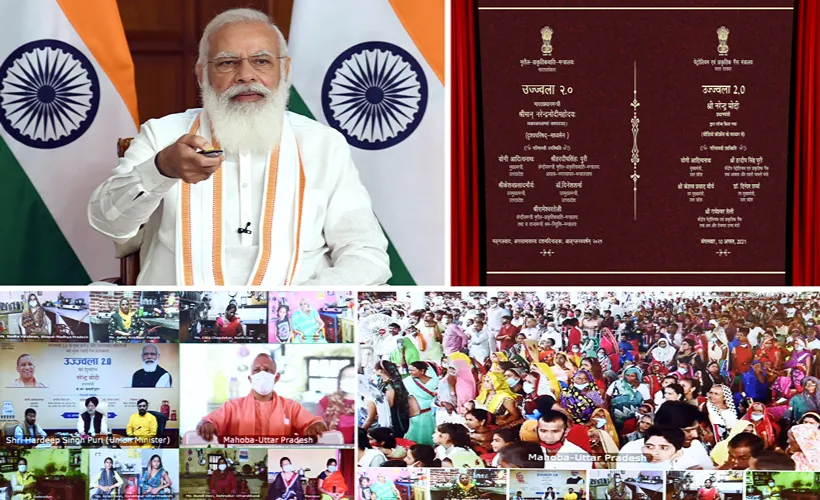
Photo: PMUY
The scale of the transformation has been substantial. The government has stated that PMUY has crossed the 10-crore connection milestone, turning what began as a targeted welfare intervention into a nationwide clean-cooking programme.
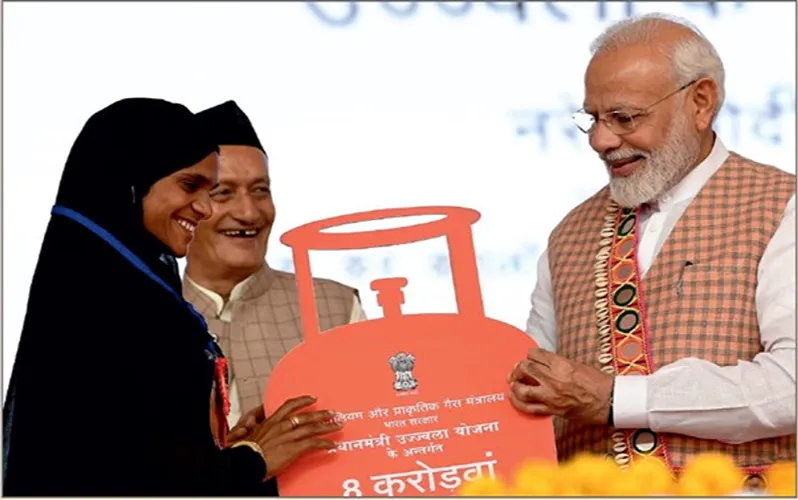
The importance of the programme goes beyond the cylinder itself. In many households, collecting firewood can consume considerable time and physical effort. Women are often the people who bear the largest share of this burden. By making LPG more accessible, the scheme sought to shift that equation. A kitchen with LPG is not simply a different cooking arrangement.
For many families, it represents less smoke, faster cooking and a reduction in the need to gather or purchase traditional fuels. The health argument is equally important. Burning biomass inside poorly ventilated kitchens produces household air pollution. Children and women can be particularly exposed because of the amount of time spent around cooking areas. PMUY therefore sits at the intersection of energy access, public health and social welfare.
The Women at the Centre of the Scheme
One of the most distinctive features of PMUY is its focus on women. An LPG connection issued in a woman’s name does more than create a formal beneficiary. It brings household energy access directly into a programme designed around women’s needs. For a woman who previously depended on firewood or other traditional fuels, an LPG stove can change the rhythm of everyday life. Cooking can become quicker, the kitchen can become less smoky and the routine of collecting fuel can be reduced.
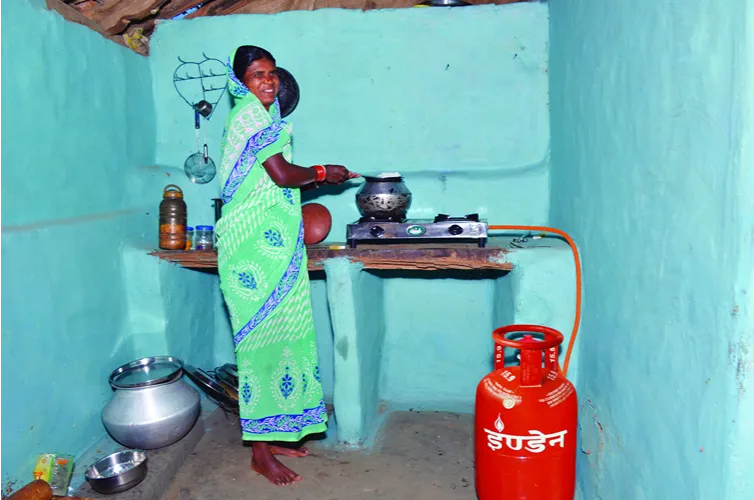
That does not mean every household experiences the same transformation. Economic circumstances vary widely. But the basic idea behind PMUY remains significant: clean cooking should be treated as part of household welfare, rather than as a luxury available only to families with higher incomes. The programme also reflects a broader shift in Indian welfare policy. Earlier welfare schemes often focused on food, housing, employment or financial support. PMUY brought household energy into that conversation. It recognised that the fuel used to cook food can have consequences for health, household expenditure, women’s time and quality of life.
The symbolism of the LPG cylinder should therefore not be underestimated.For a low-income household, receiving an LPG connection can represent entry into an energy system that was previously difficult to access. It can also reduce the social and practical gap between rural and urban kitchens. At the same time, the women’s empowerment argument needs to be viewed realistically. An LPG connection alone cannot transform gender relations inside a household. It cannot eliminate unpaid domestic work or solve income insecurity. What it can do is remove one particularly difficult obstacle: dependence on smoky and labour-intensive cooking fuels. That is a meaningful achievement, but it should be understood as one part of a larger social transformation.
The Affordability Problem Behind LPG Access
This is where the PMUY story becomes more complicated. Giving a family an LPG connection addresses access. Paying for repeated refills addresses affordability. Those are two different problems. A household may welcome an LPG connection but still make difficult choices when the cylinder needs to be refilled. Families with unstable or low incomes may try to stretch the time between refills or use a combination of LPG and traditional fuels. This is one of the most important issues in assessing the long-term success of the scheme.
The government has introduced targeted assistance and subsidy measures for PMUY consumers at different points. These measures are intended to reduce the financial burden on eligible beneficiaries and encourage continued LPG use. But the challenge remains larger than one subsidy. LPG prices are connected to a wider energy market. International crude oil prices, global supply conditions, exchange rates and domestic pricing policies can all influence the cost of petroleum products. That creates a difficult policy balancing act for India. The government wants poor households to use cleaner cooking fuel, but it must also ensure that energy costs do not become unmanageable for those households.
This is why the next stage of PMUY cannot be judged simply by counting connections. The more meaningful question is: Can a beneficiary continue using LPG regularly and affordably? The distinction matters enormously. A household that owns an LPG connection but frequently returns to firewood because of refill costs has technically gained access to clean cooking but has not fully completed the transition. Refill affordability, reliable distribution and consumer support will remain crucial to sustaining the transition to cleaner cooking.
There is also an environmental nuance. LPG produces less household air pollution than many traditional solid fuels when used for cooking, but it is still a fossil fuel. India’s long-term climate strategy will therefore require the country to look beyond LPG eventually. That does not make PMUY irrelevant. Instead, it places the scheme within a larger transition.
What PMUY Means for India’s Energy Future
PMUY’s impact extends beyond the kitchen. By expanding LPG access, the scheme has become part of India’s wider energy-security strategy. India imports a significant share of its petroleum requirements, meaning global oil prices, geopolitical conflicts and disruptions in international supply chains can affect domestic fuel costs. That makes affordability the next major test. A connection is valuable only when families can afford regular refills. Government support for eligible beneficiaries can help, but long-term success will depend on keeping clean cooking accessible while reducing vulnerability to global energy shocks.
At the same time, LPG is not the final destination of India’s clean-energy transition. Electric cooking, induction appliances, biogas and other cleaner technologies could become more important as infrastructure and electricity access improve. For now, however, LPG remains practical for millions of households because of its convenience and established distribution network. PMUY has therefore achieved its first major goal: bringing modern cooking fuel within reach of millions of households. Its next challenge is to ensure that access translates into sustained use while India gradually moves towards cleaner and more secure energy.
PMUY changed India’s clean-cooking landscape by making LPG access a central part of welfare policy. Its focus on women, rural households and cleaner cooking has given the scheme significance beyond simply distributing LPG connections. The real measure of its long-term success, however, will be whether families can afford refills, use LPG consistently and eventually transition towards even cleaner energy options. PMUY’s first chapter was about access; its next will be about affordability, sustained use and India’s broader energy transition.
What is PMUY?
PMUY stands for Pradhan Mantri Ujjwala Yojana, a government scheme launched in 2016 to expand LPG access among eligible economically disadvantaged households.
When was PMUY launched?
The scheme was launched on 1 May 2016 at Ballia in Uttar Pradesh.
Who is the main beneficiary under PMUY?
Eligible adult women are the primary beneficiaries, with LPG connections generally issued in their names.
What is Ujjwala 2.0?
Ujjwala 2.0 was launched in 2021 as an expansion of the original programme to extend LPG access to additional eligible households, including migrant families.
Is PMUY only about providing LPG connections?
No. Its broader objective is to improve access to cleaner household cooking fuel and reduce dependence on traditional fuels that can generate substantial indoor smoke.