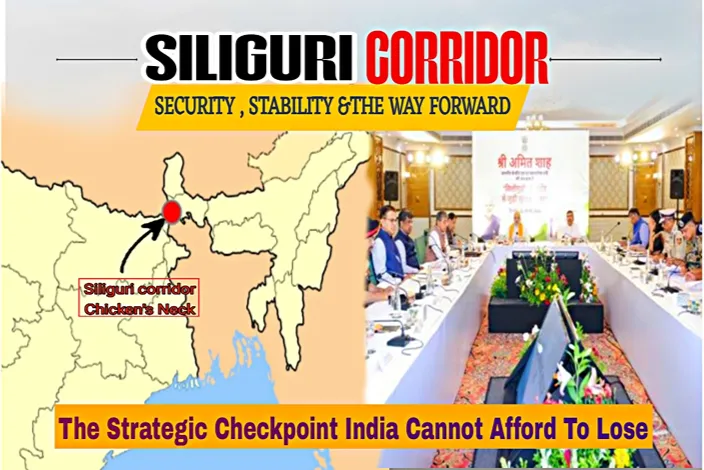

India’s Northeast depends on one narrow land link to the rest of the country. That makes Siliguri Corridor security a national priority, not merely a regional concern. The corridor, widely known as the “Chicken’s Neck,” connects mainland India with the Northeast. Its location also places it near Nepal, Bhutan and Bangladesh. Therefore, border management, infrastructure and local stability are closely connected.
The strategic vulnerability has long been recognised by Indian authorities. A government disaster management document describes the corridor as the land link to the Northeast. It also highlights the region’s significant infrastructure challenges.
Amit Shah Reviews Siliguri Corridor Security
Union Home Minister Amit Shah reviewed Siliguri Corridor security at Sukna on August 22, bringing together central agencies, security forces and West Bengal officials. The Army, BSF, SSB and Railway Protection Force were represented, while senior state officials, including the Chief Secretary and DGP, also participated. The Multi Agency Centre’s Standing Focus Group presented its assessment, covering existing security measures, infrastructure projects, intelligence requirements and the protection of vital installations.
A key outcome was the proposed Triangular Security Grid, with three new military garrisons planned at Dhubri in Assam, Kishanganj in Bihar and Chopra in West Bengal. The wider security network is intended to strengthen surveillance around the corridor and improve response capabilities across its surrounding approaches. During his Siliguri visit on August 21, 2026, Union Home Minister Amit Shah also inaugurated projects and laid foundation stones for various SSB projects, highlighting the government’s broader focus on strengthening border infrastructure and security. The review therefore went beyond conventional border deployment, focusing on infrastructure, intelligence, inter-agency coordination and broader border-management concerns.
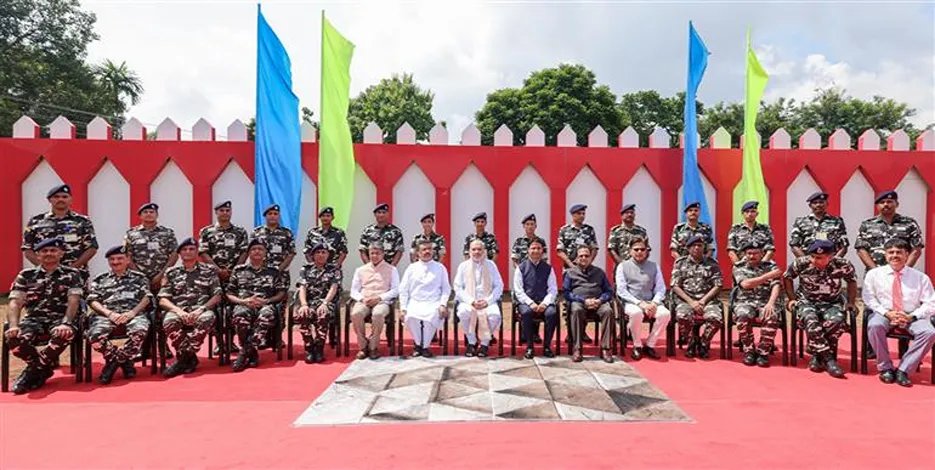
Credit: PIB
| Security Area | What Is Being Addressed | Why It Matters |
|---|---|---|
| Border security | Illegal crossings, smuggling and infiltration | Protects the corridor’s approaches |
| Security grid | New garrisons at Dhubri, Kishanganj and Chopra | Improves surveillance and response |
| Inter-agency coordination | BSF, SSB, Army and West Bengal Police | Enables faster intelligence sharing |
| Infrastructure | Roads, railways and pending connectivity projects | Strengthens military and civilian mobility |
| Vital installations | Protection of strategically important facilities | Reduces risks of disruption or sabotage |
| Encroachments | Unauthorised occupation around sensitive areas | Keeps key zones accessible and secure |
| Local stability | Gorkha political concerns and development | Links regional stability with security |
Infrastructure and Border Management: Key to Corridor Security
Security and infrastructure are closely connected in the Siliguri Corridor because roads, railways and transport links support both civilian movement and military logistics. During the latest review, Amit Shah directed agencies to complete pending infrastructure projects within a fixed timeframe and called for stronger institutional presence in the corridor. Better connectivity can improve troop movement, emergency response and the resilience of critical routes. At the same time, stronger infrastructure can help authorities monitor sensitive areas more effectively.
The review also focused on illegal immigration, encroachments and demographic changes. Agencies were directed to keep the corridor free from encroachments and strengthen measures against illegal immigration. Given the corridor’s limited geographic depth, poorly monitored areas could create additional administrative and security challenges. However, enforcement will need to remain consistent with Indian law and constitutional protections. Therefore, effective Siliguri Corridor security will require a combination of infrastructure development, border management, local administration and community cooperation.
Security Coordination and Gorkha Political Demands
The proposed security architecture places greater emphasis on coordination among the BSF, SSB and West Bengal Police. The BSF remains responsible for border management along the Bangladesh frontier, while the SSB guards India’s borders with Nepal and Bhutan. West Bengal Police adds local intelligence and law-enforcement capabilities, creating broader surveillance across the corridor’s overlapping security zones. The wider quadrangular approach seeks to ensure that agencies respond collectively rather than operating in isolation
This is important because threats such as smuggling, trafficking, illegal crossings and potential sabotage can cross administrative boundaries and require coordinated action. However, security was only one part of Amit Shah’s Siliguri visit. He also met Gorkha representatives from the Darjeeling hills, where the long-standing demand for a Permanent Political Solution was discussed. The Centre has decided to establish a committee headed by Pankaj Kumar Singh to examine political issues affecting the hills and consult political parties, social organisations and other stakeholders.
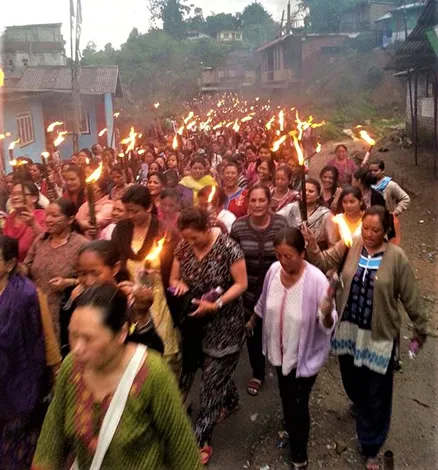
The Gorkhaland demand has shaped Darjeeling politics for decades, with major agitations taking place during 1986–88, 2007–11 and 2017. These movements have kept the question of political autonomy at the centre of regional politics. The committee’s work is expected to remain within the Indian Constitution. However, its creation does not automatically signal statehood. Instead, it opens a fresh political process for addressing unresolved Gorkha concerns while the government seeks greater stability in the wider Siliguri region.

What Happens Next for Siliguri Corridor Security?
Security and political stability in the region are closely connected. A stable local environment can improve cooperation with security agencies, while better infrastructure can strengthen both development and emergency preparedness. Therefore, India’s challenge extends beyond protecting the narrow corridor itself. The wider region must remain politically stable, economically connected and socially resilient.
The immediate priority will be implementing the new security architecture. The proposed garrisons will require supporting infrastructure, personnel and effective coordination among security agencies. Pending connectivity projects will also need to be completed quickly to improve the corridor’s resilience. Meanwhile, the Pankaj Kumar Singh-led committee will begin consultations on the Gorkha political issue. Its recommendations could influence North Bengal’s political future, although expectations will need to be managed carefully.
Ultimately, the success of Siliguri Corridor security will depend on more than additional deployments. Intelligence sharing, infrastructure delivery, Centre-state coordination and community confidence will all be critical. Balancing security with democratic participation and regional development could determine how resilient the corridor becomes.
Security Requires More Than Soldiers
The Siliguri Corridor remains one of India’s most sensitive strategic spaces. Its importance comes from geography, connectivity and its proximity to several international borders. The latest measures suggest that Siliguri Corridor security is being approached as a wider ecosystem. Military presence, border surveillance and infrastructure are being combined with local political engagement. The proposed security grid could strengthen India’s ability to respond quickly. However, infrastructure and inter-agency coordination will be equally important.
At the same time, the Gorkha committee creates a parallel political pathway. If handled carefully, that process could contribute to greater stability in North Bengal. Ultimately, the corridor’s resilience will depend on all these elements working together. India’s challenge is not simply to guard the Chicken’s Neck. It is to make the entire region harder to disrupt.
FAQs
Why is the Siliguri Corridor strategically important?
It is the principal land connection between mainland India and the Northeast. Its location also places it close to Nepal, Bhutan and Bangladesh.
What is the new security grid for the Siliguri Corridor?
The proposed Triangular Security Grid includes new military garrisons at Dhubri, Kishanganj and Chopra
Which agencies are involved in corridor security?
The security framework involves the Army, BSF, SSB, state police and intelligence agencies. Railway security authorities are also involved in the wider review.
What is the Gorkha political issue?
Gorkha representatives have long sought a political solution for the Darjeeling hills. The Centre has formed a committee to examine the issue constitutionally.
What will happen to the Gorkha demands next?
The Pankaj Kumar Singh-led committee will consult stakeholders and prepare recommendations. Those recommendations will then be submitted to the Centre.