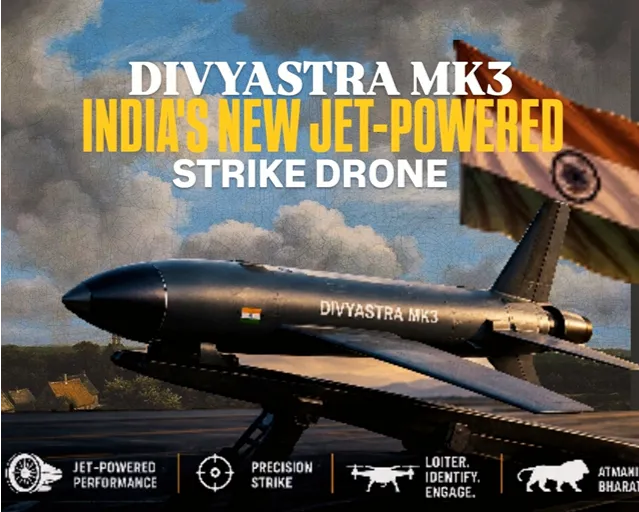

India’s drone warfare strategy is rapidly evolving beyond surveillance and conventional unmanned aerial vehicles. The Divyastra Mk3 marks a significant step in this shift, emerging as an indigenous jet-powered loitering munition designed to expand India’s precision-strike capabilities.
Developed by Kawa UAV Pvt. Ltd. under its HoverIT brand, the Divyastra Mk3 completed its maiden flight on 11 August 2026. Its jet-powered configuration represents a technological progression within the Divyastra family and highlights the growing role of Indian private companies in developing advanced defence systems.
The development is significant amid the growing importance of drones, autonomous platforms and precision weapons in modern warfare. More importantly, the Divyastra Mk3 reflects the broader Atmanirbhar Bharat push, as Indian defence startups increasingly seek to develop critical technologies, propulsion systems and unmanned platforms domestically.
What Is Divyastra Mk3?

The Divyastra Mk3 is a jet-powered loitering munition developed by Indian defence company Kawa UAV. It combines the characteristics of an unmanned aerial vehicle with the strike role of a precision weapon. This allows the platform to operate over a designated area before engaging a selected target. Unlike conventional surveillance drones, which are primarily designed for intelligence gathering and reconnaissance, loitering munitions are built around a search-and-strike concept. They can provide commanders with greater flexibility when a target needs to be identified, tracked and engaged within a limited time window.
The most notable feature of the Divyastra Mk3 is its jet propulsion system. This represents a technological shift from earlier Divyastra variants and could provide advantages in speed, responsiveness and overall flight performance. The platform’s development also highlights India’s growing efforts to build advanced unmanned weapons through domestic defence companies.
However, publicly available information about the Mk3 remains limited. Specific figures for range, endurance, payload capacity and maximum speed have not been sufficiently established through official technical documentation. Therefore, such specifications should be treated cautiously until Kawa UAV or relevant defence authorities provide confirmed details.
Divyastra Mk3: Flight & Atmanirbhar Bharat
The Divyastra Mk3 comes as India strengthens its focus on defence self-reliance. On the eve of Independence Day, Defence Minister Rajnath Singh highlighted the growth of indigenous defence production under Aatmanirbhar Bharat and Make in India. He noted that domestic defence production rose from around ₹46,000 crore in 2014 to a record ₹1.78 lakh crore in FY 2025–26.

Against this backdrop, Kawa UAV conducted the Divyastra Mk3’s maiden flight on 11 August 2026. The jet-powered loitering munition uses an indigenous propulsion system developed with DG Propulsion, although its exact engine configuration remains unconfirmed. Its range, speed, endurance and payload are also yet to be officially disclosed.
The development reflects India’s growing private-sector role in advanced defence technology. With defence exports reaching ₹38,424 crore in FY 2025–26, the Divyastra Mk3 highlights India’s broader effort to develop sophisticated unmanned systems and reduce dependence on foreign defence technology.
Divyastra Mk3: Company and Evolution
Kawa UAV Pvt. Ltd., operating under the HoverIT brand, developed the Divyastra family. The company was incorporated in 2022 and focuses on UAVs, autonomous systems and defence applications. Its portfolio includes Divyastra Mk1, Divyastra Mk2, Aankh-01, Raftaar eVTOL and Baaz, showing its wider focus on unmanned warfare rather than a single platform. The company has also highlighted work involving ISR, high-altitude operations and tactical payload delivery. The progression from Mk1 to Mk3 reflects an effort to develop increasingly advanced unmanned strike technologies.
| Year | Platform | Key development | Published specifications |
|---|---|---|---|
| 2022 | Kawa UAV / HoverIT | Company established | Focus on UAV and autonomous defence technology |
| 2024 | Divyastra Mk1 | Autonomous tactical strike platform | Up to 5-hour endurance; 500-km range; 15-kg payload |
| 2025 | Divyastra Mk2 | Longer-range UAV concept | 8–12-hour endurance; 1,500–2,000-km range; 50–100-kg payload |
| 2026 | Divyastra Mk3 | Jet-powered loitering munition | Maiden flight on 11 August, detailed performance figures not officially published |
The Divyastra Mk3 represents the most notable technological shift in this progression because it introduces jet propulsion. Unlike the earlier variants, its publicly reported development focuses on a higher-performance propulsion architecture rather than simply increasing range or payload. The Mk3’s exact operational capabilities remain unclear, so its range, endurance, speed and payload should not be treated as confirmed until Kawa UAV releases official specifications. Increase in the model number.
Why Divyastra Mk3 Matters
The Divyastra Mk3 comes as drone warfare is rapidly evolving, with militaries increasingly relying on autonomous and precision-strike systems. For India, such technology could strengthen capabilities across challenging northern and western border environments, where difficult terrain and long distances demand faster and more flexible unmanned platforms.
However, the Mk3 remains at the development stage following its maiden flight. Further flight trials, propulsion testing and military evaluation will be necessary before any operational induction or procurement decision. For Kawa UAV, the bigger challenge will be turning the prototype into a reliable, affordable and scalable military system supported by an indigenous supply chain.
The platform’s development also highlights the growing role of Indian startups in advanced defence technology. If the Mk3 successfully progresses through testing and enters production, it could strengthen India’s unmanned warfare capabilities while advancing the broader Atmanirbhar Bharat objective of developing critical defence technologies domestically.
What is Divyastra Mk3?
Divyastra Mk3 is a jet-powered loitering munition developed by Kawa UAV under its HoverIT brand. Its maiden flight was conducted on 11 August 2026.
Who developed Divyastra Mk3?
The platform was developed by Kawa UAV Pvt. Ltd., which operates under the HoverIT brand. The propulsion technology is associated with the Indian company DG Propulsion.
Is Divyastra Mk3 operational with the Indian Army?
There is currently no reliable public evidence confirming operational induction. The August 2026 event was a maiden flight, so further testing and military evaluation are expected.
How is Divyastra Mk3 different from Mk1?
The major publicly reported change is propulsion. The Mk1 is an earlier autonomous tactical strike platform, while the Mk3 introduces a jet-powered configuration.
Is Divyastra Mk3 the same as Mission Divyastra?
No. They are different defence projects. Mission Divyastra refers to India’s 2024 Agni-5 MIRV test, while Divyastra Mk3 is a UAV-based loitering-munition platform.