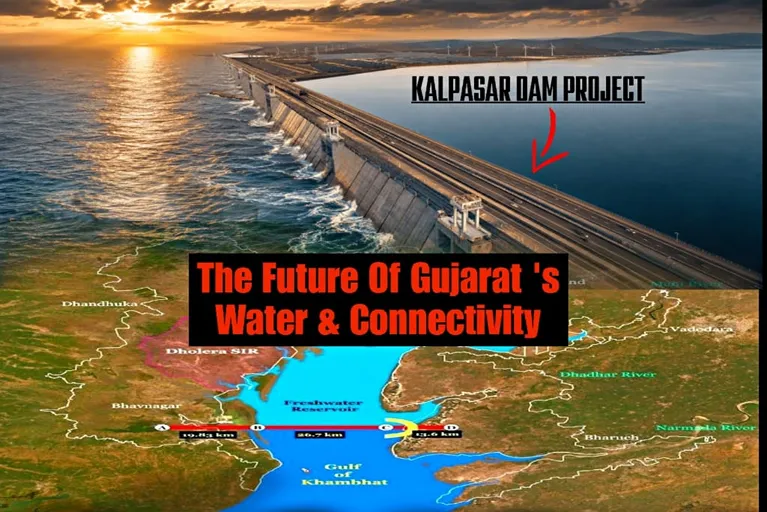

The Kalpasar Dam Project has remained one of India’s most ambitious infrastructure proposals for decades. If completed, it could transform Gujarat’s water supply, transportation, and regional economy. However, despite its enormous potential, the project continues to face significant engineering, environmental, and financial challenges.
First proposed several decades ago, the project has gained renewed attention as Gujarat accelerates investment in water security and large-scale infrastructure. Yet, an important question remains: can this long-delayed vision finally become reality?
What Is the Kalpasar Dam Project?
The Kalpasar Dam Project—short for Khambhat Lake Project—is a proposed multipurpose freshwater reservoir across the Gulf of Khambhat in Gujarat. The project aims to construct a massive dam between Bhavnagar and Bharuch, creating one of the world’s largest man-made freshwater lakes.
According to the Gujarat government, the reservoir would store surplus water from several rivers flowing into the Gulf, including the Narmada, Mahi, Sabarmati, and Dhadhar. This stored water could then be supplied for irrigation, drinking water, and industrial use.
Why Was the Project Proposed?
The Kalpasar Dam Project was proposed to address Gujarat’s long-term water challenges by storing freshwater that would otherwise flow into the Arabian Sea during the monsoon. The idea is to make better use of seasonal river flows and ensure a more reliable water supply throughout the year.
By creating a large freshwater reservoir, the project aims to support agriculture, meet growing domestic and industrial water demand, and reduce pressure on over-exploited groundwater resources. In the long run, it is expected to strengthen the state’s water resilience and support sustainable economic development.
Where Will It Be Built?
The Kalpasar Dam Project is proposed across the Gulf of Khambhat in Gujarat, linking the Bhavnagar and Bharuch districts. The location was chosen because several major rivers, including the Narmada, Mahi, Sabarmati, and Dhadhar, flow into the gulf.
This makes it possible to create a large freshwater reservoir while also providing space for a road and transport corridor over the dam. Together, these features are intended to improve water storage and strengthen connectivity between South Gujarat and the Saurashtra region.
Key Objectives and Features
The project has several long-term objectives:
- Create a massive freshwater reservoir.
- Improve drinking water availability across Gujarat.
- Expand irrigation for agricultural land.
- Support industrial growth.
- Reduce groundwater depletion.
- Generate renewable energy through tidal and solar opportunities.
- Improve regional transportation.
If implemented as planned, the reservoir would become one of the largest freshwater storage systems in India.
How Will the Sea Bridge Improve Connectivity?
A key component of the Kalpasar Dam Project is a proposed highway-cum-rail corridor built on top of the dam across the Gulf of Khambhat. The corridor is designed to improve connectivity between South Gujarat and the Saurashtra region. According to the current project layout, the new route is expected to reduce the travel distance between Bhavnagar and Surat by about 179 km, bringing it down from approximately 356 km to 177 km.
This shorter route is expected to reduce travel time, improve freight movement, and lower transportation costs. In addition, the corridor could strengthen regional trade, support industrial growth, and improve access to ports and economic hubs. Over time, it may also complement Gujarat’s broader transport and logistics network by integrating with other major infrastructure projects.
Current Status and Latest Developments
Although the Kalpasar Dam Project was proposed decades ago, it has yet to move into the construction phase because of its engineering complexity, environmental concerns, and high estimated cost. In recent years, the Gujarat government has revived the project by approving funds to update the Detailed Project Report (DPR).
The revised studies will assess the dam’s design, environmental impact, financial viability, and overall feasibility using current data. The project remains in the planning stage. Construction can begin only after the updated DPR is completed and the necessary environmental, technical, and financial approvals are secured.
Engineering and Environmental Challenges
The proposed dam across the Gulf of Khambhat is unlike a conventional river dam. It is designed to create a freshwater reservoir in a tidal estuary while also supporting a road and rail corridor. To achieve this, the structure would require long embankments, controlled sluice gates, and protective barriers capable of handling strong tides and high sediment loads.
One of the biggest engineering challenges is preventing seawater from mixing with the stored freshwater. Engineers must also manage sediment carried by rivers, which could reduce the reservoir’s storage capacity over time. These issues are being studied through updated hydraulic modelling and design revisions before construction begins.
Environmental concerns are equally significant. The Gulf of Khambhat supports diverse marine life, fisheries, mudflats, and mangrove ecosystems. Altering natural tidal flows could affect these habitats and local livelihoods. Therefore, the project will require a comprehensive Environmental Impact Assessment (EIA), along with mitigation measures to protect biodiversity and maintain ecological balance.
Cost, Funding, and Timeline
The Kalpasar Dam Project is expected to be one of India’s costliest water infrastructure projects. According to the project’s environmental clearance documents, the estimated cost is around ₹1,00,200 crore, covering the dam, freshwater reservoir, transport corridor, canal network, water treatment facilities, and other supporting infrastructure. The final investment may change once the revised project design is approved.
The project is expected to be funded primarily by the Government of Gujarat, although the final financing structure has not yet been officially announced. The project is also benefiting from an Indo-Dutch technical partnership, which is providing expertise in coastal engineering, hydraulic modelling, salinity management, and climate-resilient infrastructure. Construction is planned to be carried out in phases. the project is expected to take around eight years to complete after construction begins.
Future Impact on Gujarat
If successfully executed, the Kalpasar Dam Project could significantly reshape Gujarat’s development. Greater water availability would support agriculture, industries, and urban growth. The transport corridor could strengthen supply chains and regional connectivity. Improved infrastructure may also attract private investment and generate employment.
However, the project’s long-term success will depend on careful planning, environmental sustainability, and effective execution.
Conclusion
The Kalpasar Dam Project represents a bold vision for Gujarat’s future. It combines water conservation, transport infrastructure, and economic development into a single mega project.
Even so, ambition alone will not guarantee success. Technical feasibility, environmental responsibility, financial planning, and public support will determine whether this decades-old proposal finally becomes a transformative reality.
FAQ
What is the Kalpasar Dam Project?
The Kalpasar Dam Project is a proposed multipurpose infrastructure project in Gujarat that aims to build a freshwater reservoir across the Gulf of Khambhat. It also includes a highway-cum-rail corridor to improve water security and regional connectivity.
What is the current status of the Kalpasar Dam Project?
The project is currently in the planning stage. The Gujarat government is finalising the revised Detailed Project Report (DPR) while technical, environmental, and economic assessments continue before construction can begin.
How much will the Kalpasar Dam Project cost?
According to the project’s environmental clearance documents, the estimated cost is around ₹1,00,200 crore. The final investment may change after the revised DPR is approved.
How will the Kalpasar Dam Project improve connectivity?
The project includes a highway-cum-rail corridor across the Gulf of Khambhat. It is expected to reduce the distance between Bhavnagar and Surat by about 179 km, making travel and freight movement faster and more efficient.
When is the Kalpasar Dam Project expected to be completed?
No official construction start date has been announced. However, the Gujarat government estimates that the project could take around eight years to complete once construction begins and all required approvals are in place.