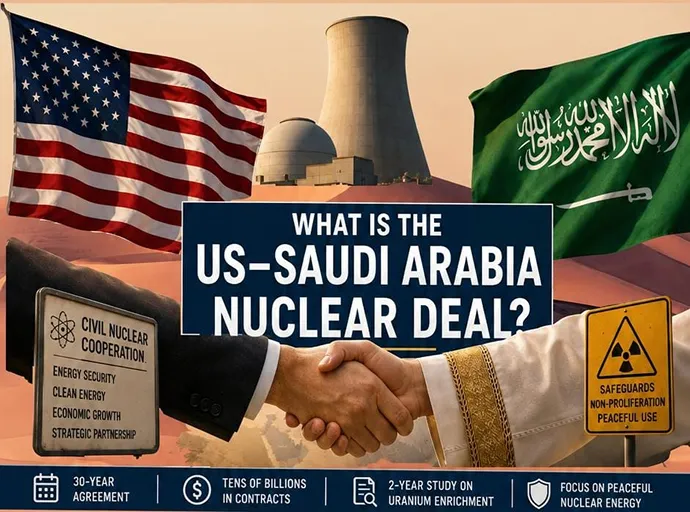

The US Saudi Nuclear Deal has become one of the most significant geopolitical agreements in the Middle East in recent years. Announced during President Donald Trump’s 2026 visit to Saudi Arabia, the proposed 30-year civilian nuclear cooperation agreement aims to help the kingdom develop its nuclear energy sector using American technology and expertise. While both governments describe it as a peaceful energy partnership, the deal has raised global concerns over regional security and nuclear proliferation.
The biggest controversy is the possibility that Saudi Arabia could eventually be allowed to enrich uranium domestically after a planned two-year US–Saudi feasibility study. Supporters say the agreement will strengthen energy security and deepen US influence in the Gulf, while critics warn it could trigger a regional nuclear race and reshape the Middle East’s strategic balance for decades.
Why the Deal Matters
The US–Saudi Nuclear Deal is more than a civilian energy agreement. It supports Saudi Arabia’s Vision 2030 by helping the kingdom diversify its economy, reduce reliance on oil for electricity, meet growing energy demand, increase crude oil exports, strengthen energy security, lower carbon emissions, and develop a modern nuclear industry.
For the United States, the agreement strengthens its strategic partnership with Saudi Arabia while creating opportunities for American nuclear companies. It also helps counter the growing influence of China and Russia in the Gulf. At the same time, the deal raises concerns over uranium enrichment and nuclear proliferation, making it a key development for regional security and the future balance of power in the Middle East.
Current Developments and Agreement
The US–Saudi Nuclear Deal establishes a 30-year civilian nuclear cooperation agreement worth tens of billions of dollars, with American companies helping Saudi Arabia develop its first civilian nuclear energy programme. The agreement includes reactor development, technology transfer, workforce training, nuclear safety, fuel supply, and bilateral safeguards.
The deal does not immediately allow Saudi Arabia to enrich uranium. Instead, both countries will conduct a two-year feasibility study, and any future approval would require a US administration’s consent and be subject to strict safeguards and oversight.
| Year / Phase | Expected Development | Purpose |
|---|---|---|
| 2026 | 30-year civilian nuclear agreement signed | Establish long-term US–Saudi nuclear cooperation. |
| 2026–2028 | Joint feasibility and technical studies | Assess reactor requirements, fuel needs, and whether domestic uranium enrichment is necessary. |
| 2027 onwards | Nuclear infrastructure planning | Select reactor sites, conduct environmental assessments, and begin project design. |
| 2028 onwards | Technology transfer and workforce training | Train Saudi engineers and transfer American civilian nuclear expertise. |
| Future Phase | Construction of civilian nuclear reactors | Generate clean electricity and reduce dependence on oil-fired power generation. |
| Long Term | Fuel supply, safety systems, and waste management | Ensure secure fuel supplies, maintain high safety standards, and safely manage spent nuclear fuel. |
| Throughout the Agreement | Bilateral safeguards and technical oversight | Monitor peaceful nuclear activities and strengthen cooperation on nuclear security. |
Uranium Enrichment and Safeguards
The US–Saudi Nuclear Deal does not currently allow Saudi Arabia to enrich uranium. Instead, both countries will conduct a two-year feasibility study to determine whether domestic enrichment is necessary. Even if approved in the future, any decision would require authorization from a future US administration and remain subject to bilateral safeguards and international oversight. Uranium enrichment is highly sensitive because the same technology used to produce reactor fuel can also be used to produce weapons-grade uranium, raising concerns over nuclear proliferation.
To address these risks, the agreement includes safeguards such as nuclear fuel monitoring, spent fuel tracking, technical oversight, and nuclear security cooperation. However, experts argue the deal offers weaker protections than previous US nuclear agreements because it reportedly does not require Saudi Arabia to adopt the IAEA Additional Protocol or the US–UAE “Gold Standard.” Critics warn this could increase long-term proliferation risks and encourage other Middle Eastern countries to pursue similar nuclear capabilities.
Regional Nuclear Race
The US–Saudi Nuclear Deal has raised concerns that it could trigger a regional nuclear race. Saudi Arabia has previously said it would seek similar capabilities if Iran developed a nuclear weapon. Although the agreement is for civilian purposes, the possibility of future uranium enrichment has heightened concerns about nuclear proliferation and regional security.
Experts warn that countries such as Egypt, Turkey, Jordan, and the United Arab Emirates could pursue similar nuclear programmes to maintain the regional balance of power. Israel has also reportedly expressed concerns that expanding nuclear capabilities across the Middle East could increase strategic tensions and challenge long-term regional stability.
Strategic and Political Significance
Before taking effect, the US–Saudi Nuclear Deal must undergo Congressional review, where some Democratic lawmakers have raised concerns over uranium enrichment and nuclear proliferation. Although opposition exists, blocking the agreement would require a two-thirds majority in Congress to override a presidential veto, making rejection unlikely.
Strategically, the deal strengthens the US–Saudi partnership while supporting Saudi Arabia’s Vision 2030 and expanding its civilian nuclear energy programme. It also helps the United States maintain its influence in the Gulf and counter the growing presence of China and Russia. While supporters see it as a major energy and security partnership, critics warn it could increase proliferation risks and intensify geopolitical competition across the Middle East.
Conclusion
The US–Saudi Nuclear Deal is more than a civilian energy partnership; it is a strategic agreement with far-reaching geopolitical implications. While it supports Saudi Arabia’s Vision 2030 and strengthens US influence in the Middle East, it also raises concerns over uranium enrichment, nuclear safeguards, and regional security. Its long-term impact will depend on strong oversight, transparency, and future policy decisions, making it a key development for global nuclear diplomacy and Middle East stability.
What is the US-Saudi Nuclear Deal?
It is a 30-year civilian nuclear cooperation agreement under which the United States will assist Saudi Arabia in developing nuclear energy infrastructure for peaceful purposes.
Can Saudi Arabia enrich uranium under the agreement?
Not yet. A joint US–Saudi study will first determine whether domestic uranium enrichment is necessary. Any future enrichment would require additional approval.
Why is uranium enrichment controversial?
The same technology used to produce reactor fuel can also produce weapons-grade uranium, making it a key concern for nuclear non-proliferation.
Why is the agreement important for the United States?
The deal strengthens US influence in the Middle East, supports American nuclear companies, and limits strategic opportunities for China and Russia.
Could the agreement trigger a regional nuclear race?
Some experts believe it could encourage other Middle Eastern countries to seek similar nuclear capabilities, especially if Saudi Arabia eventually gains uranium enrichment rights.