
India is entering a new era of sustainable transportation with the launch of its first Hydrogen Train India project. More than just a new train, it marks a significant shift toward cleaner mobility, reduced carbon emissions, and greater energy security. As the world’s fourth-largest railway network, India is investing in hydrogen technology to reduce its dependence on diesel while supporting the country’s long-term goal of achieving net-zero emissions by 2070.
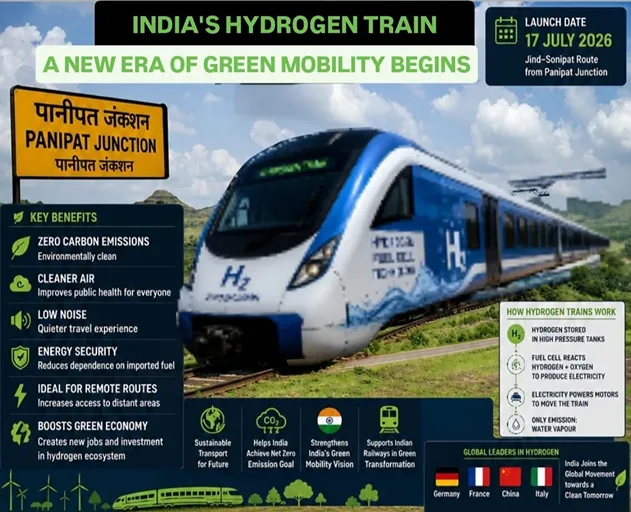
On 17 July 2026, Prime Minister Narendra Modi flagged off India’s first indigenous hydrogen-powered passenger train on the Jind–Sonipat route in Haryana, with Panipat serving as the key hub for the hydrogen rail project and related infrastructure. The pilot service is designed to demonstrate how hydrogen fuel-cell technology can power trains on non-electrified routes while emitting only water vapour. If successful, the project could pave the way for wider deployment across India and place the country among a select group of nations including Germany, France, and China that are advancing hydrogen-powered rail transport.
What Is Hydrogen Train India?
Hydrogen Train India uses hydrogen fuel cells to generate electricity instead of diesel engines. The process combines hydrogen with oxygen to produce electricity, emitting only water vapour and heat. This makes hydrogen trains a cleaner and more environmentally friendly alternative to diesel-powered trains.
India has electrified most of its railway network, but some routes still rely on diesel locomotives. Hydrogen trains can operate on these non-electrified lines without overhead power cables, helping reduce carbon emissions, lower fuel imports, and support India’s long-term clean energy goals.
Why Panipat Was Chosen?
Panipat has been selected as the launch point for India’s first hydrogen train, making it the country’s testing ground for next-generation green rail technology. The pilot will assess the train’s safety, efficiency, and real-world performance before hydrogen-powered services are introduced on more routes.
The project is a major milestone under India’s National Green Hydrogen Mission and reflects the country’s push toward cleaner transport and energy independence. If the Panipat pilot succeeds, it could pave the way for hydrogen trains across non-electrified railway lines, reducing diesel use, cutting carbon emissions, and strengthening India’s position in the global clean mobility race.
Hydrogen Train Launch Timeline
Indian Railways is preparing to launch India’s first hydrogen train after completing safety tests, fuel infrastructure, and operational trials. The project is a key part of the country’s clean energy roadmap and aims to introduce hydrogen-powered trains on selected non-electrified routes.
While the launch timeline has been revised during development, the Panipat pilot remains one of Indian Railways’ most ambitious green mobility projects. Once operational, it will provide crucial data on performance, maintenance, and costs, helping shape the future expansion of Hydrogen Train India across the railway network.
How Hydrogen Trains Work
Hydrogen trains store compressed hydrogen in high-pressure tanks mounted on the train. Inside the fuel cell, hydrogen combines with oxygen from the air to generate electricity, which powers the train’s electric motors. Unlike diesel engines, this process involves no combustion and produces only water vapour and heat, making it a clean and eco-friendly mode of transport.
The trains also use rechargeable batteries to store excess energy generated during operation and regenerative braking. This stored energy improves efficiency during acceleration, reduces hydrogen consumption, and enhances overall performance, making hydrogen trains a reliable solution for non-electrified railway routes.
Hydrogen vs Diesel and Electric Trains
Unlike diesel trains, Hydrogen Train India runs on hydrogen fuel cells that generate electricity and emit only water vapour and heat. Unlike electric trains, hydrogen trains do not require overhead power lines, making them ideal for non-electrified and remote railway routes. They also operate more quietly than diesel locomotives while reducing dependence on imported fossil fuels.
Hydrogen trains offer several long-term benefits for India. They produce zero direct carbon emissions, reduce air and noise pollution, and support the National Green Hydrogen Mission. In addition, they are well-suited for routes where electrification is costly, encourage domestic hydrogen production and innovation, and help strengthen India’s energy security by reducing reliance on imported crude oil. Their adoption could also boost investments in renewable energy, hydrogen infrastructure, and advanced manufacturing.
Hydrogen Train India vs Other Trains
| Feature | Hydrogen Train | Electric Train | Diesel Train |
|---|---|---|---|
| Fuel Source | Green Hydrogen | Electricity | Diesel |
| Direct Emissions | Water vapour | Very low* | High CO₂ |
| Overhead Wires | Not required | Required | Not required |
| Noise Level | Very low | Low | High |
| Best for Remote Routes | Yes | Limited | Yes |
| Energy Security | High (Domestic hydrogen) | Grid dependent | Imported fuel dependent |
Countries Using Hydrogen Trains
Several countries have already embraced hydrogen-powered trains to cut carbon emissions and reduce reliance on diesel-powered railways. Germany became the world’s first country to launch hydrogen passenger trains in commercial service, setting a global benchmark for clean rail transport. Since then, France, Italy, Austria, China, South Korea, and the United Kingdom have introduced pilot projects, trials, or regional hydrogen rail services.
These nations are using hydrogen technology to modernise rail networks, especially on non-electrified routes where installing overhead power lines is costly. Their experience in fuel-cell technology, safety standards, and railway operations provides valuable insights for Hydrogen Train India as Indian Railways prepares to begin its hydrogen rail journey from Panipat. If successful, India could join this growing group of countries leading the global shift toward sustainable transportation.
Global Technology Behind India’s Hydrogen Train
India is building its hydrogen train largely through indigenous engineering and manufacturing, but it is also drawing on global expertise. Countries such as Germany and France have pioneered hydrogen rail technology, providing valuable experience in fuel-cell systems, safety standards, and commercial operations.
Rather than relying entirely on imported technology, Indian Railways is adapting global best practices to suit Indian conditions under the Make in India initiative. This approach aims to strengthen domestic manufacturing, accelerate clean transport innovation, and position India as a future leader in hydrogen-powered railway technology.
Hydrogen Train India at a Glance
Hydrogen Train India will begin with a pilot on the Jind–Sonipat section from Panipat, Haryana. Powered by hydrogen fuel cells, the train emits only water vapour, offering a cleaner alternative to diesel. The project is part of the National Green Hydrogen Mission and is being developed by Indian Railways.
Its goal is to reduce diesel use, cut carbon emissions, and provide a sustainable solution for non-electrified routes. Countries including Germany, France, China, and Italy already operate or test hydrogen trains, and India aims to join this growing global shift toward green rail transport.
1. What is Hydrogen Train India?
Hydrogen Train India refers to Indian Railways’ initiative to introduce hydrogen fuel-cell-powered trains that produce electricity using hydrogen instead of diesel.
2. Why was Panipat selected for the first hydrogen train?
Panipat serves as the pilot location because it allows Indian Railways to evaluate hydrogen technology under real operating conditions before wider expansion.
3. How is a hydrogen train different from an electric train?
Hydrogen trains generate electricity onboard using fuel cells. Electric trains rely on overhead power lines or external electricity supplies.
4. Which countries already operate hydrogen trains?
Germany leads commercial operations, while France, Italy, Austria, China, South Korea, and the United Kingdom have introduced projects or pilot programmes.
5. What are the benefits of hydrogen trains?
They reduce emissions, lower noise pollution, decrease diesel consumption, and support clean-energy goals while operating on routes without overhead electrification.