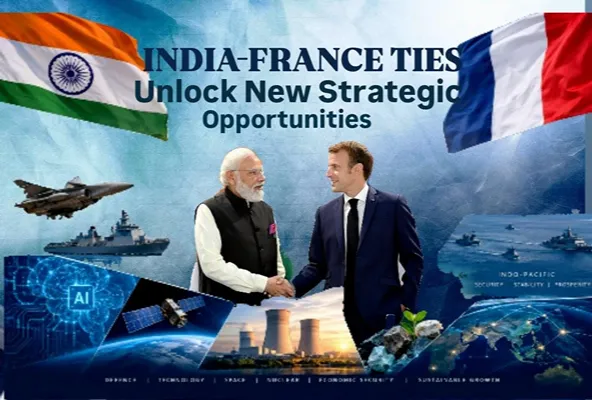

India-France Ties are entering a more ambitious phase as New Delhi and Paris expand cooperation across defence, advanced technology, space, nuclear energy and economic security. The partnership is also gaining greater importance in the Indo-Pacific, where both countries share interests in maritime security, regional stability and resilient supply chains.
The relationship is moving beyond traditional defence purchases towards co-development, technology sharing and joint manufacturing. At the same time, cooperation in AI, innovation, critical minerals and strategic industries is creating new economic opportunities while strengthening India’s push for greater technological and industrial self-reliance.
In 2026, India and France elevated their relationship to a Special Global Strategic Partnership, giving bilateral cooperation a broader long-term framework. For India, France is an important European partner that supports its strategic autonomy. For France, deeper engagement with India strengthens its Indo-Pacific presence and opens access to one of the world’s major growth markets.
India-France Ties Enter a New Strategic Era
India and France established their Strategic Partnership in 1998, creating a foundation for long-term cooperation in defence, counter-terrorism, space and civil nuclear energy. Over the following years, the relationship expanded as both countries developed closer military, diplomatic and economic ties.
The partnership gained a broader long-term vision with the Horizon 2047 Roadmap, which set out an ambitious framework for cooperation across strategic, economic, technological and people-to-people areas. By 2026, the relationship had moved well beyond its traditional pillars, with greater attention on artificial intelligence, advanced technologies, critical minerals, innovation, economic security and sustainable development.
The elevation of the relationship to a Special Global Strategic Partnership in 2026 marked another important step. Both countries also agreed to strengthen high-level consultations through an annual Foreign Ministers’ Comprehensive Dialogue. Meanwhile, the India-France Innovation Roadmap 2030 has placed technology and innovation at the centre of the partnership. The broader direction shows how New Delhi and Paris are building a relationship designed to support India’s strategic autonomy while strengthening France’s role in the Indo-Pacific.
| Year | Development | Strategic Significance |
|---|---|---|
| 1998 | India-France Strategic Partnership established | Created the foundation for long-term strategic cooperation |
| 2008 | Civil nuclear cooperation agreement signed | Opened a new phase in nuclear energy cooperation |
| 2016 | India and France signed the Rafale inter-governmental agreement | Strengthened bilateral defence cooperation |
| 2018 | India-France cooperation expanded in the Indo-Pacific | Increased focus on maritime security and regional stability |
| 2023 | Horizon 2047 Roadmap adopted | Set a long-term vision for the partnership |
| 2024 | Bilateral trade reached US$15.11 billion | Highlighted growing economic engagement |
| 2024 | French FDI stock reached about US$10.94 billion | Reflected France’s expanding investment presence in India |
| 2026 | Relationship upgraded to Special Global Strategic Partnership | Broadened cooperation across strategic and economic sectors |
| 2026 | India-France Year of Innovation | Put AI, technology and research at the centre of bilateral ties |
| 2026 | Innovation Roadmap 2030 advanced | Created a framework for deeper technology and innovation cooperation |
| 2047 | India’s nuclear energy target: 100 GW | Creates potential for expanded long-term nuclear cooperation |
Defence and Technology Drive Closer Cooperation
Defence remains a central pillar of India-France Ties, but the partnership is moving beyond conventional arms purchases. New Delhi and Paris are focusing on joint research, co-design, co-development and co-production, combining French defence expertise with India’s expanding manufacturing capabilities. This shift supports India’s goal of reducing import dependence while building a stronger domestic defence industry.
The two countries have also agreed to establish a Joint Advanced Technology Development Group to identify and develop emerging defence technologies. France already has a strong defence partnership with India across fighter aircraft, submarines, missiles and other military systems. The next phase could place greater emphasis on technology transfer and manufacturing in India, potentially creating opportunities for India to expand its defence exports.
Technology is adding a new strategic dimension to the relationship. The India-France Year of Innovation 2026 and the Innovation Roadmap 2030 focus on artificial intelligence, digital technologies, cybersecurity, research, healthcare and education. Greater cooperation between start-ups, universities and research institutions could accelerate innovation, while joint work on secure and responsible AI could strengthen both countries’ technological and strategic resilience.
Space, Nuclear Energy and the Indo-Pacific
India-France Ties are expanding into strategic sectors such as space, nuclear energy and maritime security. India’s ISRO and France’s CNES have a long history of cooperation, which is now extending to human spaceflight, microgravity research and space situational awareness. Both countries are also encouraging greater participation from private space companies, recognising that space technology is increasingly linked to communications, navigation, disaster management and national security.
Nuclear energy offers another major opportunity for deeper cooperation. India aims to expand its nuclear power capacity to 100 GW by 2047, while France has extensive expertise across the nuclear energy sector. The Jaitapur Nuclear Power Project remains an important part of bilateral discussions, while emerging technologies such as Small Modular Reactors and Advanced Modular Reactors could open new areas for collaboration. For India, stronger nuclear cooperation could support energy security and its long-term low-carbon transition.
The strategic value of the partnership also extends across the Indo-Pacific. France maintains overseas territories and military capabilities in the region, while India is seeking a stronger role in the Indian Ocean. Their shared interests create opportunities for greater cooperation in maritime surveillance, naval exercises, logistics and space-based monitoring. Exercises such as Varuna, Garuda and Shakti have already strengthened military coordination, while deeper cooperation could give both countries greater influence in maintaining stability across the Indo-Pacific.ing and disaster response.
Economic Security and the Geopolitical Stakes
Economic security is becoming an increasingly important part of India-France Ties as both countries seek stronger supply chains and greater resilience against global disruptions. India and France have agreed to create a high-level mechanism to work towards doubling bilateral trade within five years, while an Economic Security Dialogue will focus on emerging risks involving critical minerals, advanced technologies and strategic industries. For French companies, India’s expanding economy offers significant opportunities, while India can benefit from French investment, technology and access to wider European industrial networks.
The economic partnership also has a wider geopolitical dimension. As competition intensifies over semiconductors, critical minerals, energy technologies and advanced manufacturing, countries are increasingly treating supply-chain security as a national-security priority. Stronger India-France cooperation could therefore help both sides diversify strategic dependencies. Closer India-EU economic engagement could further expand these opportunities, particularly as India and the European Union deepen their trade relationship.
The broader significance of India-France Ties lies in their potential to strengthen both countries’ strategic autonomy. India can use the partnership to expand its defence-industrial and technological capabilities without relying excessively on any single power. France, meanwhile, gains a major Indo-Pacific partner and a growing economic market. Together, the two countries could play a larger role in shaping maritime security, technology governance, defence production and resilient supply chains. However, the success of this partnership will ultimately depend on implementation, investment and the timely delivery of major projects.
India-France Ties: What Comes Next
The next phase of India-France Ties will depend on how effectively both countries turn strategic commitments into measurable results. Defence manufacturing is likely to remain a key priority, but cooperation in AI, space, nuclear energy, critical minerals and advanced technologies could become equally important. India will seek greater technology transfer and domestic production, while France will look to expand its presence in India’s growing market and industrial ecosystem.
This could gradually transform the relationship from a traditional defence partnership into a model of strategic co-production and co-development. Joint manufacturing, technology partnerships and resilient supply chains could create benefits beyond the two countries. They may also strengthen India’s defence-industrial base and give French companies greater access to India’s expanding manufacturing and technology ecosystem.
Overall, India-France Ties are entering a more ambitious strategic phase. The partnership now extends well beyond defence and diplomacy, covering technology, industrial production, space, nuclear energy, economic security and the Indo-Pacific. For India, France offers an important European partner that supports strategic autonomy. For France, India provides scale, investment opportunities and a strong Indo-Pacific partner. If New Delhi and Paris can deliver on their commitments, the relationship could emerge as one of India’s most comprehensive and consequential partnerships with a European power.
What is the current status of India-France Ties?
India and France upgraded their relationship to a Special Global Strategic Partnership in 2026. Cooperation now covers defence, technology, space, nuclear energy, trade and economic security.
Why is France important to India’s Indo-Pacific strategy?
France has overseas territories and strategic interests in the Indo-Pacific. It also maintains military capabilities in the region, making it an important European partner for India.
What are the main areas of India-France cooperation?
The major areas include defence, space, civil nuclear energy, AI, innovation, cybersecurity, critical minerals, healthcare, trade and education.
How is defence cooperation changing?
The relationship is moving beyond equipment purchases. India and France are focusing increasingly on co-design, co-development and co-production of advanced defence technologies.
What is the India-France Year of Innovation?
2026 has been designated the India-France Year of Innovation. It promotes cooperation in AI, science, technology, healthcare, education and research.