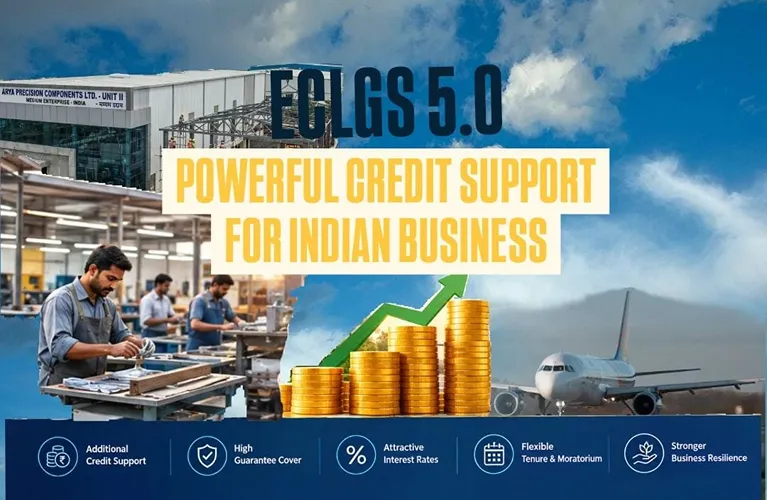

India has opened another important credit channel for businesses dealing with external economic disruptions. Emergency Credit Line Guarantee Scheme (ECLGS 5.0) is designed to provide additional working capital to eligible enterprises while reducing the lending risk faced by financial institutions through government-backed guarantees.
The scheme comes at a time when geopolitical uncertainty, supply-chain disruptions, higher logistics costs and liquidity pressures can quickly affect business operations. With a potential additional credit flow of up to ₹2.55 lakh crore, ECLGS 5.0 seeks to keep enterprises funded, protect employment and prevent temporary financial stress from turning into a deeper business crisis.
Unlike the original Emergency Credit Line Guarantee Scheme launched during the COVID-19 crisis, the latest version has been structured around a wider set of external disruptions. It covers Micro, Small, and Medium Enterprises (MSMEs) across sectors, eligible non-MSME businesses and scheduled passenger airlines, giving the programme a broader role in maintaining economic continuity.
What Makes ECLGS 5.0 Different This Time?
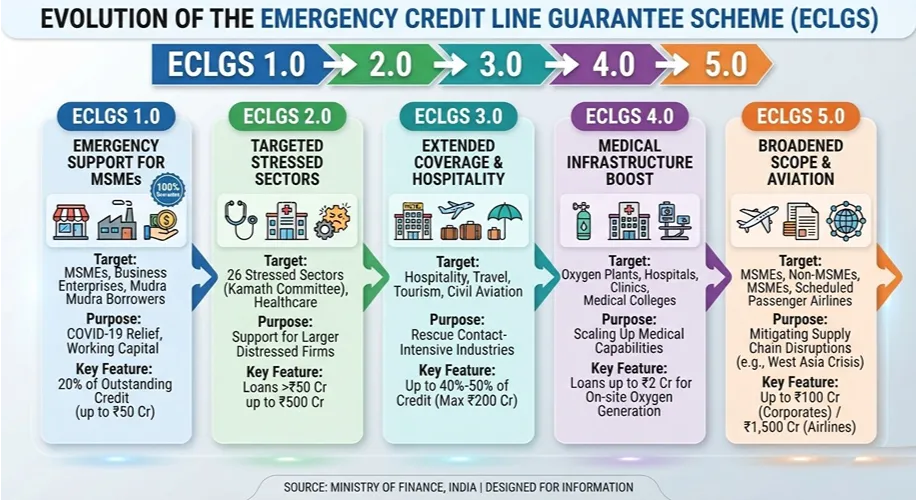
The Emergency Credit Line Guarantee Scheme began as a pandemic-era rescue mechanism, but its structure changed with each phase as the nature of economic stress evolved. The first four versions progressively widened or redirected support towards businesses and sectors facing severe disruption, before the earlier framework ended on 31 March 2023.
The latest version represents a shift from pandemic-specific relief towards business resilience during external economic disruptions. Instead of concentrating on a single crisis-hit sector, ECLGS 5.0 brings MSMEs across sectors into the framework alongside eligible non-MSMEs and scheduled passenger airlines. NCGTC remains at the centre of the guarantee mechanism, allowing participating lenders to extend additional credit while receiving government-backed protection.
ECLGS Evolution: Year-Wise Details and Specifications
| Phase | Year | Main purpose | Key specification |
|---|---|---|---|
| ECLGS 1.0 | 2020 | COVID-19 emergency support | Covered MSMEs, business enterprises, Mudra borrowers and individual business loans; borrower exposure up to ₹50 crore; up to 60 days past due as on 29 February 2020 |
| ECLGS 2.0 | 2020 | Support for stressed sectors | Expanded coverage to 26 stressed sectors identified by the Kamath Committee and healthcare; exposure above ₹50 crore and up to ₹500 crore; up to 60 days past due |
| ECLGS 3.0 | 2021 | Support for contact-intensive sectors | Covered hospitality, travel and tourism, leisure and sporting activities and civil aviation; eligible facilities could have up to 60 days past due |
| ECLGS 4.0 | 2021 | Healthcare infrastructure support | Covered hospitals, nursing homes, clinics, medical colleges and manufacturers of liquid oxygen and oxygen cylinders; eligibility allowed up to 90 days past due as on 31 March 2021 |
| ECLGS 5.0 | 2026 | Response to external economic disruptions | Covers MSMEs across sectors, eligible non-MSMEs and scheduled passenger airlines |
| ECLGS 5.0 credit — MSMEs/non-MSMEs | 2026 | Additional working-capital support | Up to 20% of peak fund-based working-capital outstanding during Q4 FY2025–26; maximum ₹100 crore per borrower |
| ECLGS 5.0 — MSME guarantee | 2026 | Reduce lender credit risk | 100% guarantee coverage |
| ECLGS 5.0 — non-MSME guarantee | 2026 | Reduce lender credit risk | 90% guarantee coverage |
| ECLGS 5.0 — airlines | 2026 | Support scheduled passenger airlines | Additional credit up to 100%; maximum ₹1,500 crore per borrower |
| Airline guarantee coverage | 2026 | Credit-risk protection | 90% guarantee coverage |
| General loan tenure | 2026 | Easier repayment | 5 years, including 1-year moratorium |
| Airline loan tenure | 2026 | Longer repayment window | 7 years, including 2-year moratorium |
| Overall guarantee ceiling | 2026 | Programme limit | Up to ₹2.55 lakh crore |
| Scheme validity | 2026–27 | Operational period | Until 31 March 2027 or until the guarantee ceiling is reached, whichever is earlier |
| Guarantees issued | As of 20 Aug 2026 | Latest utilisation | 6,73,979 |
| Guaranteed amount | As of 20 Aug 2026 | Latest utilisation | ₹2,50,024 crore |
| MSME share of guarantees | As of 20 Aug 2026 | Utilisation by number | 97.3% |
| MSME share of guaranteed amount | As of 20 Aug 2026 | Utilisation by value | 80.79% |
The table shows the central difference between the phases: ECLGS 1.0–4.0 were largely shaped by the pandemic and its immediate sectoral consequences, while ECLGS 5.0 is structured around broader external economic pressures. The latest phase therefore retains the guarantee-based lending model but applies it to a changed risk environment.
The scale of the latest programme is already evident from its early utilisation. By 20 August 2026, the scheme had moved close to its overall guarantee ceiling, with MSMEs making up the overwhelming majority of guarantees issued.
Who Qualifies and How Much Can Businesses Borrow?
Eligibility under ECLGS 5.0 depends on the category of borrower, the existing credit relationship and the status of the borrowing account. For MSMEs and eligible non-MSMEs, borrowers must have existing working capital facilities with Member Lending Institutions as of 31 March 2026. Their repayments must not have been overdue by more than 60 days.
MSMEs have an important advantage because the scheme is available to them across all sectors. The position is different for non-MSME borrowers, as several sectors are specifically excluded from coverage. These include NBFCs, power generation, transmission and distribution, telecom services, sugar and ethanol, information technology, paper and paper products, educational institutions, and beverages other than tea and coffee, along with tobacco.
Where an enterprise operates across both eligible and excluded sectors, eligibility is determined by the lending institution based on the proportion of turnover generated from eligible sectors during FY2025–26. This makes the nature of a business’s operations an important factor for larger non-MSME borrowers. Another restriction concerns businesses that have already received support under the Credit Guarantee Scheme for Exporters (CGSE). Such borrowers cannot receive ECLGS 5.0 assistance up to the amount already availed under CGSE. This prevents overlapping guarantee support for the same borrowing requirement.
The participating lending network is broad. It includes Scheduled Commercial Banks, Scheduled Urban Co-operative Banks, Financial Institutions and eligible NBFCs. This gives borrowers multiple institutional channels through which additional credit can be considered. For MSMEs and non-MSMEs, the additional credit is capped at ₹100 crore per borrower. For airlines, the ceiling rises dramatically to ₹1,500 crore because of the capital-intensive nature of the sector. However, the higher airline limit comes with additional conditions, including promoter equity for assistance above ₹1,000 crore.
The scheme also provides regulated interest-rate parameters for the general business category. MSME loans are linked to the External Benchmark Lending Rate (EBLR), while eligible non-MSME loans are linked to the Marginal Cost of Funds-Based Lending Rate (MCLR). Lending institutions may charge up to 0.75% above the relevant benchmark, subject to an overall ceiling of 9% per annum. Eligible NBFCs cannot charge more than 13% per annum.
Why ECLGS 5.0 Matters for Businesses
ECLGS 5.0 addresses a common problem during economic disruptions: a viable business can suddenly face a working-capital shortage even when its underlying operations remain sound. Delayed payments, higher input costs, disrupted logistics and weaker demand can create cash-flow pressure that is difficult to bridge through conventional borrowing. By providing government-backed guarantees, the scheme reduces lender risk and creates greater scope for eligible businesses to access additional credit.
The benefit is particularly significant for MSMEs, which receive 100% guarantee coverage, while eligible non-MSMEs receive 90% coverage. The scheme also provides a repayment window that gives businesses time to stabilise. MSME and eligible non-MSME borrowers get a five-year tenure, including a one-year moratorium, while scheduled passenger airlines receive a seven-year tenure with a two-year moratorium.
ECLGS 5.0 can therefore support more than individual borrowers. When enterprises have sufficient working capital, production can continue, suppliers can maintain operations and employment can be protected. This becomes particularly important for businesses connected to wider domestic and international supply chains, where a liquidity problem at one company can quickly affect several others.
The scheme also provides a significant window of support for the aviation sector. Eligible scheduled passenger airlines can access additional credit of up to 100%, subject to a ceiling of ₹1,500 crore per borrower. For assistance above ₹1,000 crore and up to ₹1,500 crore, a proportionate equity contribution from promoters or owners is required.
Strong Uptake Puts the Scheme in Focus
The early numbers show substantial demand for ECLGS 5.0. As of 20 August 2026, 6,73,979 guarantees had been issued, covering ₹2,50,024 crore. MSMEs accounted for 97.3% of guarantees by number and 80.79% of the total guaranteed amount, highlighting their dominant role in the scheme’s utilisation.
This level of utilisation also makes the remaining headroom important. ECLGS 5.0 has an overall guarantee ceiling of ₹2.55 lakh crore and is scheduled to remain operational until 31 March 2027, or until the guarantee limit is reached, whichever occurs earlier.
For eligible businesses, the key issue is therefore not simply the availability of government-backed credit but whether they meet the prescribed conditions and secure the facility through a participating lending institution. ECLGS 5.0 is not an automatic grant or unrestricted source of funds; it is a structured credit facility designed to help eligible borrowers manage temporary liquidity pressures.
Eligible borrowers can also use the Jan Samarth Portal to access the scheme digitally. Ultimately, the strength of ECLGS 5.0 will be measured by how effectively it converts government-backed guarantees into timely working capital, allowing otherwise viable businesses to withstand external shocks without disrupting production, employment and supply chains.
What is ECLGS 5.0?
ECLGS 5.0 is a government-backed credit guarantee scheme designed to provide additional credit to eligible MSMEs, non-MSME businesses and scheduled passenger airlines facing external economic disruptions. NCGTC provides the guarantee support to participating lending institutions.
How much additional credit can an MSME receive?
An eligible MSME can receive additional credit of up to 20% of its peak fund-based working capital outstanding during Q4 FY2025–26, subject to a maximum of ₹100 crore per borrower.
What guarantee coverage is available under ECLGS 5.0?
Eligible MSMEs receive 100% guarantee coverage, while eligible non-MSMEs and scheduled passenger airlines receive 90% coverage under the scheme.
What is the interest rate under ECLGS 5.0?
For MSMEs, the rate is linked to EBLR with lending institutions permitted to charge up to 0.75% above the benchmark, subject to a 9% annual ceiling. For eligible non-MSMEs, it is linked to MCLR under the same 0.75% and 9% ceiling framework. Eligible NBFC loans are capped at 13% per annum.
How long is the ECLGS 5.0 loan tenure?
MSME and eligible non-MSME loans have a five-year tenure, including a one-year moratorium. Airline loans have a seven-year tenure, including a two-year moratorium.