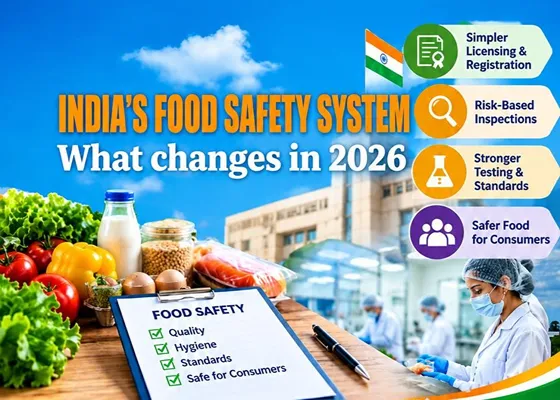

India’s food-safety framework is entering a major transition in 2026. The government is reducing routine compliance while moving towards more targeted, risk-based enforcement. The changes affect a diverse food sector that includes manufacturers, restaurants, retailers, exporters, street-food vendors and small businesses.
At the centre is the Food Safety and Standards Authority of India (FSSAI), which sets standards, manages licensing and registration, and coordinates enforcement with State and Union Territory authorities. Under the revised system, businesses with turnover up to ₹1.5 crore require registration, while those earning above ₹1.5 crore and up to ₹50 crore need a State licence. Businesses above ₹50 crore require a Central licence. FSSAI licences and registrations will also have perpetual validity, subject to suspension, cancellation or surrender.
The reforms also provide deemed registration for eligible street-food vendors and strengthen risk-based inspections. With the new rules effective from 1 April 2026, the key challenge is balancing easier compliance with strong enforcement. The success of the reforms will ultimately depend on whether India can reduce paperwork without weakening consumer protection.
What Is India Food Safety?
India Food Safety refers to the regulatory framework designed to ensure that food reaching consumers is safe, hygienic, wholesome and meets prescribed standards. It covers more than food adulteration, including contamination, toxins, chemical and antibiotic residues, additives, hygiene, processing, packaging, labelling and storage. FSSAI sets standards for these areas and regulates a wide range of food products and businesses.
Food safety works as a chain rather than as the responsibility of one agency. It begins with production and continues through processing, transportation, storage, retail and consumption. A problem at any stage can affect food quality and create risks for consumers. This makes effective monitoring and enforcement important across the entire food supply chain.
The challenge is especially significant in India because the food economy includes millions of small businesses, street-food vendors, restaurants and retailers alongside large manufacturers and multinational companies. A single compliance model can create unnecessary pressure on smaller operators, while weak oversight can leave gaps in consumer protection. The 2026 food-safety reforms aim to address this balance by reducing routine regulatory burdens while moving towards more targeted, risk-based enforcement.
How India’s Food Safety Laws Evolved
India’s food-safety framework has evolved from a narrow focus on adulteration to a broader system covering food quality and consumer safety. The early framework was built around the Prevention of Food Adulteration Act, 1954. A major change came with the Food Safety and Standards Act, 2006, which brought several food-related laws under one framework. This created the foundation for a unified food-safety system, with FSSAI established on 5 September 2008.
The framework became more detailed with the Food Safety and Standards Regulations, 2011. These regulations established requirements for food products, additives, contaminants, licensing and registration. Over the years, FSSAI also expanded its regulatory scope to newer areas such as organic foods, food fortification and nutraceuticals. Since 2016, the system has increasingly adopted scientific and risk-based approaches, allowing regulators to focus more closely on potential food-safety risks rather than relying only on traditional adulteration checks.
Key Milestones
| Year | Major Development |
|---|---|
| 1954 | Prevention of Food Adulteration Act |
| 2006 | Food Safety and Standards Act |
| 2008 | FSSAI established |
| 2011 | Food Safety and Standards Regulations introduced |
| 2016 onward | Scientific and risk-based regulation expanded |
| 2023 | Food Safety and Standards Act amended |
| 2026 | Major licensing and compliance reforms introduced |
FSSAI and Food Safety
FSSAI is the central pillar of India’s food-safety system. It sets science-based standards, regulates food businesses and oversees licensing and registration. However, enforcement is shared with State and Union Territory authorities, which conduct inspections, collect samples and act against violations. Accredited laboratories test food for contaminants, toxins, residues and other safety parameters, while manufacturers, restaurants, retailers, importers and vendors are responsible for meeting the prescribed requirements. Consumers also contribute by reporting unsafe products and filing complaints.
The system functions as a connected chain. FSSAI sets the standards, State and UT authorities enforce them, food businesses follow the requirements, and laboratories test samples. Regulators can then take action when violations are detected, while consumers strengthen the system by reporting suspected safety issues. The scale is significant. As of 8 July 2026, FoSCoS recorded more than 6.08 million active registrations and 1.27 million active licences. It had also issued over 15.4 million registrations and nearly 2.94 million licences, highlighting how widely even a small regulatory change can affect India’s food sector.
What Are the Major Food Safety Reforms in 2026?
The 2026 food-safety reforms bring major changes to FSSAI licensing, registration and enforcement. One of the biggest changes is perpetual validity for FSSAI licences and registrations. Businesses no longer need to renew them periodically. They remain valid unless suspended, cancelled or surrendered. However, businesses must still follow all applicable hygiene and food-safety requirements. The reform therefore reduces paperwork without removing regulatory responsibility.
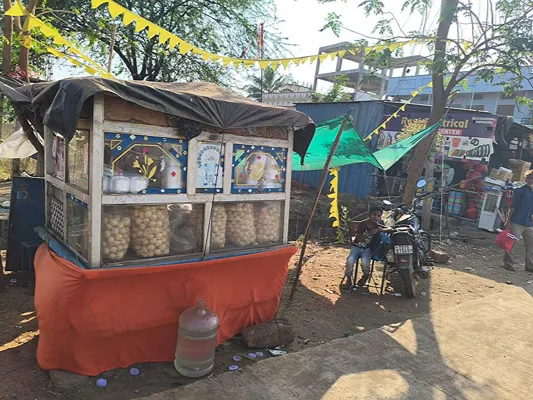
The government has also raised the basic FSSAI registration threshold from ₹12 lakh to ₹1.5 crore in annual turnover. From 1 April 2026, businesses with turnover up to ₹1.5 crore require registration, those above ₹1.5 crore and up to ₹50 crore require a State licence, and those above ₹50 crore require a Central licence. Another major change covers street-food vendors. Vendors already registered with Municipal Corporations or Town Vending Committees can receive deemed FSSAI registration. The government expects this measure to benefit more than 10 lakh vendors.
The reforms also move India towards a stronger risk-based inspection and food-safety audit system. Instead of giving every food business the same level of scrutiny, regulators can focus more on higher-risk products, processes and operations. This could make enforcement more efficient while helping authorities direct resources towards areas where food-safety risks are greater. Overall, the 2026 changes aim to make compliance easier for businesses while maintaining consumer protection.
What the 2026 Reforms Mean
The 2026 reforms could significantly reduce compliance pressure on food businesses, particularly smaller operators. Perpetual licences will remove repeated renewal requirements, while the higher registration threshold gives many growing businesses access to a simpler regulatory category for longer. However, easier compliance will only strengthen the system if effective inspections, regular sampling and reliable laboratory testing support it. The key measure of success will be whether unsafe food is detected and removed quickly.
The impact also extends beyond India’s domestic food market. Food safety is increasingly tied to international trade, export competitiveness and market access. Indian exporters must meet the safety standards of overseas markets, while differences between national regulations can increase compliance costs. India has been a member of the Codex Alimentarius Commission since 1964, with FSSAI serving as the national contact point for Codex-related work. Strong standards, testing capacity and credible certification can therefore help Indian food products compete more effectively in global markets.
At the same time, the reforms do not signal a retreat from food-safety regulation. FSSAI continues to update technical standards covering contaminants, naturally occurring toxic substances, antibiotic residues and food labelling. The broader direction is therefore clear: less administrative burden, but more targeted regulation where risks are higher. For India, the challenge will be to maintain consumer confidence while making it easier for businesses to grow and compete in global food markets.
What Could Change Next?
India’s food-safety policy is likely to move further towards risk-based inspections, digital compliance and stronger testing systems. Platforms such as FoSCoS could play a larger role in managing regulatory data and compliance. Laboratory capacity will remain equally important for detecting contamination and verifying safety standards. Food businesses may also face greater expectations around traceability, record-keeping and self-compliance. Meanwhile, international food standards could gain more importance as India expands its food exports. The next stage will therefore be less about adding paperwork and more about using data, testing and targeted inspections effectively.
India’s food-safety system has already moved beyond its earlier focus on adulteration. The creation of FSSAI brought the framework under a more unified system, while the 2026 reforms are pushing it towards simpler licensing and targeted enforcement. For businesses, this could mean less paperwork and greater regulatory continuity. For consumers, however, the real test will be enforcement. The success of India’s food safety reforms will depend on whether unsafe food is detected, tested and stopped before reaching consumers. In this sense, 2026 could mark a broader shift—from applying the same regulatory approach to every business towards concentrating oversight where food-safety risks are highest.
What is India’s Food Safety system?
India’s Food Safety system is the national framework used to regulate food quality and safety. FSSAI sets standards, while State and UT authorities conduct much of the ground-level enforcement.
What changed in FSSAI rules in 2026?
Major changes include perpetual validity for licences and registrations, higher turnover thresholds, deemed registration for eligible street-food vendors and a stronger risk-based inspection framework.
What is the new FSSAI registration limit?
From 1 April 2026, businesses with annual turnover up to ₹1.5 crore fall under the registration category. Businesses above ₹1.5 crore and up to ₹50 crore require a State licence. Businesses above ₹50 crore require a Central licence.
Do perpetual FSSAI licences mean businesses no longer face inspections?
No. Perpetual validity removes routine renewal requirements. It does not remove food-safety obligations or enforcement powers.
Why does food safety matter for India’s exports?
International buyers impose strict food-safety requirements. Strong domestic standards, testing and certification can help Indian exporters meet those requirements and compete in global markets.