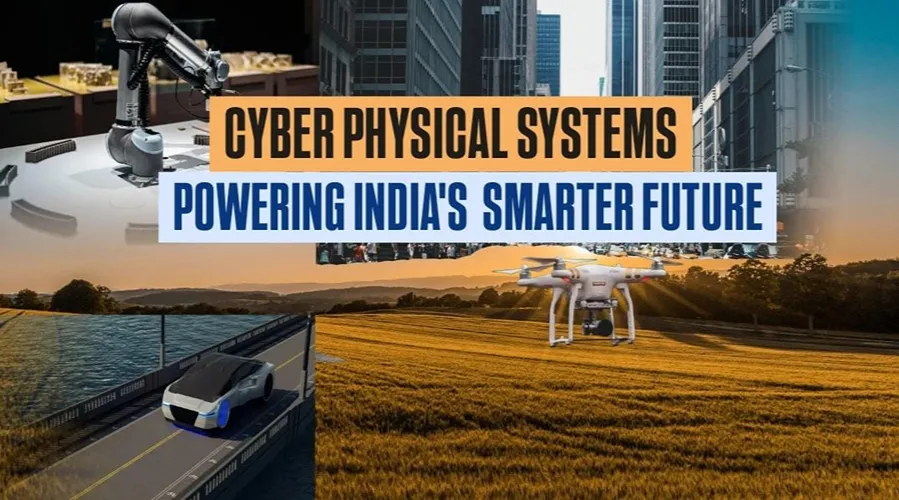

The machines shaping the next phase of the digital economy will not exist only on computer screens. They will drive vehicles, operate factories, monitor crops, assist doctors, manage energy systems and increasingly interact with people in real time. This is where Cyber-Physical Systems (CPS) are becoming important.
CPS brings computing, sensors, communications and physical machinery into one connected system. The concept is already behind technologies such as autonomous vehicles, smart manufacturing and digital twins, but its importance is growing as artificial intelligence and connected infrastructure become more widespread.
For India, the opportunity is particularly significant. The country is trying to build domestic capabilities in advanced technologies instead of remaining dependent on imported systems. Through the National Mission on Interdisciplinary Cyber-Physical Systems (NM-ICPS), India is creating research centres, technology hubs, start-ups and skilled manpower around this emerging field.
What Are Cyber-Physical Systems and How Do They Work?
A CPS essentially allows a physical system to interact continuously with a digital one. Sensors collect information from the physical environment, software processes that information and communication networks move data between different components. The system can then make a decision or trigger a physical response. Consider an autonomous vehicle. Cameras, radar and other sensors collect information about surrounding traffic and road conditions. Computing systems analyse that information and software decides whether the vehicle should accelerate, brake or change direction. The physical action then creates new information, which is sensed again. This creates a continuous feedback loop.
The same principle can be applied to a factory where machines monitor their own performance, a hospital where equipment tracks a patient’s condition or an agricultural system that measures soil and weather conditions. The difference between CPS and an ordinary digital application is that the output can directly influence the physical world. This connection also makes CPS more demanding. A conventional software failure may result in lost data or an unavailable service. A failure in a CPS could potentially stop a production line, disrupt transport or affect the operation of critical equipment. Security, reliability and safety therefore have to be considered alongside performance.
- India’s Nuclear Gamble: The Power Shift Behind 2047
- Malaria Elimination by 2030: India’s Critical Battle
- Praggnanandhaa Wins Grand Chess Tour in Stunning Comeback
- Kanpur Training Aircraft Crash: What It Reveals About India’s Pilot Training Safety
- Undersea Cables: The Silent Battlefield of the Next Digital War
Why India Is Building a National Cyber-Physical Systems Ecosystem
India’s national push is centred on the National Mission on Interdisciplinary Cyber-Physical Systems (NM-ICPS), implemented by the Department of Science and Technology. The Union Cabinet approved the mission in 2018 with an allocation of ₹3,660 crore over nine years. Its objective is to develop capabilities spanning research, technology development, commercialisation and skilled human resources.
The reasoning behind this approach is important. Advanced technologies rarely become economically useful simply because a laboratory has demonstrated that they work. They need engineers, manufacturers, investors, testing facilities and organisations capable of taking a prototype into the market. NM-ICPS attempts to create that broader ecosystem by connecting universities, industry, government and international partners.
The mission is also significant from a strategic perspective. India is rapidly expanding its use of digital infrastructure, automation, artificial intelligence and connected devices. Building domestic expertise in CPS can help ensure that the country is not merely a consumer of technologies developed elsewhere.
The scale of the ecosystem has grown considerably. India now has 25 Technology Innovation Hubs, while the programme has also developed specialised mechanisms for translating research into commercially viable technologies.
From Research to Reality with India’s 25 Technology Innovation Hubs
The Technology Innovation Hubs, or TIHs, are designed to take CPS research beyond academic papers and laboratory demonstrations. Their responsibilities include technology development, skill creation, entrepreneurship, start-up support and international collaboration.
In 2025, four high-performing hubs were selected to operate as Technology Translation Research Parks. IIT Kanpur is working in cybersecurity, IISc Bengaluru in robotics and AI systems, IIT (ISM) Dhanbad in mining technologies and IIT Indore in digital healthcare. This specialisation gives each park a clearer route towards translating research into practical applications.
India’s CPS ecosystem in numbers
| Indicator | Figure |
|---|---|
| NM-ICPS financial outlay | ₹3,660 crore |
| Technology Innovation Hubs | 25 |
| Technology Translation Research Parks | 4 |
| Technologies enabled | 1,146 |
| Technology products | 1,329 |
| Fellowships awarded | 5,824 |
| Professionals trained | 2.46 lakh+ |
| Start-ups and spin-offs incubated | 1,136 |
| Jobs contributed | 24,000+ |
| International collaborations | 200 |
The figures reported for August 2026 show that the programme is no longer limited to building research capacity. It has supported more than a thousand technologies and products, trained a large professional base and helped incubate more than a thousand start-ups and spin-offs.
That transition from research to deployment will ultimately determine the programme’s success. India will need technologies that can survive real-world conditions, compete on cost, meet safety standards and attract industrial customers. Research capability is the starting point, not the final measure of success.
How Cyber-Physical Systems Are Transforming Key Sectors
Healthcare is emerging as one of the most interesting areas for CPS because medicine increasingly depends on continuous data. Digital twins can create virtual representations of physical systems and use incoming information to study their behaviour. IIT Indore’s CharakDT, for example, is being developed as a digital representation of parts of the human body, including the lungs, eyes and heart.
Agriculture presents a different opportunity. Sensors can measure soil conditions, weather and micro-climate data, allowing farmers and agricultural systems to make decisions based on changing field conditions. An Agri-IoT farm management system developed at IIT Bombay is designed to support more efficient use of water and fertilisers.
Mining demonstrates why CPS can have a direct safety benefit. Operations often take place in remote or hazardous environments where sending workers for routine inspection can be risky. Drones and remote monitoring systems can collect information without putting people in the same physical environment. The TEXMiN hub at IIT (ISM) Dhanbad has developed drones capable of transmitting data over distances of up to 50 km.
Communications, cybersecurity and autonomous mobility are also becoming important applications. Indigenous 5G-Advanced technology is being developed for high-speed connectivity, while an IT-OT Security Operations Centre at IIT Kanpur is focused on monitoring connected technology environments. At IIT Hyderabad, autonomous aerial and terrestrial systems can be tested at a dedicated proving ground before deployment.
Why CPS Could Become Critical to India’s Technological Self-Reliance
The strategic importance of CPS lies in bringing AI, sensors, communications and robotics together. This convergence can strengthen smart manufacturing, intelligent transport and connected healthcare through real-time monitoring, decision-making and greater autonomy. Digital twins can also help reduce the time and cost involved in testing physical processes.
However, greater connectivity also creates greater risks. As physical infrastructure becomes digitally connected, the potential attack surface expands, and a cyberattack on operational technology can have consequences in the physical world. This makes strong cybersecurity and indigenous expertise increasingly important for India’s connected industrial and public infrastructure. AI could further expand the capabilities of CPS. BharatGen, supported under NM-ICPS and led by IIT Bombay with academic partners, is developing multilingual and multimodal AI systems. Its Param-2 foundation model has 17 billion parameters and supports all 22 Scheduled Indian languages, alongside models for speech, documents and specialised sectors.
India’s next challenge is to move beyond prototypes towards testing, certification, manufacturing and deployment. This will require a skilled workforce capable of working across AI, embedded systems, industrial engineering and cybersecurity, along with stronger links between research institutions and industry. If this ecosystem matures, CPS could connect India’s ambitions in AI, robotics, advanced communications and industrial automation. Its success, however, will depend on whether these innovations can move beyond specialised projects and become reliable technologies used across India’s economic and public infrastructure.
What are Cyber-Physical Systems?
Cyber-Physical Systems combine computing, sensors, communication networks and physical processes. They allow machines and infrastructure to collect information, analyse it and respond to changing conditions.
What is India’s NM-ICPS?
The National Mission on Interdisciplinary Cyber-Physical Systems is a Government of India programme designed to strengthen research, innovation, skills, start-ups and applications in CPS. It was approved in 2018 with an outlay of ₹3,660 crore.
Where are CPS technologies being used in India?
Applications include healthcare, agriculture, mining, advanced communications, cybersecurity, autonomous vehicles and robotics. Several of these technologies are being developed through the Technology Innovation Hubs established under NM-ICPS.
How many Technology Innovation Hubs does India have?
India has established 25 Technology Innovation Hubs under NM-ICPS. They work on technology development, human-resource development, entrepreneurship and international collaboration.
Why is CPS important for cybersecurity?
CPS connects digital networks to physical equipment. A cyberattack on such a system could potentially affect real-world operations, making protection of operational technology, industrial systems and connected infrastructure particularly important.