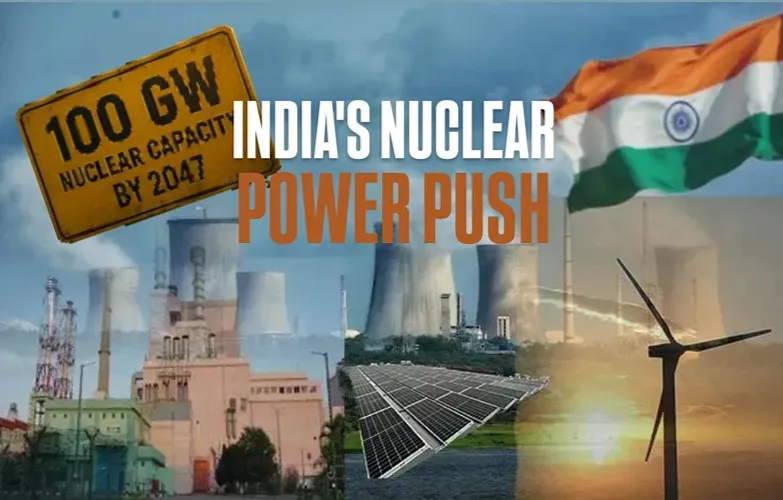

India is preparing for a major shift in the way it powers its economic rise, and nuclear power is moving closer to the centre of that strategy. For years, India’s energy story was dominated by coal, followed by an extraordinary expansion of solar and wind. Now, as electricity demand climbs and industries require dependable round-the-clock power, New Delhi is looking at atomic energy as a crucial third pillar of the future electricity mix.
The ambition is enormous. India wants to increase its nuclear capacity to around 100 GW by 2047, compared with only about 8.2 GW of installed capacity from its existing fleet. Reaching that level would require a nuclear expansion on a scale India has never attempted. It would mean building reactors faster, mobilising much more capital, bringing private industry into the sector, expanding domestic manufacturing and moving beyond the conventional reactor models that have defined India’s programme for decades. The result could be one of the country’s most consequential energy transformations, but it is also a race against time, money, technology and public confidence.
- Malaria Elimination by 2030: India’s Critical Battle
- Praggnanandhaa Wins Grand Chess Tour in Stunning Comeback
- Kanpur Training Aircraft Crash: What It Reveals About India’s Pilot Training Safety
- Undersea Cables: The Silent Battlefield of the Next Digital War
- Census 2027: The Powerful Count That Could Change India
Why India Is Betting on Nuclear Power
The case for nuclear power begins with a simple problem: India is going to need vastly more electricity. Economic growth, manufacturing, urbanisation and rising household consumption are already pushing demand higher, while new requirements are emerging from electric vehicles, data centres, artificial intelligence, semiconductor plants, green hydrogen and increasingly electricity-intensive industries. Solar and wind can supply enormous amounts of low-carbon electricity, but their output changes with sunlight and weather. Batteries and other storage technologies can address part of that problem, yet a rapidly growing economy still needs reliable generation capable of operating day and night.
That is where nuclear power becomes strategically attractive. Nuclear reactors can operate continuously for long periods and produce electricity with very low operational carbon emissions. Unlike solar and wind farms, they do not depend directly on whether the sun is shining or the wind is blowing. This does not make nuclear power a replacement for renewable energy. India’s more realistic strategy is to combine the two: use solar and wind to add large quantities of relatively low-cost renewable electricity, while nuclear power provides a dependable low-carbon component that can operate around the clock.
The scale of India’s present nuclear fleet explains why the 2047 target is so striking. The country has 24 nuclear power reactors with roughly 8.2 GW of installed capacity, although individual reactor availability and operational status can change as units undergo maintenance or commissioning-related activity. Nuclear power remains a relatively small part of India’s overall electricity system, which continues to depend heavily on coal. Yet the government’s long-term strategy envisages a substantial increase in atomic generation, making nuclear power a much more important source of electricity by the time India reaches its 2047 development milestone.
| Nuclear power indicator | India’s position / target |
|---|---|
| Current nuclear reactors | 24 |
| Current installed nuclear capacity | About 8.2 GW |
| Long-term nuclear capacity target | About 100 GW |
| Target horizon | 2047 |
| Indigenous PHWR design being expanded | 700 MW class |
| Major reactor programme | 700 MW PHWRs |
| Major fast-breeder project | Prototype Fast Breeder Reactor, Kalpakkam |
| PFBR design capacity | 500 MW |
| Major Russian reactor programme | Kudankulam |
| Kudankulam Units 1–2 | 2 × 1,000 MW |
| Kudankulam Units 3–6 | 4 × 1,000 MW planned |
| Nuclear Energy Mission allocation | ₹20,000 crore |
| SMR target announced for 2033 | At least 5 indigenous SMRs |
| Long-term domestic reactor strategy | PHWRs, fast breeders and thorium-based systems |
| Key nuclear regulator | Atomic Energy Regulatory Board |
| Principal nuclear power utility | NPCIL |
| Strategic nuclear research organisation | BARC |
| Long-term fuel strategy | Uranium, plutonium recycling and thorium |
| Three-stage programme | PHWR → Fast Breeder → Thorium |
The government’s recent nuclear push also reflects a broader concern about energy security. India imports a large proportion of the fossil fuels needed to sustain its economy, exposing the country to international prices, shipping disruptions and geopolitical shocks. Nuclear fuel has a very high energy density, meaning relatively small quantities can generate huge amounts of electricity. India has also spent decades developing a domestic nuclear ecosystem precisely because access to international nuclear technology and fuel was once heavily restricted.
The 2008 civil nuclear agreement with the United States and the subsequent international arrangements opened a new chapter, allowing India to participate much more extensively in global civilian nuclear commerce despite remaining outside the Nuclear Non-Proliferation Treaty. Since then, India has built deeper nuclear relationships with countries including Russia and France while continuing to develop indigenous reactor technology. The geopolitical value is significant: a larger nuclear fleet could reduce some of the country’s exposure to imported fossil fuels while allowing India to maintain a diversified set of international technology and fuel partnerships.
From Big Reactors to Small Nuclear Plants
India’s nuclear strategy is expanding beyond conventional large reactors, with Small Modular Reactors (SMRs) emerging as an important part of the plan. Smaller and potentially easier to manufacture and deploy, SMRs could help India overcome some of the high costs and long construction timelines associated with traditional nuclear plants. The Nuclear Energy Mission for Viksit Bharat has allocated ₹20,000 crore for nuclear technology research and development, with a goal of developing at least five indigenous SMRs by 2033. The Bharat Small Modular Reactor (BSMR) is central to this effort, drawing on India’s experience with PHWR technology.
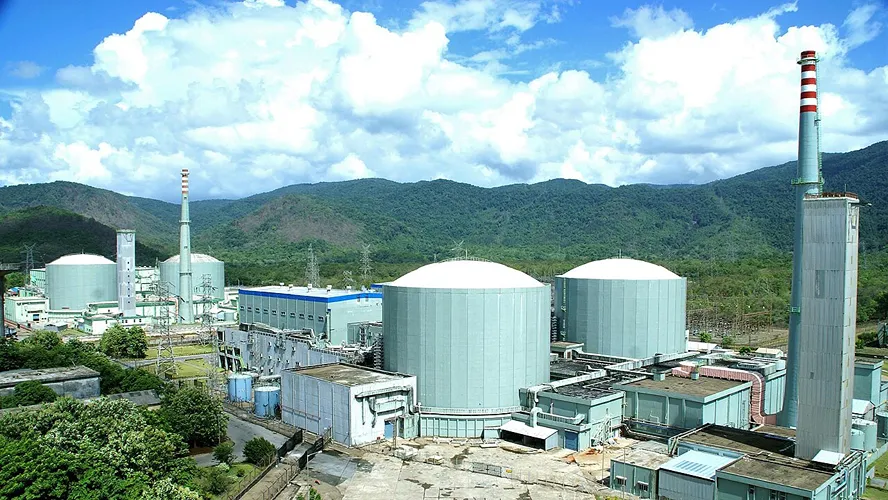
Photo: Department of Atomic Energy (DAE) – Government of India – https://twitter.com/DAEIndia/status/1055452791076986882 Licensed under the GODL
India is also expanding its indigenous 700 MW PHWR programme, using a standardised design that can be replicated across projects and strengthen domestic manufacturing. At the same time, its three-stage nuclear programme remains focused on making greater use of India’s uranium and thorium resources. PHWRs form the first stage, fast breeder reactors the second, and thorium-based systems the long-term third stage. The 500 MW Prototype Fast Breeder Reactor at Kalpakkam is a key step towards this transition.
Large reactors will continue to play a major role. Kudankulam, built with Russian cooperation, has two 1,000 MW units in operation, with four more planned. The proposed Jaitapur project in Maharashtra, involving French technology, could add substantial capacity but has faced prolonged negotiations and delays. Together, these projects show that India’s nuclear expansion will rely on a combination of indigenous technology, SMRs and international partnerships.
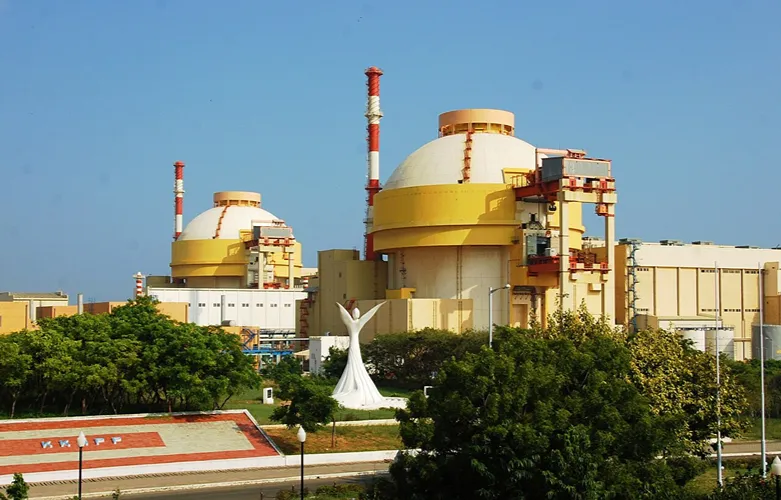
Photo: Reetesh Chaurasia Licensed under CC BY-SA 4.0/Wikimedia Commons
The Nuclear Expansion Faces a Difficult Reality
India’s nuclear ambition faces one central challenge: can it build reactors fast enough to reach 100 GW by 2047? Achieving that target will require rapid expansion in reactor construction, nuclear-grade manufacturing, skilled manpower, fuel supplies and regulatory capacity.
Finance is another major hurdle. Nuclear plants need huge upfront investment, while delays can increase costs significantly. The SHANTI Act aims to modernise India’s nuclear framework and enable wider participation by non-government entities, potentially bringing more private capital and expertise into the sector. However, investors and international suppliers will also need greater clarity on nuclear liability and long-term regulatory rules.
Safety and waste management will remain equally important as the fleet expands. The Atomic Energy Regulatory Board will have to oversee more reactors, while India must continue managing spent fuel, radioactive waste and emergency preparedness. Public acceptance could also influence the pace of projects, as concerns over land, livelihoods and safety have affected developments such as Kudankulam and Jaitapur.
India is not choosing nuclear power over coal or renewables. Coal will remain important, while solar and wind will continue expanding. Nuclear power is instead being positioned as dependable, low-carbon generation that can complement intermittent renewable sources.
The strategy also has a geopolitical dimension, with Russia, France, the United States and other partners playing roles in technology, fuel and supply chains. Yet India is simultaneously strengthening indigenous reactor and manufacturing capabilities.
Ultimately, the 100 GW target will depend on execution. If India can overcome financing, construction, regulatory and supply-chain challenges, nuclear power could become a major pillar of its energy security and low-carbon growth. If projects remain slow and expensive, the target could prove much harder to achieve than it appears on paper.
Why is India increasing its nuclear power capacity?
India is expecting a sharp rise in electricity demand from manufacturing, urbanisation, electric vehicles, data centres, AI, semiconductors and other industries. Nuclear power can provide dependable, low-carbon electricity alongside expanding solar and wind capacity.
What is India’s nuclear power target for 2047?
India has set an ambitious goal of reaching around 100 GW of nuclear capacity by 2047, a huge increase from its present installed capacity of roughly 8.2 GW.
What are Small Modular Reactors in India?
SMRs are smaller nuclear reactors designed around modular construction and deployment. India is developing indigenous SMR technology, including the Bharat Small Modular Reactor, with the government’s nuclear mission targeting at least five indigenous SMRs by 2033.
Will nuclear power replace solar and wind in India?
No. India’s strategy is better understood as a combination of technologies. Solar and wind can provide large quantities of low-carbon electricity, while nuclear power can supply dependable generation when renewable output is unavailable.
What are the biggest challenges to India’s nuclear expansion?
The major challenges include high upfront costs, lengthy construction periods, financing, nuclear liability, regulatory capacity, fuel security, radioactive-waste management, skilled manpower, safety requirements and local opposition to large nuclear projects.