
Why the 7th Meeting Matters
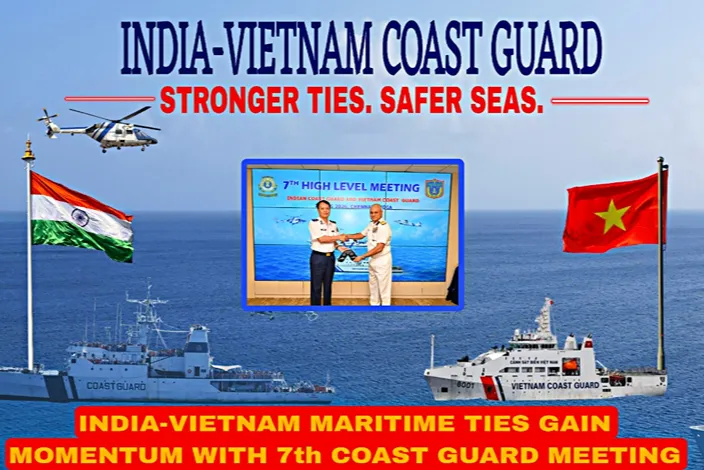
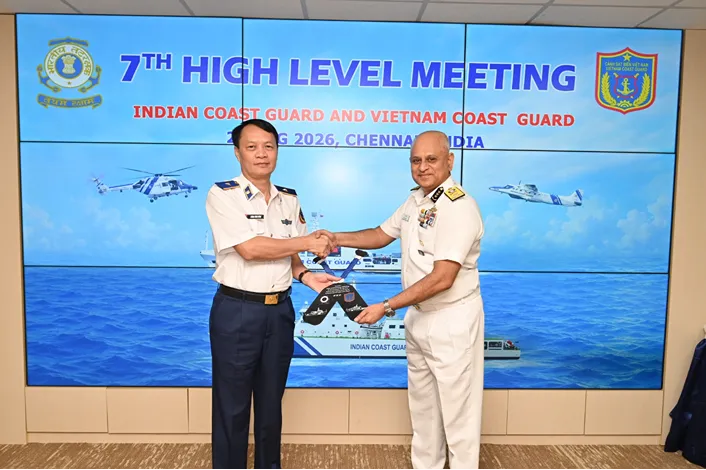
The India Vietnam Coast Guard relationship is entering a more practical stage. The 7th High-Level Meeting was held in Chennai on August 25, 2026. At first glance, the meeting may appear routine. However, its timing reveals a broader shift in bilateral maritime cooperation. The discussions were followed by the planned SAHYOG-HOP TAC exercise on August 27. Therefore, diplomatic discussions are being connected with activity at sea.
The meeting was conducted under the 2015 Memorandum of Understanding on Coast Guard Cooperation. Indian Coast Guard Director General Paramesh Sivamani and Vietnam Coast Guard Vice Commandant Major General Luong Dinh Hung co-chaired it. The agenda covered search and rescue, maritime law enforcement, pollution response and capacity building. Professional exchanges, training and ship visits were also reviewed.
More importantly, these areas require repeated contact. Procedures must be understood before they can be applied smoothly during emergencies.That makes the 7th meeting different from a purely diplomatic gathering. It reflects an effort to build operational familiarity between two maritime forces.
Credit: PIB
From the 2015 MoU to the 7th Meeting
The current relationship was institutionalised in 2015. India and Vietnam signed a Coast Guard cooperation Memorandum of Understanding (MoU) covering areas such as maritime security and cooperation against transnational crime. The framework gave both sides a mechanism for regular engagement. Since then, high-level meetings, ship visits and professional exchanges have helped keep the relationship active. The development can be understood through a few important milestones:
| Year | Milestone | Why it mattered |
|---|---|---|
| 2015 | Coast Guard cooperation MoU signed | Created a formal framework for sustained engagement |
| 2018 | First SAHYOG-HOP TAC exercise | Moved cooperation into a practical operational setting |
| 2024 | 5th High-Level Meeting in New Delhi | Continued institutional dialogue and ship visits |
| 2024 | SAHYOG-HOP TAC near Kochi | Expanded practical work in pollution response, SAR and law enforcement |
| 2025 | 6th High-Level Meeting in Hanoi | Added stronger attention to smuggling, trafficking and illegal fishing |
| 2026 | 7th High-Level Meeting in Chennai | Further emphasis on interoperability and operational cooperation |
The 5th meeting was held in New Delhi on February 20, 2024. Both sides agreed to maintain regular high-level meetings and ship visits. The 6th meeting followed in Hanoi, Vietnam on August 20, 2025. It placed greater emphasis on transnational maritime crime and coordinated responses. This sequence shows why the 7th meeting matters. The relationship has not been rebuilt from scratch. Instead, each meeting has added another layer to an existing framework.
Exercises Are Turning Dialogue Into Practice
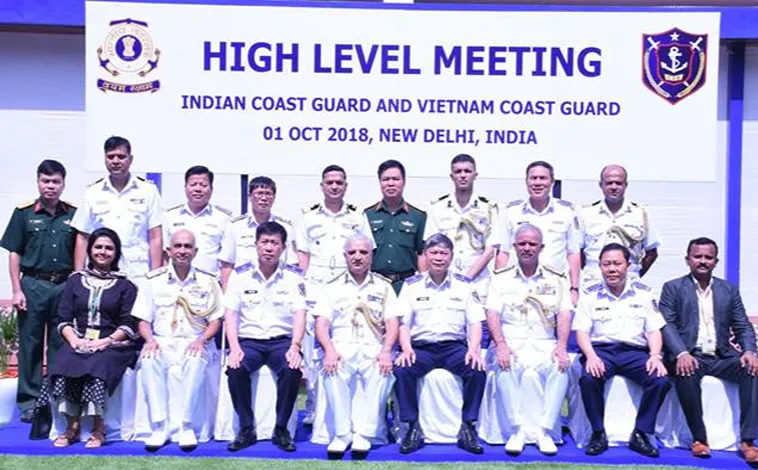
The strongest evidence of this shift can be seen at sea. The first joint Coast Guard exercise, SAHYOG-HOP TAC 2018, was held off Chennai. It involved Vietnam Coast Guard ship CSB 8001 and Indian Coast Guard ships and aircraft. The exercise simulated a hijacked oil tanker and a coordinated rescue operation. Joint boarding, anti-piracy action and firefighting were also included. The importance of that exercise went beyond the scenario itself.
Credit: PIB
Personnel from both sides had to work through common procedures. Such drills can expose differences in communication and operating methods. That experience can then be used to improve future cooperation. The partnership was demonstrated again in December 2024. Vietnam Coast Guard ship CSB 8005 visited Kochi for another SAHYOG-HOP TAC exercise. The exercise included pollution response, search-and-rescue drills, law enforcement training and medical evacuation activities. Cross-deck visits also allowed personnel to observe each other’s procedures.
Another significant interaction came in April 2024. Indian Coast Guard pollution-control vessel Samudra Paheredar visited Ho Chi Minh City. Professional exchanges focused on marine pollution response, maritime search and rescue and law enforcement. A passage exercise was also conducted with the Vietnam Coast Guard. The 2026 exercise therefore fits an established pattern. The upcoming SAHYOG-HOPTAC exercise is scheduled at sea on August 27. It is expected to improve operational coordination, interoperability and the exchange of professional experience. The important point is continuity. One exercise can demonstrate cooperation. Repeated exercises can make that cooperation usable.
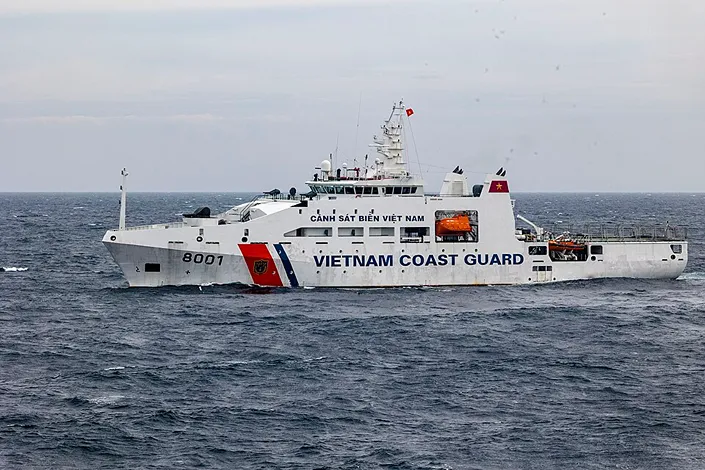
Credit: Wikimedia common
What It Means for India and the Indo-Pacific
The India Vietnam Coast Guard relationship has significance beyond bilateral diplomacy. Vietnam occupies a strategically important position in Southeast Asia. Its coastline opens onto the South China Sea and connects with important regional maritime routes. For India, closer engagement with Vietnam therefore supports wider Southeast Asian maritime outreach. However, the relationship should not automatically be presented as an anti-China arrangement.
The Coast Guard agenda is broader than strategic competition. Search and rescue, illegal fishing, trafficking and marine pollution affect countries regardless of their political relationships. This gives Coast Guard cooperation a useful diplomatic advantage. Practical maritime work can be expanded without creating the appearance of a formal military alliance. At the same time, regular interaction can strengthen professional trust. That trust could become valuable during maritime emergencies or complex regional incidents. There is also a wider Indo-Pacific benefit. Maritime security increasingly depends on networks rather than isolated national capabilities. Coast Guards can share experience, coordinate responses and establish communication channels before a crisis occurs.
India’s engagement with Vietnam fits this broader approach. The next stage will depend on consistency. More exercises, ship visits and training exchanges could make the relationship increasingly routine. That would be strategically significant. The real achievement of the 7th meeting is therefore not a dramatic new agreement. It is the consolidation of a relationship that has been built through repeated contact. The India Vietnam Coast Guard partnership began with an institutional framework. It then moved through meetings, ship visits and exercises. Now, operational cooperation is becoming a regular feature of the relationship.
A Maritime Partnership Built Over Time
The 7th High-Level Meeting shows that India-Vietnam maritime cooperation is no longer dependent on occasional diplomatic engagement. The relationship has been built gradually through institutional mechanisms and practical interaction. The 2015 MoU created the foundation. The 2018 exercise brought cooperation into an operational environment. Later ship visits and exercises expanded that experience.
The 5th and 6th high-level meetings then reinforced the institutional structure. The 7th meeting has carried that process forward. Its significance is therefore evolutionary rather than dramatic. If regular exercises and professional exchanges continue, the India Vietnam Coast Guard relationship could become a durable part of India’s maritime engagement with Southeast Asia. For the Indo-Pacific, that matters because stronger maritime networks can improve cooperation without requiring formal alliances.
FAQs
What was discussed at the 7th India-Vietnam Coast Guard meeting?
The meeting covered search and rescue, maritime law enforcement, marine pollution response and capacity building. Professional exchanges and ship visits were also reviewed.
When was the 7th meeting held?
The 7th High-Level Meeting was held in Chennai on August 25, 2026. It was conducted under the 2015 Coast Guard cooperation MoU.
When did India and Vietnam begin formal Coast Guard cooperation?
Formal cooperation was institutionalised through the 2015 MoU. Earlier ship visits had already helped establish professional contact between the two sides.
What is SAHYOG-HOP TAC?
SAHYOG-HOP TAC is the joint Coast Guard exercise between India and Vietnam. The first edition was held in 2018, while another edition was conducted near Kochi in 2024.
What is the significance of the 2026 exercise?
The 2026 SAHYOG-HOPTAC exercise is intended to strengthen operational coordination, interoperability and the exchange of professional practices.